4,068 posters, 219 videos, 101 topics, 69 sessions, 14,365 authors, 6,128 institutions
ePostersLive by SciGen Technologies S.A. All rights reserved.
Alzheimer's Association International Conference 2026
July 12-15, 2026 | London, United Kingdom, and Online

6863
Effects Of Hypertension And Hyperglycemia On Functional Brain Connectivity In Midlife And Latelife
Part of Topic
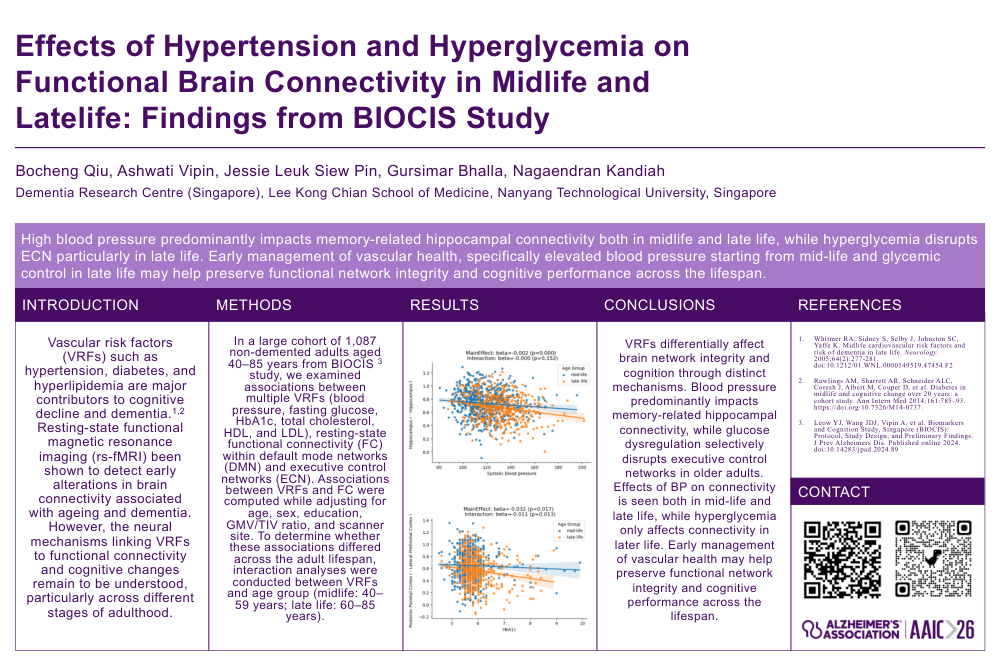
High blood pressure predominantly impacts memory-related hippocampal connectivity both in midlife and late life, while hyperglycemia disrupts ECN particularly in late life. Early management of vascular health, specifically elevated blood pressure starting from mid-life and glycemic control in late life may help preserve functional network integrity and cognitive performance across the lifespan.
Vascular risk factors (VRFs) such as hypertension, diabetes, and hyperlipidemia are major contributors to cognitive decline and dementia.1,2 Resting-state functional magnetic resonance imaging (rs-fMRI) been shown to detect early alterations in brain connectivity associated with ageing and dementia. However, the neural mechanisms linking VRFs to functional connectivity and cognitive changes remain to be understood, particularly across different stages of adulthood.
In a large cohort of 1,087 non-demented adults aged 40–85 years from BIOCIS 3 study, we examined associations between multiple VRFs (blood pressure, fasting glucose, HbA1c, total cholesterol, HDL, and LDL), resting-state functional connectivity (FC) within default mode networks (DMN) and executive control networks (ECN). Associations between VRFs and FC were computed while adjusting for age, sex, education, GMV/TIV ratio, and scanner site. To determine whether these associations differed across the adult lifespan, interaction analyses were conducted between VRFs and age group (midlife: 40–59 years; late life: 60–85 years).
VRFs differentially affect brain network integrity and cognition through distinct mechanisms. Blood pressure predominantly impacts memory-related hippocampal connectivity, while glucose dysregulation selectively disrupts executive control networks in older adults. Effects of BP on connectivity is seen both in mid-life and late life, while hyperglycemia only affects connectivity in later life. Early management of vascular health may help preserve functional network integrity and cognitive performance across the lifespan.
Comments
Email is required but is not shown publicly.
Loading comments...