4,068 posters, 219 videos, 101 topics, 69 sessions, 14,365 authors, 6,128 institutions
ePostersLive by SciGen Technologies S.A. All rights reserved.
Alzheimer's Association International Conference 2026
July 12-15, 2026 | London, United Kingdom, and Online

4738
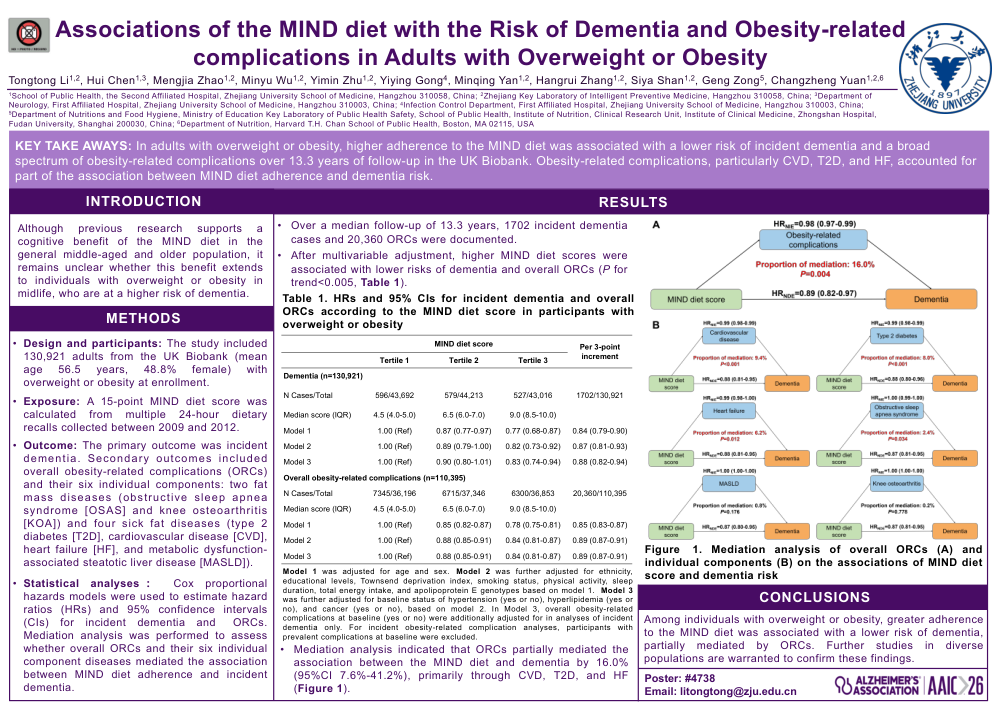
Associations Of The Mind Diet With The Risk Of Dementia And Obesity-related Complications In Adults With Overweight Or Obesity
Poster Presenter
Authors
Tongtong Li, Hui Chen, Mengjia Zhao, Minyu Wu, Yimin Zhu, Yiying Gong, Minqing Yan, Hangrui Zhang, Siya Shan, Geng Zong, Changzheng Yuan
Affiliations
School of Public Health, the Second Affiliated Hospital, Zhejiang University School of Medicine, Hangzhou 310058, China, Department of Neurology, First Affiliated Hospital, Zhejiang University School of Medicine, Hangzhou 310003, China, Infection Control Department, First Affiliated Hospital, Zhejiang University School of Medicine, Hangzhou 310003, China, Department of Nutrition and Food Hygiene, Ministry of Education Key Laboratory of Public Health Safety, School of Public Health, Institute of Nutrition, Clinical Research Unit, Institute of Clinical Medicine, Zhongshan Hospital, Fudan University, Shanghai 200030, China
Part of Topic
Background: Although previous research supports a cognitive benefit of the MIND diet in the general population, it remains unclear whether this benefit extends to individuals with overweight or obesity in midlife, who are at a higher risk of dementia and other chronic diseases.
Methods: The study included 130,921 adults from the UK Biobank (mean age 56.5 years, 48.8% female) with overweight or obesity at enrollment. A 15-point MIND diet score was calculated from multiple 24-hour dietary recalls collected between 2009 and 2012. Cox proportional hazard models were used to estimate hazard ratios (HRs) and 95% confidence intervals (CIs) for dementia and obesity-related complications (ORCs). ORCs comprised two fat mass diseases (obstructive sleep apnea syndrome[OSAS] and knee osteoarthritis [KOA]), and four sick fat diseases (type 2 diabetes [T2D], cardiovascular disease [CVD], heart failure [HF], and metabolic dysfunction-associated steatotic liver disease [MASLD]).
Results: Over a median follow-up of 13.3 years, 1702 incident dementia cases and 20,360 ORCs were documented. After multivariable adjustment, higher MIND diet scores were associated with lower risks of dementia and all six ORCs (P for trend<0.005). Compared to the lowest tertile of MIND diet score, the highest tertile showed HRs of 0.82 (95% CI 0.73-0.93) for dementia and 0.84 (0.81-0.87) for overall ORCs. Similar associations were observed with individual ORCs, with T2D, MASLD and OSAS demonstrating the strongest associations.Mediation analysis further indicated that ORCs partially mediated the association between the MIND diet and dementia, accounting for 16.0% (95%CI 7.6%-41.2%) of the effect, primarily through CVD, T2D, and HF.
Conclusions: Among individuals with overweight or obesity, greater adherence to the MIND diet was associated with a lower risk of dementia, an association partially mediated by the ORCs. Further studies in diverse populations are warranted to confirm these findings.
Comments
Email is required but is not shown publicly.
Loading comments...