4,068 posters, 219 videos, 101 topics, 69 sessions, 14,365 authors, 6,128 institutions
ePostersLive by SciGen Technologies S.A. All rights reserved.
Alzheimer's Association International Conference 2026
July 12-15, 2026 | London, United Kingdom, and Online

10308
Is Apoe ε2 Always A Protective Allele?
Poster Presenter
Part of Topic
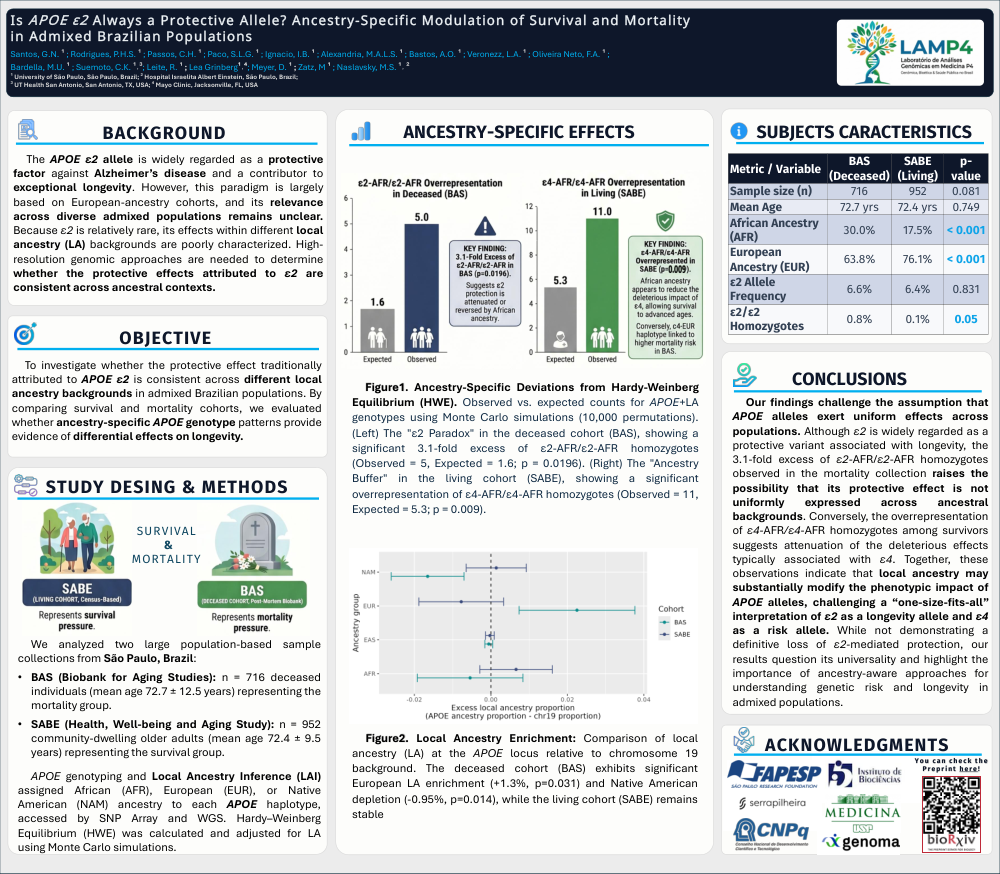
The APOE ε2 allele is widely regarded as a protective factor against Alzheimer’s disease and a contributor to exceptional longevity. However, this paradigm is largely based on European-ancestry cohorts, and its relevance across diverse admixed populations remains unclear. Because ε2 is relatively rare, its effects within different local ancestry (LA) backgrounds are poorly characterized. High-resolution genomic approaches are needed to determine whether the protective effects attributed to ε2 are consistent across ancestral contexts.
We analyzed two large population-based sample collections from São Paulo, Brazil:
APOE genotyping and Local Ancestry Inference (LAI) assigned African (AFR), European (EUR), or Native American (NAM) ancestry to each APOE haplotype, accessed by SNP Array and WGS. Hardy–Weinberg Equilibrium (HWE) was calculated and adjusted for LA using Monte Carlo simulations.
Our findings challenge the assumption that APOE alleles exert uniform effects across populations. Although ε2 is widely regarded as a protective variant associated with longevity, the 3.1-fold excess of ε2-AFR/ε2-AFR homozygotes observed in the mortality collection raises the possibility that its protective effect is not uniformly expressed across ancestral backgrounds. Conversely, the overrepresentation of ε4-AFR/ε4-AFR homozygotes among survivors suggests attenuation of the deleterious effects typically associated with ε4. Together, these observations indicate that local ancestry may substantially modify the phenotypic impact of APOE alleles, challenging a “one-size-fits-all” interpretation of ε2 as a longevity allele and ε4 as a risk allele. While not demonstrating a definitive loss of ε2-mediated protection, our results question its universality and highlight the importance of ancestry-aware approaches for understanding genetic risk and longevity in admixed populations.
Figure1. Ancestry-Specific Deviations from Hardy-Weinberg Equilibrium (HWE). Observed vs. expected counts for APOE+LA genotypes using Monte Carlo simulations (10,000 permutations). (Left) The "ε2 Paradox" in the deceased cohort (BAS), showing a significant 3.1-fold excess of ε2-AFR/ε2-AFR homozygotes (Observed = 5, Expected = 1.6; p = 0.0196). (Right) The "Ancestry Buffer" in the living cohort (SABE), showing a significant overrepresentation of ε4-AFR/ε4-AFR homozygotes (Observed = 11, Expected = 5.3; p = 0.009).
Figure2. Local Ancestry Enrichment: Comparison of local ancestry (LA) at the APOE locus relative to chromosome 19 background. The deceased cohort (BAS) exhibits significant European LA enrichment (+1.3%, p=0.031) and Native American depletion (-0.95%, p=0.014), while the living cohort (SABE) remains stable.
Comments
Email is required but is not shown publicly.
Loading comments...