4,068 posters, 219 videos, 101 topics, 69 sessions, 14,365 authors, 6,128 institutions
ePostersLive by SciGen Technologies S.A. All rights reserved.
Alzheimer's Association International Conference 2026
July 12-15, 2026 | London, United Kingdom, and Online

1564
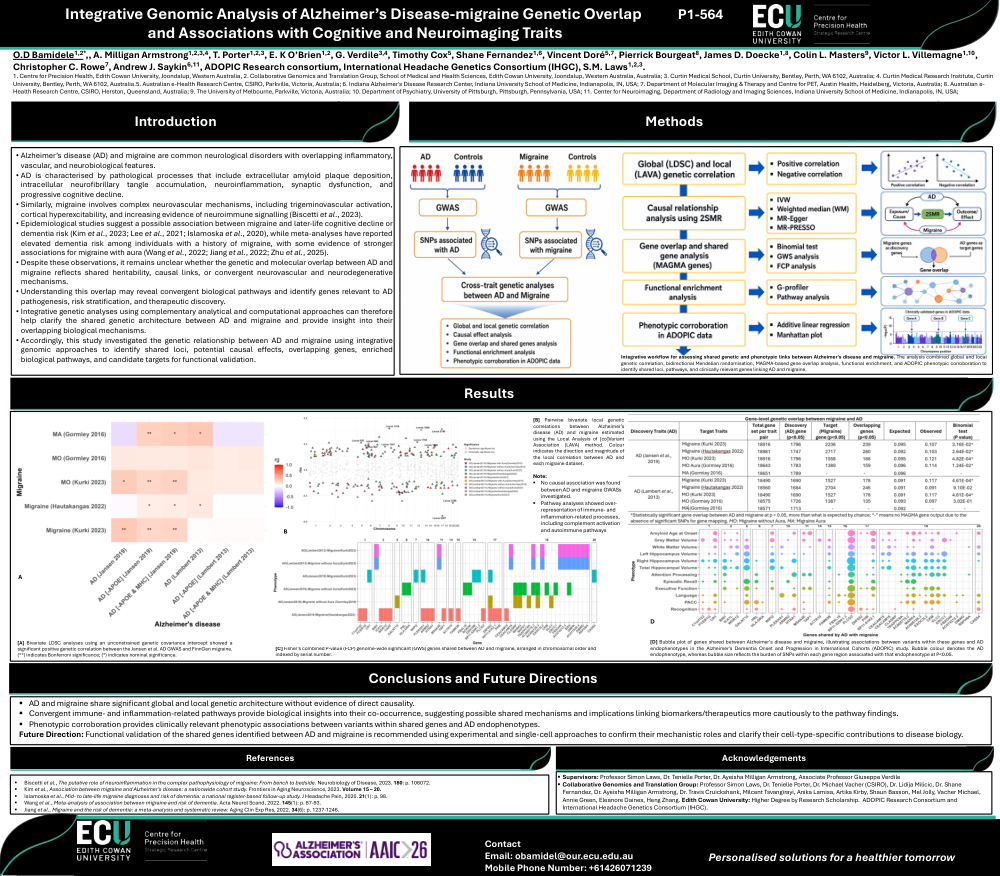
Integrative Genomic Analysis Of Alzheimer’S Disease-migraine Genetic Overlap And Associations With Cognitive And Neuroimaging Traits
Poster Presenter
Authors
Olasunkanmi David Bamidele, Ayeisha Milligan Armstrong, Tenielle Porter, Eleanor K. O’Brien, Giuseppe Verdile, Timothy Cox, Shane Fernandez, Vincent Doré, Pierrick Bourgeat, James D Doecke, Colin L Masters, Victor L Villemagne, Christopher C Rowe, Andrew J Saykin, Simon M Laws
Affiliations
Center for Precision Health, Edith Cowan University, Perth, Australia, Curtin Medical School, Curtin University, Perth, Australia,, Australian e-Health Research Centre, CSIRO, Parkville, Australia, IndianaAlzheimer's Disease Research Center, Indiana University School of Medicine, Indianapolis, IN, USA, Department of Molecular Imaging & Therapy and Centre for PET, Austin Health, Heidelberg, Australia, Australian e-Health Research Centre, CSIRO, Herston, Queensland, Australia, The University of Melbourne, Parkville,Australia, Department of Psychiatry, University of Pittsburgh, Pittsburgh, Pennsylvania, USA, Department of Molecular Imaging & Therapy and Centre for PET, Austin Health, Heidelberg, Victoria, Australia, Center for Neuroimaging, Department of Radiology and Imaging Sciences, Indiana University School of Medicine, Indianapolis, IN, USA
Part of Topic
Introduction
Alzheimer’s disease (AD) and migraine are common neurological disorders with overlapping inflammatory, vascular, and neurobiological features.
AD is characterised by pathological processes that include extracellular amyloid plaque deposition, intracellular neurofibrillary tangle accumulation, neuroinflammation, synaptic dysfunction, and progressive cognitive decline.
Similarly, migraine involves complex neurovascular mechanisms, including trigeminovascular activation, cortical hyperexcitability, and increasing evidence of neuroimmune signalling (Biscetti et al., 2023).
Epidemiological studies suggest a possible association between migraine and later-life cognitive decline or dementia risk (Kim et al., 2023; Lee et al., 2021; Islamoska et al., 2020), while meta-analyses have reported elevated dementia risk among individuals with a history of migraine, with some evidence of stronger associations for migraine with aura (Wang et al., 2022; Jiang et al., 2022; Zhu et al., 2025).
Despite these observations, it remains unclear whether the genetic and molecular overlap between AD and migraine reflects shared heritability, causal links, or convergent neurovascular and neurodegenerative mechanisms.
Understanding this overlap may reveal convergent biological pathways and identify genes relevant to AD pathogenesis, risk stratification, and therapeutic discovery.
Integrative genetic analyses using complementary analytical and computational approaches can therefore help clarify the shared genetic architecture between AD and migraine and provide insight into their overlapping biological mechanisms.
Accordingly, this study investigated the genetic relationship between AD and migraine using integrative genomic approaches to identify shared loci, potential causal effects, overlapping genes, enriched biological pathways, and candidate targets for functional validation.
Future Direction
Functional validation of the shared genes identified between AD and migraine is recommended using experimental and single-cell approaches to confirm their mechanistic roles and clarify their cell-type-specific contributions to disease biology.
Comments
Email is required but is not shown publicly.
Loading comments...