4,068 posters, 219 videos, 101 topics, 69 sessions, 14,365 authors, 6,128 institutions
ePostersLive by SciGen Technologies S.A. All rights reserved.
Alzheimer's Association International Conference 2026
July 12-15, 2026 | London, United Kingdom, and Online

6131
Association Between Triglyceride-Glucose Index Variability And Midlife Cognitive Function Varies By Obesity Status
Poster Presenter
Authors
Soo Jung Kang, Jeanette Gustat, Wan Tang, Phillip Hwang, Owen Carmichael, Eunsun Gill, Ileana De Anda-Duran, Lydia Bazzano
Affiliations
Pennington Biomedical Research Center, Department of Epidemiology, Tulane University Celia Scott Weatherhead School of Public Health and Tropical Medicine, Department of Biostatistics and Data Science, Tulane University Celia Scott Weatherhead School of Public Health and Tropical Medicine, Department of Epidemiology, Boston University School of Public Health
Part of Topic
Association Between Triglyceride-Glucose Index Variability And Midlife Cognitive Function Varies By Obesity Status
: Soo Jung Kang1, Jeanette Gustat1, Wan Tang2, Phillip H. Hwang3, Owen T. Carmichael4, Eunsun Gill1, Ileana De Anda-Duran, MD, MPH5, Lydia A. Bazzano6,1.
1Epidemiology, Tulane University, New Orleans, LA, USA, 2Biostatistics and Data Science, Tulane University, New Orleans, LA, USA, 3Epidemiology, Boston University School of Public Health, Boston, MA, USA, 4Brain and Metabolism Imaging in Chronic Disease Laboratory, Pennington Biomedical Research Center, Baton Rouge, LA, USA, 5Tulane University, NEW ORLEANS, LA, USA, 6Internal Medicine, University of Texas Southwestern Medical Center, Dallas, TX, USA.
Abstract:
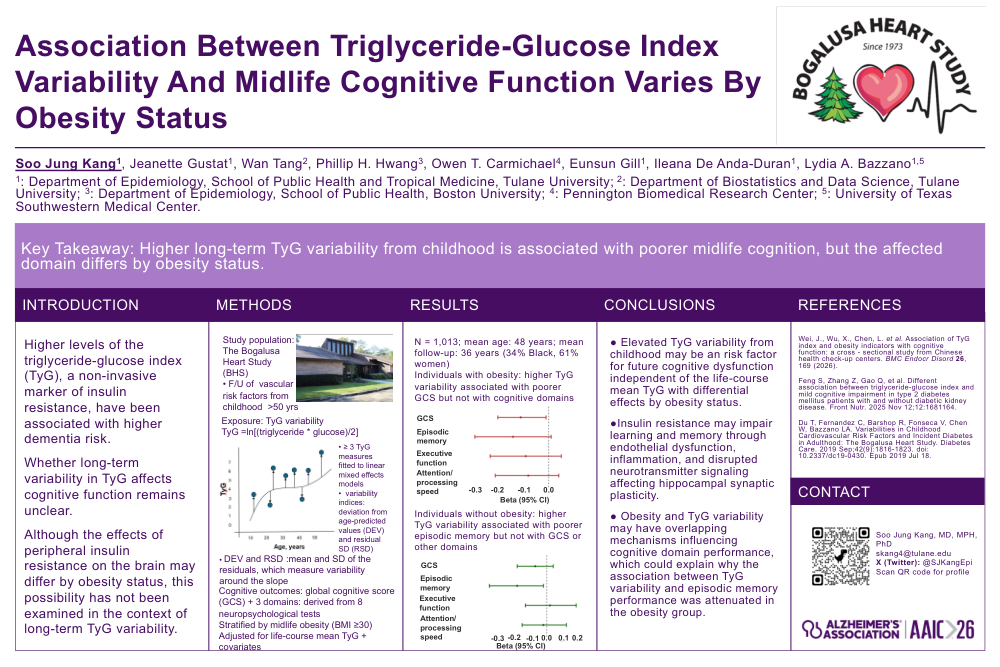
Background: Higher triglyceride-glucose index (TyG), a non-invasive marker of insulin resistance, have been associated with increased dementia risk, but whether long-term variability in TyG affects cognitive function remains unclear. Moreover, although the effects of peripheral insulin resistance on the brain may differ by obesity status, this possibility has not been examined in relation to long-term TyG variability.
Methods: Participants in the Bogalusa Heart Study with ≥ 3 repeated fasting triglyceride and glucose measures across the life course and one midlife CF assessment were included. TyG was calculated as ln[(triglyceride * glucose)/2]. CF was assessed using the global cognitive score (GCS), the average of eight standardized neuropsychological tests assessing executive function, episodic memory, and attention/processing speed. TyG variability was measured using deviation from age-predicted values (DEV) and residual SD (RSD), which measure variability around the slope from linear mixed- effects models. Analysis was stratified by midlife obesity (body mass index ≥ 30 kg/m²). Associations between tertiles of TyG variability and CF were examined using multivariable linear regression models, adjusting for follow-up, smoking, life-course mean TyG, socioeconomic status, APOE ε4 status, and antihypertensive, diabetes, and cholesterol medication use. The lowest tertile of TyG variability served as reference.
Results: Among 1,013 participants (34% Black, 61% women, mean age 48 years, mean follow-up 36 years), 533 (53%) had obesity at midlife. Life-course mean TyG was higher in individuals with obesity than in those without (8.3 vs. 8.1, p <0.001). In the full sample, being in the highest tertile of TyG variability was associated with poorer episodic memory (by DEV, β = -0.14, 95% CI -0.26, -0.03). Among individuals with obesity, being in the middle tertile of TyG variability was associated with poorer GCS (by RSD, β = -0.11, 95% CI -0.20, -0.01) but not with cognitive domains. Among individuals without obesity, being in the highest tertile of TyG variability was associated with poorer episodic memory (by DEV, β = -0.18, 95% CI -0.35, -0.02) but not with GCS or other domains.
Conclusion: Elevated TyG variability from childhood may be an independent risk factor for future cognitive dysfunction with differential effects by obesity status.
Comments
Email is required but is not shown publicly.
Loading comments...