4,068 posters, 219 videos, 101 topics, 69 sessions, 14,365 authors, 6,128 institutions
ePostersLive by SciGen Technologies S.A. All rights reserved.
Alzheimer's Association International Conference 2026
July 12-15, 2026 | London, United Kingdom, and Online

10166
Multi-ancestry Analysis Of Mitochondrial DNA Variants In Alzheimer Disease
Poster Presenter
Authors
Tong Tong, Congcong Zhu, John Farrell, Eden Martin, Margaret Pericak-Vance, Li-San Wang, William Bush, Gerard Schellenberg, Jonathan Haines, Kathryn Lunetta, Lindsay Farrer, Xiaoling Zhang
Affiliations
Departments of Medicine (Biomedical Genetics), Boston University Chobanian & Avedisian School of Medicine, Boston, MA, USA, Hussman Institute of Human Genetics, University of Miami Miller School of Medicine, Miami, FL, USA, Department of Pathology and Laboratory Medicine, University of Pennsylvania Perelman School of Medicine, Philadelphia, PA, USA, Department of Population and Quantitative Health Sciences, Case Western Reserve University, Cleveland, OH, USA, Department of Biostatistics, Boston University School of Public Health, Boston, MA, USA
Part of Topic
Background: Findings regarding associations of mitochondrial DNA (mtDNA) variants, haplogroups and heteroplasmy with Alzheimer disease (AD) have been inconsistent.
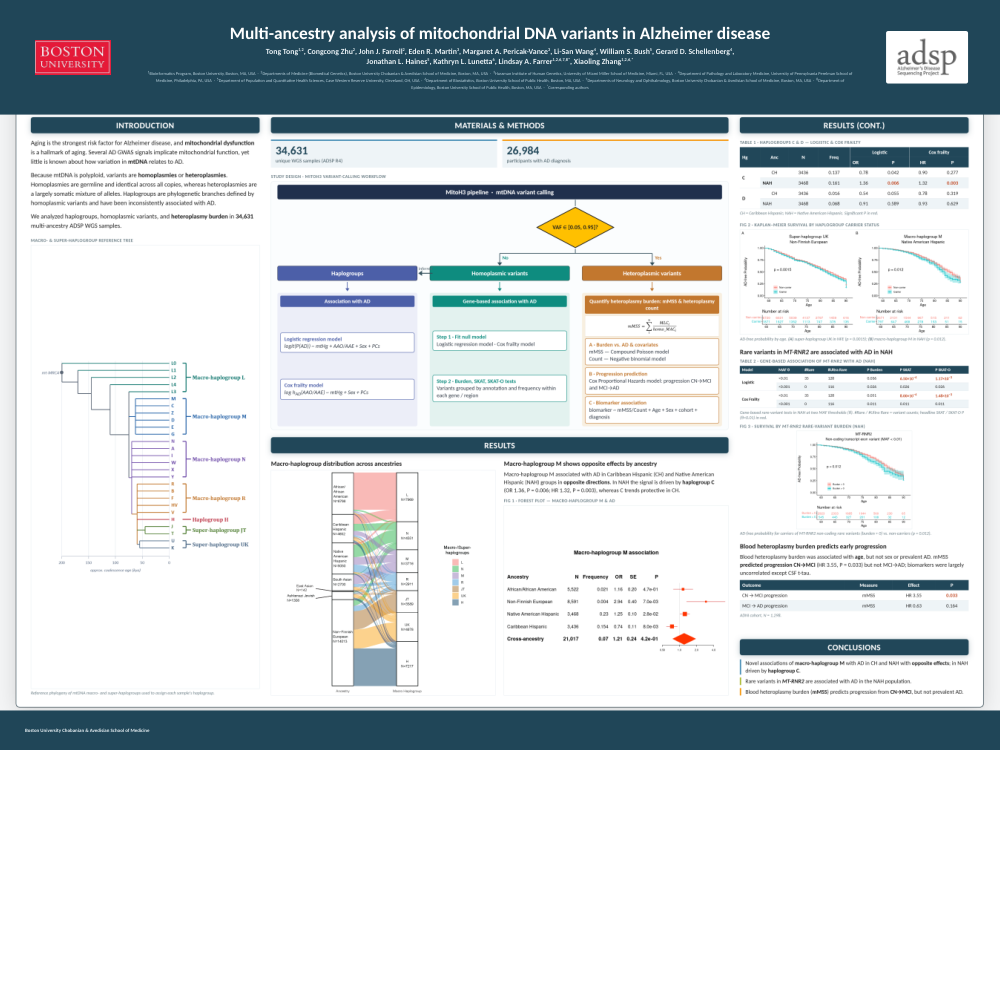
Methods: We investigated associations of mtDNA haplogroups, homoplasmy, and heteroplasmy with AD using whole genome sequence (WGS) data from the Alzheimer's Disease Sequencing Project (Release 4), including 9,720 genetically defined Non-Finnish Europeans (NFE), 5,660 Africans/African Americans (AFA), 3,578 Caribbean Hispanics (CH), 4,384 Native American Hispanics (NAH), and 954 Ashkenazi Jews (AJ). Haplogroups were collapsed into super-/macro-haplogroups and analyzed using logistic mixed-effects model and Cox models, with each haplogroup compared against all others. Gene-based association analyses, using both logistic and Cox frailty models, were conducted for rare homoplasmic (MAF < 0.01) across 13 coding genes, 2 rRNAs, a concatenated tRNA region, and the D-loop region. We calculated a modified mitochondrial local constraint score sum (mMSS) and number of heteroplasmic sites to quantify heteroplasmy burden and tested its association with AD in blood specimens. Mixed-effects cox proportional hazards models were used to assess whether heteroplasmy burden predicted conversion from cognitively normal (CN) to mild cognitive impairment (MCI) or from MCI to AD using Alzheimer’s Disease Neuroimaging Initiative data (ADNI). The association of AD biomarkers and cognitive functions with heteroplasmy burden in blood was evaluated using linear regression.
Results: Macro-haplogroup M was associated with lower AD risk in CH (OR = 0.74, P = 8.00 × 10⁻³) but higher AD risk in NAH (OR = 1.25, P = 0.028). Super-haplogroup UK was found to be associated with higher AD risk in Cox model (HR = 1.09, P = 0.047). Gene-based analysis identified an association of MT-RNR2 with AD in NAH (SKAT-O P = 1.17 × 10⁻³). Survival analysis of 354 ADNI baseline CN participants showed that higher blood mMSS predicted increased risk of conversion from CN to MCI (Ncase=60, HR = 3.55, P = 0.033). We also identified significant associations of blood heteroplasmy count with total tau in cerebrospinal fluid (β = -0.06, P = 0.046).
Conclusions: Macro-haplogroup M and MT-RNR2 show ancestry-specific associations with AD. Increased blood mtDNA heteroplasmy burden is associated with elevated MCI incidence, rather than prevalent AD risk, supporting a role for mitochondrial dysfunction in AD pathogenesis.
Comments
Email is required but is not shown publicly.
Loading comments...