4,068 posters, 219 videos, 101 topics, 69 sessions, 14,365 authors, 6,128 institutions
ePostersLive by SciGen Technologies S.A. All rights reserved.
Alzheimer's Association International Conference 2026
July 12-15, 2026 | London, United Kingdom, and Online

6450
Cardiovascular Risk Factors For Dementia And Cognitive Performance In An Argentinean Sample
Poster Presenter
Authors
Leticia Vivas, Claudia Arias, Maria de la Paz Pereyra, Araceli Revollo Sarmiento, Axel Fernández Zaionz, Cecilia Errecalde, Ludmila Casasola, Luciano Wibaux, Maria Celeste López Moreno, Franco Morales, Estela Benítez
Affiliations
IPSIBAT, UNMDP/CONICET, Argentina, Facultad de Psicología, UNMDP, Argentina, Facultad de Ciencias de la Salud y Trabajo Social, UNMDP, Argentina
Part of Topic
Background: Some of the well documented risk factors for dementia are cardiovascular risk factors including: hypertension, cholesterol, smoking, diabetes, obesity, sedentarism and alcohol consumption. These factors have shown to vary across cultures and communities. In the current work we analysed the presence of these factors in an Argentinean sample of older old adults (>75) from Mar del Plata city.
Methods: Sample: 81 participants (age 75-98), 65 female, years of education 9,57 (SD 4,27).Instruments: ANU-ADRI Spanish translation and Argentinean version of the ACE-III.Procedure: participants were assessed individually with the questionnaire and the cognitive test. The protocol was approved by the ethics committee of the National University of Mar del Plata.
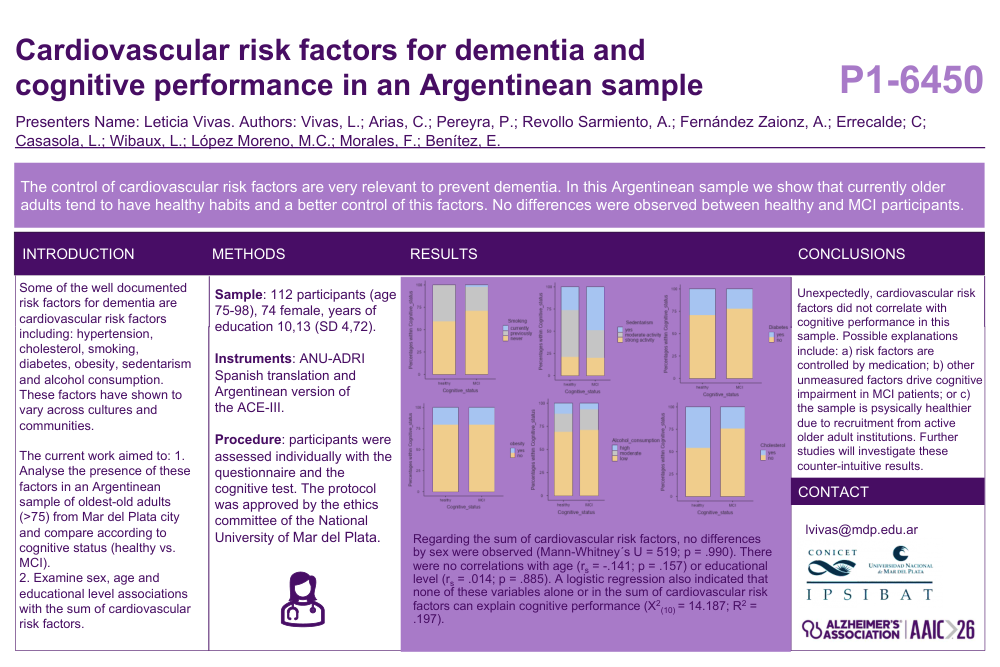
Results: Regarding the presence of each cardiovascular risk factor, hypertension was present in 53.1% of the sample, diabetes in 18.5%, cholesterol in 48.1%, sedentarism 9.9%, smoking 24.7%, high alcohol consumption 9.9% and obesity 23%. It is relevant to note that 67.9% of the sample presented only 2 or less from these risk factors. There was no association between the number of risk factors present in each participant and the cognitive status (MCI vs health) (Mann-Whitney´s U = 254; p = .580). No differences by sex were observed either (Mann-Whitney´s U = 519; p = .990). There were no correlations with age (p = .570) or educational level (p = .485). Additionally, a logistic regression also indicated that none of these variables alone or in the sum of cardiovascular risk factors can explain cognitive performance (R2 = .130).
Conclusion: Unexpectedly, these results show that cardiovascular risk factors are not associated with cognitive performance in this sample. Some explanations ca be: a) although those risk factors are present in the sample they are controlled by medication minimizing their effect; b) there are other risk factors present that determine the presence of cognitive impairment in those who present MCI; c) the screening tool used to assess participants is not enough to identify cognitive differences between participants; d) this is a biased sample with low levels of cardiovascular risk factors. Further studies are going to be performed trying to explain these counter-intuitive results.
Comments
Email is required but is not shown publicly.
Loading comments...