4,068 posters, 219 videos, 101 topics, 69 sessions, 14,365 authors, 6,128 institutions
ePostersLive by SciGen Technologies S.A. All rights reserved.
Alzheimer's Association International Conference 2026
July 12-15, 2026 | London, United Kingdom, and Online

6364
A Literature-driven Framework For Population-level Causal Modeling Of Alzheimer's Disease
Poster Presenter
Authors
Yijiang Pang, Ramya Majji, Hao Dai, Yu Huang, Jiang Bian, Jiankun Wang
Affiliations
University of Michigan, Michigan State University, Indiana University
Part of Topic
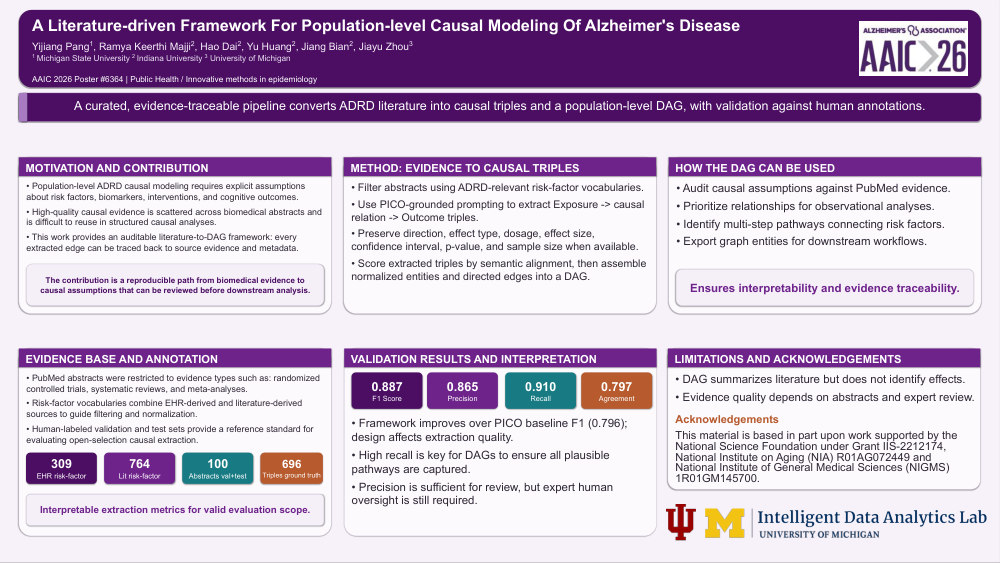
Background: Understanding the complex, multi-factorial causal pathways underlying Alzheimer’s Disease and Related Dementias (ADRD) remains challenging. Although extensive biomedical literature reports associations among risk factors, biomarkers, interventions, and cognitive outcomes, this evidence is largely unstructured and difficult to integrate into formal causal models. We aim to develop a reproducible, literature-driven framework for constructing a population-level Directed Acyclic Graph (DAG) of ADRD by systematically extracting and aggregating causal knowledge from high-quality biomedical studies.
Methods: We propose an end-to-end pipeline for literature-derived DAG construction consisting of abstract curation, Large Language Model (LLM)-based causal extraction, and human-in-the-loop validation. ADRD-related abstracts were curated from PubMed, restricted to randomized controlled trials, systematic reviews, and meta-analyses, and filtered based on predefined ADRD risk factors. Each abstract was processed independently using an optimized LLM prompting framework grounded in the PICO (Population, Intervention/Exposure, Comparator, Outcome) schema to extract structured causal triples of the form Exposure → Causal Relation → Outcome, along with supporting evidence metadata. To assess extraction quality, 100 abstracts were manually annotated across multiple rounds by two independent annotators. Performance was evaluated as an open-selection problem using semantic matching, reporting generalized precision, recall, F1 score, and agreement. Extracted triples were then aggregated into a population-level DAG, with nodes representing biomedical entities and directed edges representing literature-supported causal effects.
Results: On the test set, the optimized method achieved an F1 score of 0.887, precision of 0.865, recall of 0.910, and agreement of 0.797, compared with an F1 score of 0.796 for a plain PICO-based prompt. The resulting literature-derived DAG captured well-established ADRD risk pathways as well as multi-step causal chains supported by independent studies, with each edge traceable to its source abstracts.
Conclusions: This study demonstrates the feasibility of automatically constructing a transparent, scalable, and evidence-grounded causal DAG for ADRD directly from biomedical literature. The proposed framework provides a structured population-level summary of reported causal knowledge and offers a foundation for hypothesis generation, risk-factor prioritization, and integration with observational data-driven causal analyses.
Comments
Email is required but is not shown publicly.
Loading comments...