4,068 posters, 219 videos, 101 topics, 69 sessions, 14,365 authors, 6,128 institutions
ePostersLive by SciGen Technologies S.A. All rights reserved.
Alzheimer's Association International Conference 2026
July 12-15, 2026 | London, United Kingdom, and Online

488
Lithium Isotopes Differentially Influence β-amyloid Assembly And Mitochondrial Toxicity
Part of Topic
Video
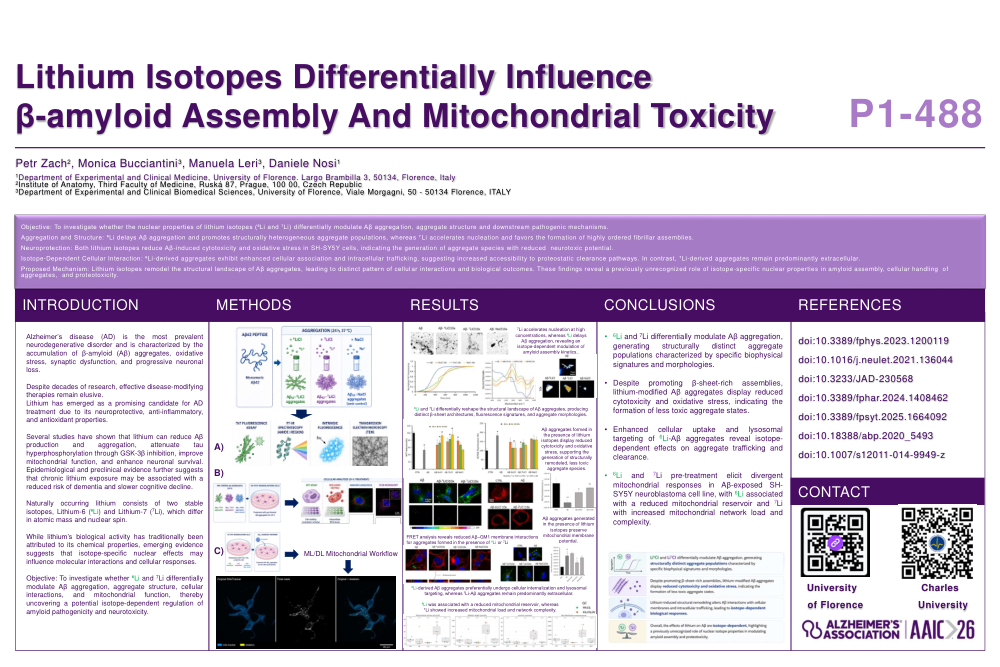
Lithium Isotopes Differentially Influence β-amyloid Assembly And Mitochondrial Toxicity.
Alzheimer’s disease (AD) is the most prevalent neurodegenerative disorder and is characterized by the accumulation of β-amyloid (Aβ) aggregates, oxidative stress, synaptic dysfunction, and progressive neuronal loss.
Despite decades of research, effective disease-modifying therapies remain elusive.
Lithium has emerged as a promising candidate for AD treatment due to its neuroprotective, anti-inflammatory, and antioxidant properties.
Several studies have shown that lithium can reduce Aβ production and aggregation, attenuate tau hyperphosphorylation through GSK-3β inhibition, improve mitochondrial function, and enhance neuronal survival. Epidemiological and preclinical evidence further suggests that chronic lithium exposure may be associated with a reduced risk of dementia and slower cognitive decline.
Naturally occurring lithium consists of two stable isotopes, Lithium-6 (⁶Li) and Lithium-7 (7Li), which differ in atomic mass and nuclear spin.
While lithium’s biological activity has traditionally been attributed to its chemical properties, emerging evidence suggests that isotope-specific nuclear effects may influence molecular interactions and cellular responses.
Objective: To investigate whether ⁶Li and 7Li differentially modulate Aβ aggregation, aggregate structure, cellular interactions, and mitochondrial function, thereby uncovering a potential isotope-dependent regulation of amyloid pathogenicity and neurotoxicity.
Comments
Email is required but is not shown publicly.
Loading comments...