4,068 posters, 219 videos, 101 topics, 69 sessions, 14,365 authors, 6,128 institutions
ePostersLive by SciGen Technologies S.A. All rights reserved.
Alzheimer's Association International Conference 2026
July 12-15, 2026 | London, United Kingdom, and Online

698
Designing inclusive dementia studies in LMICs
Poster Presenter
Part of Topic
Designing Inclusive Dementia Studies in Low- and Middle-Income Countries
Geographic location alone does not ensure diversity. Even in LMICs, traditional recruitment strategies preferentially enroll socially advantaged participants, reinforcing the need for structured community-engaged recruitment models.
Dementia disproportionately affects low- and middle-income countries (LMICs), yet Alzheimer’s disease research remains concentrated in highly selected populations from high-income settings. This limits the generalizability of biomarkers and emerging therapies. Importantly, conducting research in LMICs does not automatically ensure representative sampling, as traditional recruitment often favors socially advantaged individuals. The Brazilian BioAz cohort provides a real-world example of this challenge.
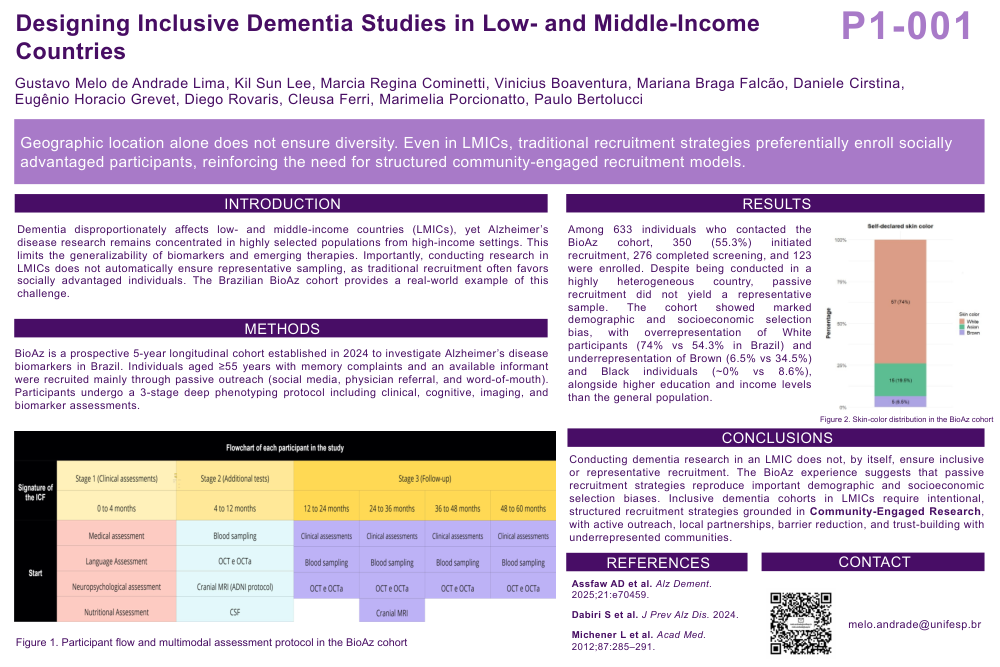
BioAz is a prospective 5-year longitudinal cohort established in 2024 to investigate Alzheimer’s disease biomarkers in Brazil. Individuals aged ≥55 years with memory complaints and an available informant were recruited mainly through passive outreach (social media, physician referral, and word-of-mouth). Participants undergo a 3-stage deep phenotyping protocol including clinical, cognitive, imaging, and biomarker assessments.
Among 633 individuals who contacted the BioAz cohort, 350 (55.3%) initiated recruitment, 276 completed screening, and 123 were enrolled. Despite being conducted in a highly heterogeneous country, passive recruitment did not yield a representative sample. The cohort showed marked demographic and socioeconomic selection bias, with overrepresentation of White participants (74% vs 54.3% in Brazil) and underrepresentation of Brown (6.5% vs 34.5%) and Black individuals (~0% vs 8.6%), alongside higher education and income levels than the general population.
Conducting dementia research in an LMIC does not, by itself, ensure inclusive or representative recruitment. The BioAz experience suggests that passive recruitment strategies reproduce important demographic and socioeconomic selection biases. Inclusive dementia cohorts in LMICs require intentional, structured recruitment strategies grounded in Community-Engaged Research, with active outreach, local partnerships, barrier reduction, and trust-building with underrepresented communities.
Comments
Email is required but is not shown publicly.
Loading comments...