4,068 posters, 219 videos, 101 topics, 69 sessions, 14,365 authors, 6,128 institutions
ePostersLive by SciGen Technologies S.A. All rights reserved.
Alzheimer's Association International Conference 2026
July 12-15, 2026 | London, United Kingdom, and Online

6657
Association Of Amyloid Related Imaging Abnormalities With Blood Pressure And Anti-hypertensive Use In A Memory Clinic
Poster Presenter
Authors
Brian Appleby, Alexsandra Kovacevich, Kyle Duale, Rebecca DiFranco, Susie Sami, Mohamed Elkasaby, Rajeet Shrestha
Affiliations
Case Western Reserve University Case Medical Center, University Hospitals Cleveland Medical Center, University Case Medical Center, University Hospitals Cleveland Medical Center, University Hospitals Cleveland Medical Center
Part of Topic
Background
Amyloid Related Imaging Abnormalities (ARIA) are an adverse event that is sometimes observed in anti-amyloid monoclonal antibody treatments for Alzheimer’s disease. Although most cases are asymptomatic and captured by surveillance magnetic resonance imaging, identifying risk factors could be useful in counseling patients regarding this treatment. Clinical trial data suggests that elevated blood pressure may increase and anti-hypertensive use may decrease overall ARIA risk. We examined these variables in a real-world clinic population of early-stage Alzheimer’s disease patients who received amyloid targeting therapy (ATT) with regards to ARIA occurrence.
Methods
Fifty-seven patients received ATT (lecanemab and donanemab) from 01/01/2024 to 08/31/2025 for an average of 13.31 treatments over an average duration of 214 days at University Hospitals Cleveland Medical Center. Data regarding baseline blood pressure and anti-hypertensive medication use were abstracted from patients’ medical records and examined for associations with ARIA.
Results
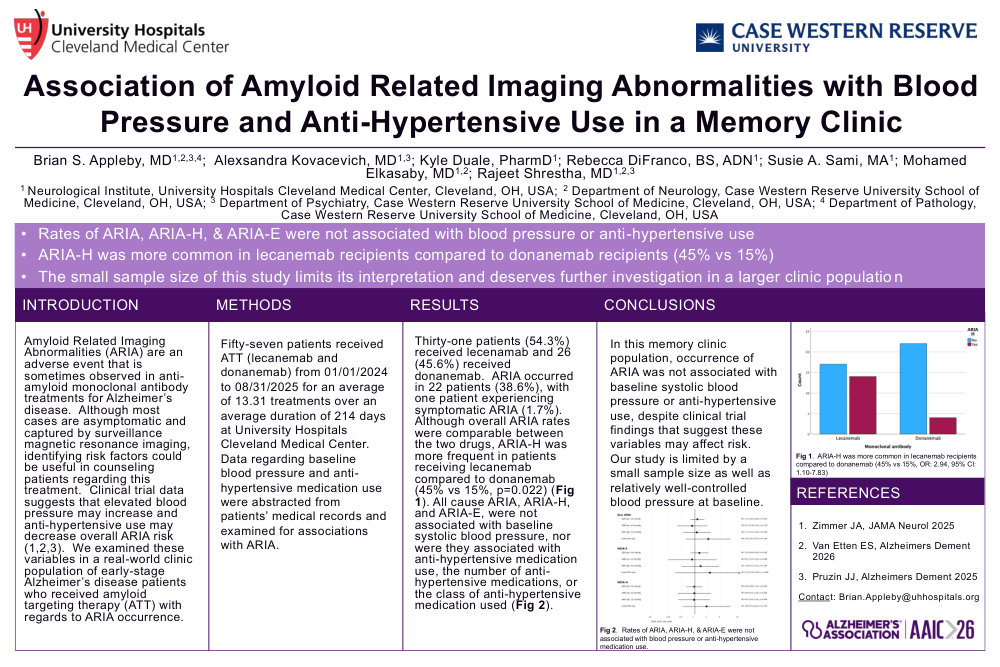
Thirty-one patients (54.3%) received lecenamab and 26 (45.6%) received donanemab. ARIA occurred in 22 patients (38.6%), with one patient experiencing symptomatic ARIA (1.7%). Although overall ARIA rates were comparable between the two drugs, ARIA-H was more frequent in patients receiving lecanemab compared to donanemab (45% vs 15%, p=0.022). Overall ARIA, ARIA-H, and ARIA-E, were not associated with baseline systolic blood pressure. Nor were they associated with anti-hypertensive medication use, the number of anti-hypertensive medications, or the class of anti-hypertensive medication used.
Conclusions
In this memory clinic population, occurrence of ARIA was not associated with baseline systolic blood pressure or anti-hypertensive use, despite clinical trial findings that suggest these variables may affect risk. Our study is limited by a small sample size as well as relatively well-controlled blood pressure at baseline.
Comments
Email is required but is not shown publicly.
Loading comments...