4,068 posters, 219 videos, 101 topics, 69 sessions, 14,365 authors, 6,128 institutions
ePostersLive by SciGen Technologies S.A. All rights reserved.
Alzheimer's Association International Conference 2026
July 12-15, 2026 | London, United Kingdom, and Online

7281
Short-term Psychological Outcomes Of Amyloid-β Imaging Disclosure In MCI: An EMA-Based Intensive Longitudinal Analysis
Part of Topic
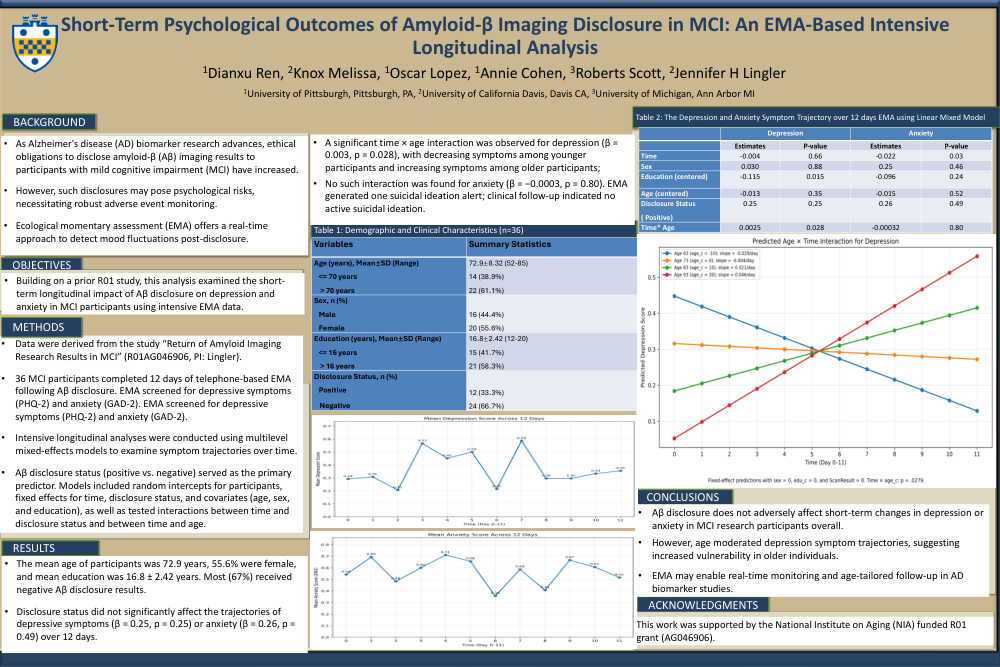
Background: As Alzheimer's disease (AD) biomarker research advances, ethical obligations to disclose amyloid-β (Aβ) imaging results to participants with mild cognitive impairment (MCI) have increased. However, such disclosures may pose psychological risks, necessitating robust adverse event monitoring. Ecological momentary assessment (EMA) offers a real-time approach to detect mood fluctuations post-disclosure. Building on a prior R01 study, this analysis examined the short-term longitudinal impact of Aβ disclosure on depression and anxiety in MCI participants using intensive EMA data.
Methods: Data were derived from the study “Return of Amyloid Imaging Research Results in MCI” (R01AG046906, PI: Lingler). 36 MCI participants completed 14 days of telephone-based EMA following Aβ disclosure. EMA screened for depressive symptoms (PHQ-2) and anxiety (GAD-2). Intensive longitudinal analyses were conducted using multilevel mixed-effects models to examine symptom trajectories over time. Aβ disclosure status (positive vs. negative) served as the primary predictor. Models included random intercepts for participants, fixed effects for time, disclosure status, and covariates (age, sex, and education), as well as tested interactions between time and disclosure status and between time and age.
Results: Participants had a mean age of 72.9 ± 8.3 years, 55.6% were female, and mean education was 16.8 ± 2.4 years. Most (67%) received negative Aβ disclosure results. Disclosure status did not significantly affect the trajectories of depressive symptoms (β = 0.006, p = 0.75) or anxiety (β = −0.01, p = 0.64) over14 days. A significant time × age interaction was observed for depression (β = 0.003, p = 0.028), with decreasing symptoms among younger participants and increasing symptoms among older participants; no such interaction was found for anxiety (β = −0.0003, p = 0.84). EMA generated one suicidal ideation alert; clinical follow-up indicated no active suicidal ideation.
Conclusions: Aβ disclosure does not adversely affect short-term changes in depression or anxiety in MCI research participants overall. However, age moderated depression symptom trajectories, suggesting increased vulnerability in older individuals. EMA appears a feasible and sensitive tool for real-time adverse event monitoring, enabling early detection of subgroup-specific psychological risks in AD biomarker studies. Future protocols may benefit incorporating age-stratified follow-up strategies to mitigate potential psychological harms.
Comments
Email is required but is not shown publicly.
Loading comments...