4,068 posters, 219 videos, 101 topics, 69 sessions, 14,365 authors, 6,128 institutions
ePostersLive by SciGen Technologies S.A. All rights reserved.
Alzheimer's Association International Conference 2026
July 12-15, 2026 | London, United Kingdom, and Online

6219
Effectiveness Of Humanitude Training For The General Public On Communication Confidence And Attitudes Toward Dementia
Poster Presenter
Part of Topic
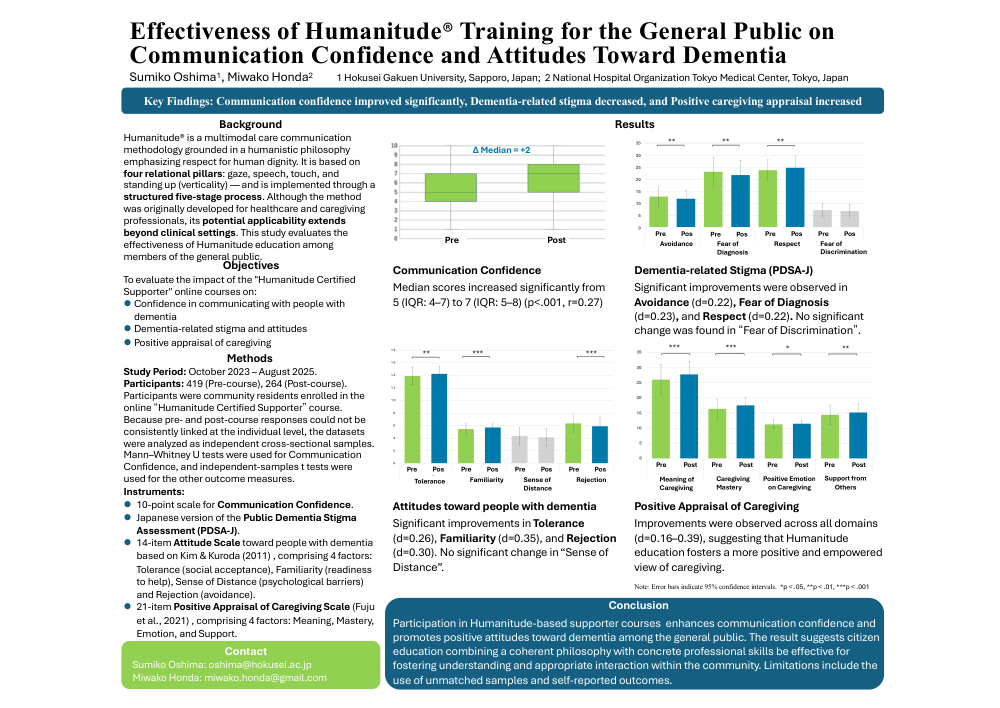
Background: Humanitude® is a multimodal care communication methodology grounded in a humanistic philosophy emphasizing respect for human dignity. Although originally developed for healthcare professionals, its applicability may extend to the general public. This study evaluated the effectiveness of Humanitude online courses designed for community residents.
Methods: A survey was conducted among participants in the “Humanitude Certified Supporter” program between 2023 and 2025. Data from 419 participants before the course and 264 after course completion were analyzed. Outcomes included communication confidence, dementia-related stigma (PDSA-J), attitudes toward people with dementia, and positive appraisal of caregiving.
Results: Communication confidence improved significantly after course completion, with median scores increasing from 5 to 7 (p < .001). Significant improvements were also observed in dementia-related stigma, particularly in Avoidance, Fear of Diagnosis, and Respect. Positive attitudes toward people with dementia improved in the domains of Tolerance, Familiarity, and Rejection. In addition, all domains of positive appraisal of caregiving—meaning, mastery, positive emotion, and support—showed significant enhancement. No significant changes were observed for Fear of Discrimination or Sense of Distance.
Conclusion: Humanitude-based education enhanced communication confidence and promoted more positive attitudes toward dementia among members of the general public. These findings suggest that citizen education combining a coherent care philosophy with concrete communication skills may contribute to the development of dementia-friendly communities.
Comments
Email is required but is not shown publicly.
Loading comments...