4,068 posters, 219 videos, 101 topics, 69 sessions, 14,365 authors, 6,128 institutions
ePostersLive by SciGen Technologies S.A. All rights reserved.
Alzheimer's Association International Conference 2026
July 12-15, 2026 | London, United Kingdom, and Online

6310
Multimodal Biomedical Knowledge Graphs Improve Cognitive Risk Modeling In Alzheimer's Disease
Poster Presenter
Authors
Haobo Zhang, Jiankun Wang, Zhe Huang, Qiannan Zhang, Chang Su, Fei Wang, Jiankun Wang
Affiliations
Part of Topic
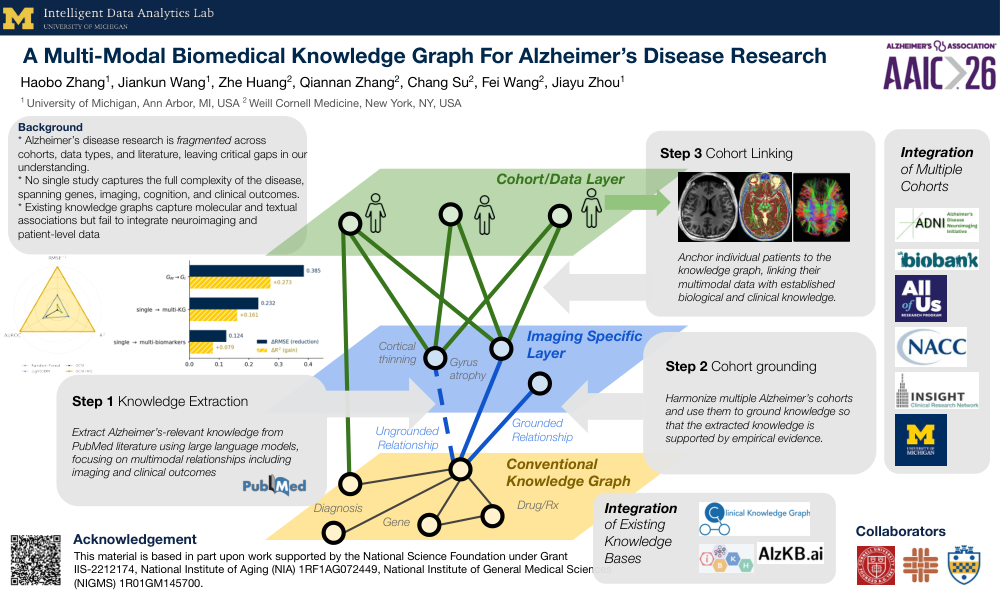
Background: Digital biomarkers and cohort studies have expanded Alzheimer’s disease (AD) research, yet key evidence remains fragmented across modalities (genetics, imaging, cognition) and across cohorts, limiting robust, generalizable discovery. A major unmet need is a unified framework that explicitly encodes neuroimaging biomarkers and connects them to molecular and clinical knowledge. We developed an imaging-augmented multimodal biomedical knowledge-graph approach and evaluated whether it improves patient-level cognitive outcome modeling.
Method: We leveraged an integrative biomedical knowledge-graph backbone and extended it with an explicit neuroimaging layer (e.g., hippocampal volume, ventricular volume, FDG-PET uptake) aligned to cohort-derived variables (Figure 1). Using ADNI participants, we constructed multi-branch graphs linking (1) patient–patient similarity edges from demographics and MRI embeddings, (2) patient–gene edges from curated AD-risk loci, and (3) patient–imaging-biomarker nodes and imaging-knowledge edges. We trained graph convolutional networks (GCNs) for cognitive prediction (MMSE regression and cognitive status classification) and compared against strong tabular baselines and GCN variants with ablated graph components.
Result: Knowledge-graph augmentation improved predictive performance over both tabular and patient-only graph baselines. In cognitive status classification, adding a gene-centric KG improved AUROC from 0.714 (GCN) to 0.740 (GCN+KG) and reduced RMSE from 2.477 to 2.428 (Table 1). For MMSE regression, incorporating imaging biomarkers and an imaging KG provided the largest gains: a multimodal configuration achieved RMSE 2.099 and (R^2) 0.348, outperforming variants that used only genetic features or incomplete graph structures (Table 2).
Conclusion: Explicitly representing neuroimaging biomarkers as first-class knowledge-graph entities and connecting them to patient data yields measurable improvements in cognitive outcome modeling in AD. This framework can influence translational informatics by turning heterogeneous cohort measurements into interoperable, queryable, and learnable structures, enabling cross-cohort hypothesis testing and EHR enrichment with surrogate biomarkers. Next steps include scaling cohort-grounding across multiple cohorts and validating downstream clinical utility in real-world EHR prediction and causal analyses.
Comments
Email is required but is not shown publicly.
Loading comments...