4,068 posters, 219 videos, 101 topics, 69 sessions, 14,365 authors, 6,128 institutions
ePostersLive by SciGen Technologies S.A. All rights reserved.
Alzheimer's Association International Conference 2026
July 12-15, 2026 | London, United Kingdom, and Online

3678
Repurposing Clinically Ordered Structural Magnetic Resonance Images For Use In Research On Cognitive Aging: The Act Study
Poster Presenter
Authors
Linda McEvoy, Rod Walker, Jalal Andre, Patti Curl, Nicole Gatto, Bradley Howlett, David Hunt, Nina LaPiana, Samantha Murray Tuesta, James Ralston, Juan Eugenio Iglesias, Christine Mac Donald
Affiliations
University of Washington, Kaiser Permanente Washington Health Research Institute, Massachusetts General Hospital and Harvard Medical School
Part of Topic
Introduction
Acquiring a large database of brain MRIs in cohort studies is cost prohibitive.
MRI scans are being increasingly used in clinical care. The ability to repurpose these scans for research use would provide an efficient method for increasing sample size and allow inclusion of individuals less likely to volunteer for research MRI.
Objective
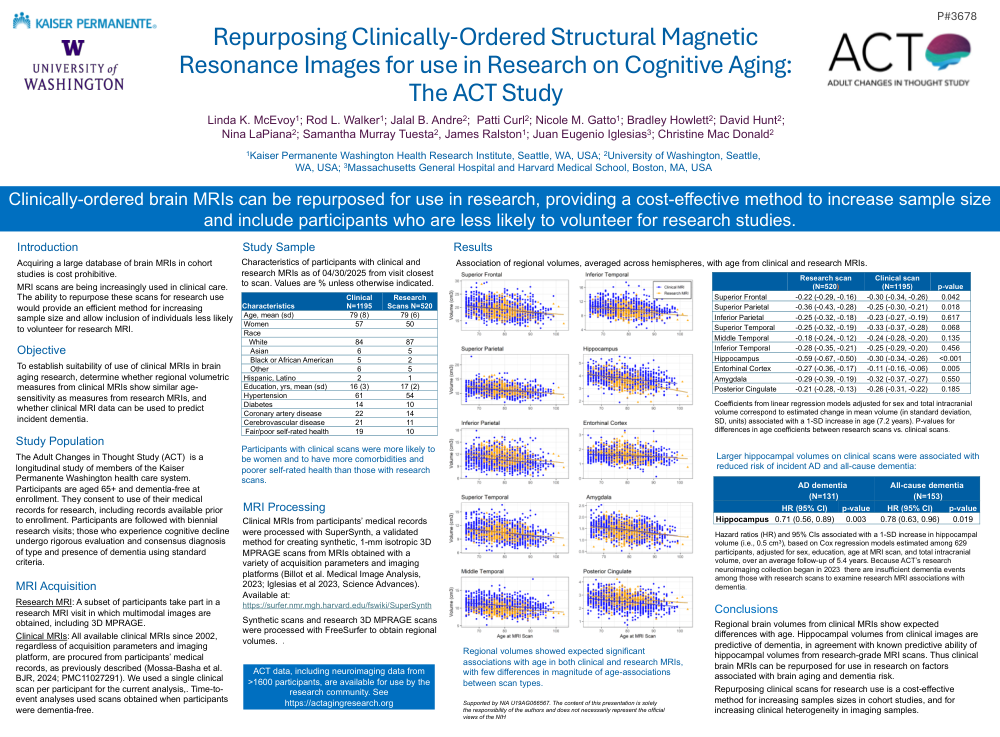
To establish suitability of use of clinical MRIs in brain aging research, determine whether regional volumetric measures from clinical MRIs show similar age-sensitivity as measures from research MRIs, and whether clinical MRI data can be used to predict incident dementia.
Study Population
The Adult Changes in Thought Study (ACT) is a longitudinal study of members of the Kaiser Permanente Washington health care system. Participants are aged 65+ and dementia-free at enrollment. They consent to use of their medical records for research, including records available prior to enrollment. Participants are followed with biennial research visits; those who experience cognitive decline undergo rigorous evaluation and consensus diagnosis of type and presence of dementia using standard criteria.
MRI Acquisition
Research MRI: A subset of participants take part in a research MRI visit in which multimodal images are obtained, including 3D MPRAGE.
Clinical MRIs: All available clinical MRIs since 2002, regardless of acquisition parameters and imaging platform, are procured from participants’ medical records, as previously described (Mossa-Basha et al. BJR, 2024; PMC11027291). We used a single clinical scan per participant for the current analysis,. Time-to-event analyses used scans obtained when participants were dementia-free.
Study Sample
Participants with clinical scans were more likely to be women and to have more comorbidities and poorer self-rated health than those with research scans.
MRI Processing
Clinical MRIs from participants’ medical records were processed with SuperSynth, a validated method for creating synthetic, 1-mm isotropic 3D MPRAGE scans from MRIs obtained with a variety of acquisition parameters and imaging platforms (Billot et al. Medical Image Analysis, 2023; Iglesias et al 2023, Science Advances). Available at: https://surfer.nmr.mgh.harvard.edu/fswiki/SuperSynth
Synthetic scans and research 3D MPRAGE scans were processed with FreeSurfer to obtain regional volumes.
Results
Regional volumes showed expected significant associations with age in both clinical and research MRIs, with few differences in magnitude of age-associations between scan types.
Larger hippocampal volumes on clinical scans were associated with reduced risk of incident AD and all-cause dementia.
Conclusions
Regional brain volumes from clinical MRIs show expected differences with age. Hippocampal volumes from clinical images are predictive of dementia, in agreement with known predictive ability of hippocampal volumes from research-grade MRI scans. Thus clinical brain MRIs can be repurposed for use in research on factors associated with brain aging and dementia risk.
Repurposing clinical scans for research use is a cost-effective method for increasing samples sizes in cohort studies, and for increasing clinical heterogeneity in imaging samples.
Comments
Email is required but is not shown publicly.
Loading comments...