4,068 posters, 219 videos, 101 topics, 69 sessions, 14,365 authors, 6,128 institutions
ePostersLive by SciGen Technologies S.A. All rights reserved.
Alzheimer's Association International Conference 2026
July 12-15, 2026 | London, United Kingdom, and Online

2464
A diagnostic plasma omics-biomarker panel for Alzheimer’s Disease based on microglial single-cell transcriptomics
Poster Presenter
Authors
Michael Lutz, Zhaohui Man, Srilakshmi Venkatesan, Yifei Zheng, Aditya Krishnan, Ornit Chiba-Falek
Affiliations
Division of Translational Brain Sciences, Department of Neurology, Duke University School of Medicine; Durham, NC 27710, USA., Department of Biostatistics and Bioinformatics, Duke University School of Medicine; Durham, NC 27710, USA, University of North Carolina at Chapel Hill, Chapel Hill, NC 27599, USA.
Part of Topic
Video
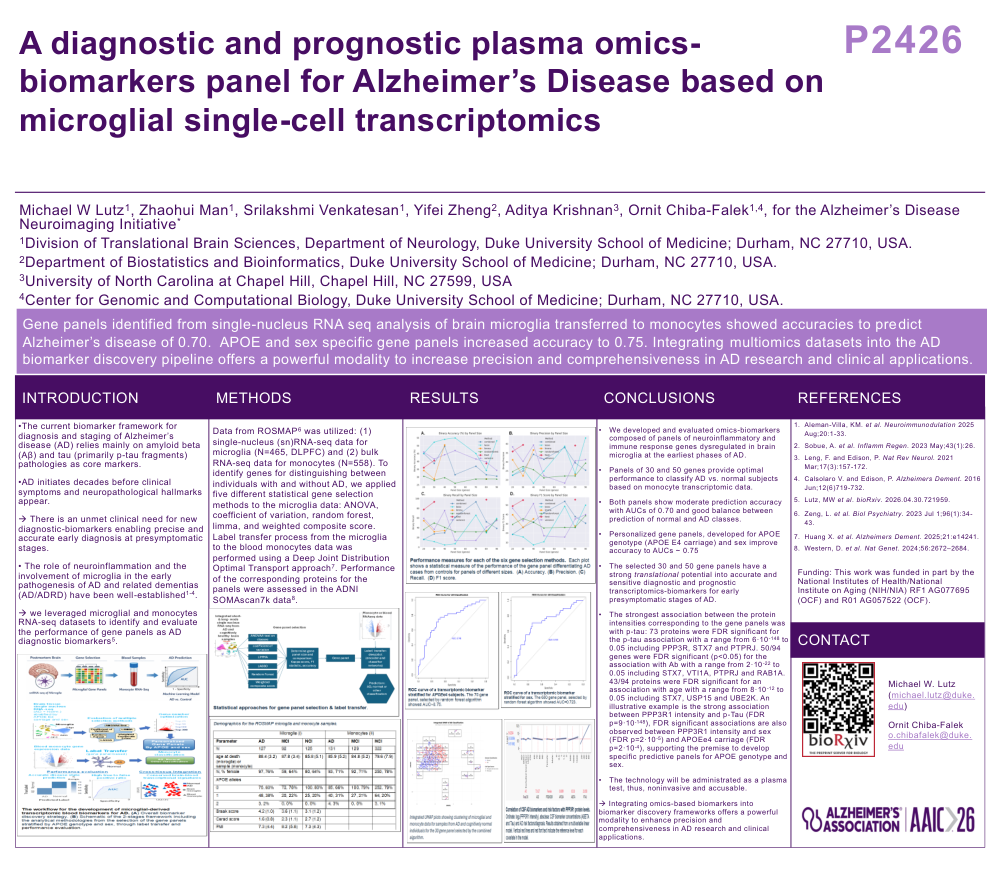
Background: There is an unmet need for accurate biomarkers to identify subjects at risk to develop Alzheimer’s disease (AD) years before symptoms. The role of neuroinflammation and microglia in the pathogenesis of AD are well-established. In this study we develop a blood-based omics-biomarker panel composed of neuroinflammatory and immune response genes dysregulated at the earliest phases of AD.
Methods: Data from ROSMAP was utilized: (1) single-nucleus (sn)RNA-seq data for microglia (N=465, DLPFC) and (2) bulk RNA-seq data for monocytes (N=558). To identify genes for distinguishing between individuals with and without AD, we applied five different statistical gene selection methods to the microglia data: ANOVA, coefficient of variation, random forest, limma, and weighted composite score. Label transfer process from the microglia to the blood monocytes data was performed using a Deep Joint Distribution Optimal Transport approach. Performance of the corresponding proteins for the panels were assessed in the ADNI SOMAscan7k data.
Results: A 300 genes panel was selected using limma. Panels of 50 and 30 genes were selected using the t-test and composite scores. We transferred the AD subtype labels from the microglial transcriptomic signature into blood samples using optimal transport. Using the panel of 300 genes, AUC for blood samples was 0.7 with strong accuracy to predict the AD class (75%) however accuracy to predict cognitively normal individuals was 53%. The accuracy and specificity of the 50 and 30 panels demonstrated better balance between prediction of the AD and normal classes (65-71%) with similar AUC (0.7) to the 300 gene panel (Table). For 94 proteins derived from the 300 gene panel, 13 were FDR significant (0.039 < p < 3.48*10-17) at distinguishing AD, MCI and normal cognition.
Conclusion: We developed an omics-biomarkers panel by selecting a microglial AD-transcriptomics signature and demonstrated significant accuracy and specificity of its performance by label transferring into monocyte transcriptomic data. Our AD omics-biomarkers panel has a strong translational potential as a diagnostic and prognostic tool with utilities including, (1) precise early diagnosis, (2) clinical studies design at preclinical stages, and (3) prediction of patients who are responsive vs non-responsive to disease modifying therapies.
Comments
Email is required but is not shown publicly.
Loading comments...