4,068 posters, 219 videos, 101 topics, 69 sessions, 14,365 authors, 6,128 institutions
ePostersLive by SciGen Technologies S.A. All rights reserved.
Alzheimer's Association International Conference 2026
July 12-15, 2026 | London, United Kingdom, and Online

9393
DNA Methylation Signature Of Cognitive Reserve
Part of Topic
DNA methylation signature of cognitive reserve moderates CSF tau pathology in prodromal Alzheimer’s disease
Lily Wang, David Lukacsovich, Juan I. Young, Lissette Gomez, Brian W. Kunkle, Zhixin Mao, Wei Zhang, X. Steven Chen, Deirdre M. O’Shea, Tatjana Rundek, Eden R. Martin
BACKGROUND
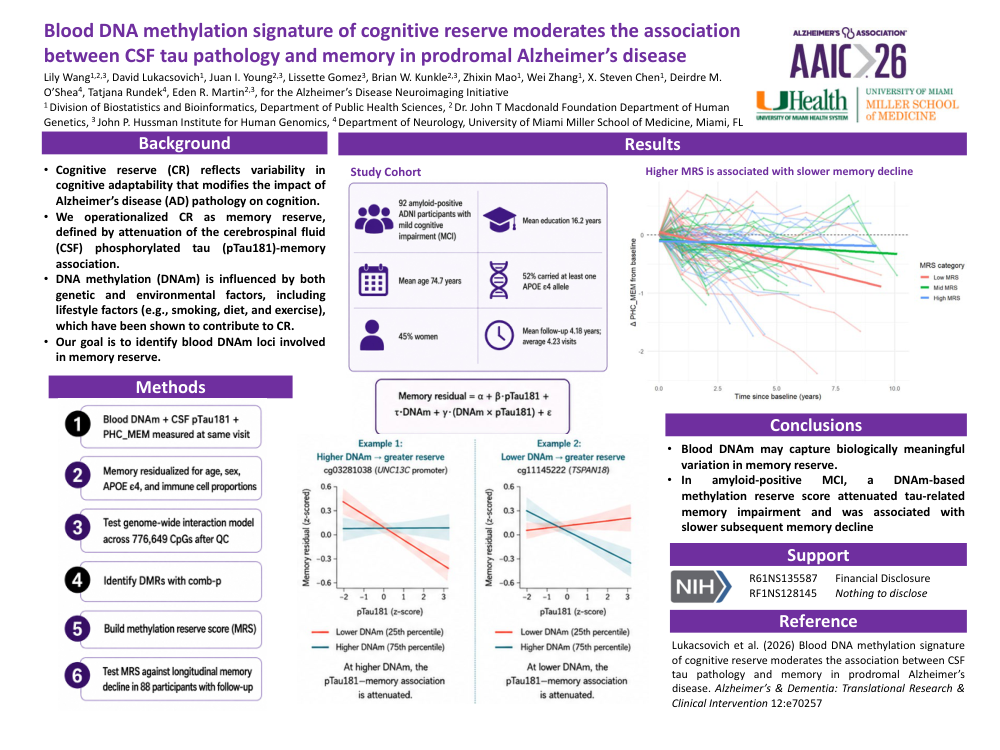
Cognitive reserve (CR) reflects variability in cognitive adaptability that modifies the impact of Alzheimer’s disease (AD) pathology on cognition. However, blood-based biomarkers of CR have not been established in prodromal AD. We operationalized CR as memory reserve, defined by attenuation of the cerebrospinal fluid (CSF) phosphorylated tau (pTau181)-memory association. We aimed to (i) identify blood DNAm loci that moderate the pTau181-memory relationship in amyloid-positive mild cognitive impairment (MCI) and (ii) evaluate whether a DNAm-based memory reserve score predicts future memory decline.
METHODS
We studied 92 amyloid-positive MCI participants from Alzheimer’s Disease Neuroimaging Initiative (ADNI) with blood DNAm, CSF pTau181, and memory (PHC_MEM) measured at the same visit. Memory was residualized after adjustment for age, sex, APOE4 allele count, and estimated immune cell-type proportions. For each CpG, linear models tested DNAm, pTau181, and DNAm×pTau181 interaction; inflation was corrected using the bacon method. In addition to individual CpGs, we also identified differentially methylated regions (DMRs). Moreover, we constructed a methylation reserve score (MRS), and tested associations with longitudinal memory using linear mixed-effects models in 88 participants with follow-up information.
RESULTS
After removing low-variability CpGs, we identified 6 CpGs with suggestive DNAm×pTau181 interaction (P-value <1×10⁻⁵) and 11 DMRs passing multiple-comparisons correction. The significant CpGs and DMRs mapped to genes implicating synaptic function, vascular/blood-brain barrier integrity, amyloid clearance, and immune regulation, with minimal marginal effects on pTau181 or memory, consistent with moderation effects. Importantly, higher baseline MRS attenuated the pTau181-memory association and predicted slower subsequent memory decline, independent of age, sex, education, APOE ε4, and baseline pTau181 (Figure 1).
CONCLUSIONS
Blood DNAm moderating the pTau181-memory relationship captures epigenetics underlying memory reserve and can be summarized as an MRS that predicts longitudinal memory trajectories in MCI, supporting DNAm as a promising non-invasive biomarker of cognitive resilience to AD pathology.
Comments
Email is required but is not shown publicly.
Loading comments...