4,068 posters, 219 videos, 101 topics, 69 sessions, 14,365 authors, 6,128 institutions
ePostersLive by SciGen Technologies S.A. All rights reserved.
Alzheimer's Association International Conference 2026
July 12-15, 2026 | London, United Kingdom, and Online

2895
Machine Learning-derived Plasma Proteomic Signatures For 10-year Prediction Of Incident Dementia
Poster Presenter
Authors
Ramon Casanova, Bowei Zhang, Andrea LaCroix, Susan Resnick, Steve Nguyen, Towia Libermann, Long Ngo, Alexander Reiner, Danni Li, Caroline Nievergelt, Adam Maihofer,, Linda McEvoy,, Aladdin Shadyab
Affiliations
Wake Forest University School of Medicine, University of Washington, Kaiser Permanente Washington Health Research Institute, University of California San Diego, Laboratory of Behavioral Neuroscience, National Institute on Aging, Beth Israel Deaconess Medical Center, University of Minnesota
Part of Topic
Background: There is growing interest in evaluating the potential of proteomics, plasma biomarkers of Alzheimer’s disease and related dementias (ADRD), and their combination to predict incident dementia.
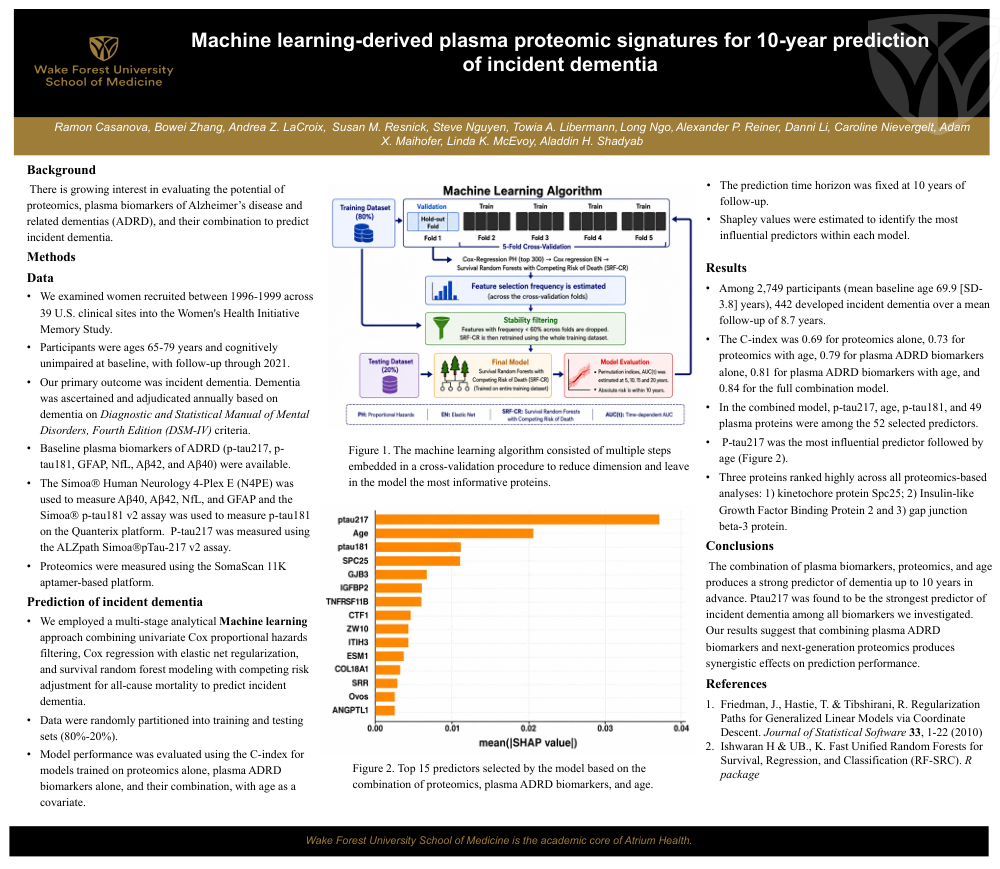
Methods: We examined women recruited between 1996-1999 across 39 U.S. clinical sites into the Women's Health Initiative Memory Study. Participants were ages 65-79 years and cognitively unimpaired at baseline, with follow-up through 2021. Baseline plasma biomarkers of ADRD (p-tau217, p-tau181, GFAP, NfL, Aβ42, and Aβ40) and proteomics were measured in 2024. The SimoaÒ Human Neurology 4-Plex E (N4PE) was used to measure Ab40, Ab42, NfL, and GFAP and the SimoaÒ p-tau181 v2 assay was used to measure p-tau181 on the Quanterix platform. P-tau217 was measured using the ALZpath SimoaÒpTau-217 v2 assay. Proteomics were measured using the SomaScan 11K aptamer-based platform.
We employed a multi-stage analytical approach combining univariate Cox proportional hazards filtering, Cox-net regularization, and survival random forest modeling with competing risk adjustment for all-cause mortality to predict incident dementia. Data were randomly partitioned into training and testing sets(80%-20%). Model performance was evaluated using Harrell's C-index for models trained on proteomics alone, plasma ADRD biomarkers alone, and their combination, with age as a covariate. The prediction time horizon was fixed at 10 years of follow-up. Shapley values were estimated to identify the most influential predictors within each model.
Results: Among 2,749 participants (mean baseline age 69.9 [SD-3.8] years), 442 developed incident dementia over a mean follow-up of 8.7 years. The C-index was 0.69 for proteomics alone, 0.73 for proteomics with age, 0.79 for plasma ADRD biomarkers alone, 0.81 for plasma ADRD biomarkers with age, and 0.84 for the full combination model. In the combined model, p-tau217,age,p-tau181, and 49 plasma proteins were among the 52 selected predictors. P-tau217 was the most influential predictor followed by age (Figure 1). Three proteins ranked highly across all proteomics-based analyses: 1) kinetochore protein Spc25;2) gap junction beta-2 protein and 3) gap junction beta-3 protein.
Conclusions: The combination of plasma biomarkers, proteomics, and age produces a strong predictor of dementia up to 10 years in advance. Combining plasma ADRD biomarkers and next-generation proteomics produces synergistic effects on prediction performance.
Comments
Email is required but is not shown publicly.
Loading comments...