4,068 posters, 219 videos, 101 topics, 69 sessions, 14,365 authors, 6,128 institutions
ePostersLive by SciGen Technologies S.A. All rights reserved.
Alzheimer's Association International Conference 2026
July 12-15, 2026 | London, United Kingdom, and Online

1221
Eye Movement And Gait Metrics As Functional Biomarkers Of Early Lecanemab Response In Alzheimer’S Disease: A 3-month Case Study
Poster Presenter
Authors
Yao Li, Kaiyue Xie, Siyv Qian, Zixun Wang, Haining zhang, Li Sun
Affiliations
Part of Topic
Abstract:
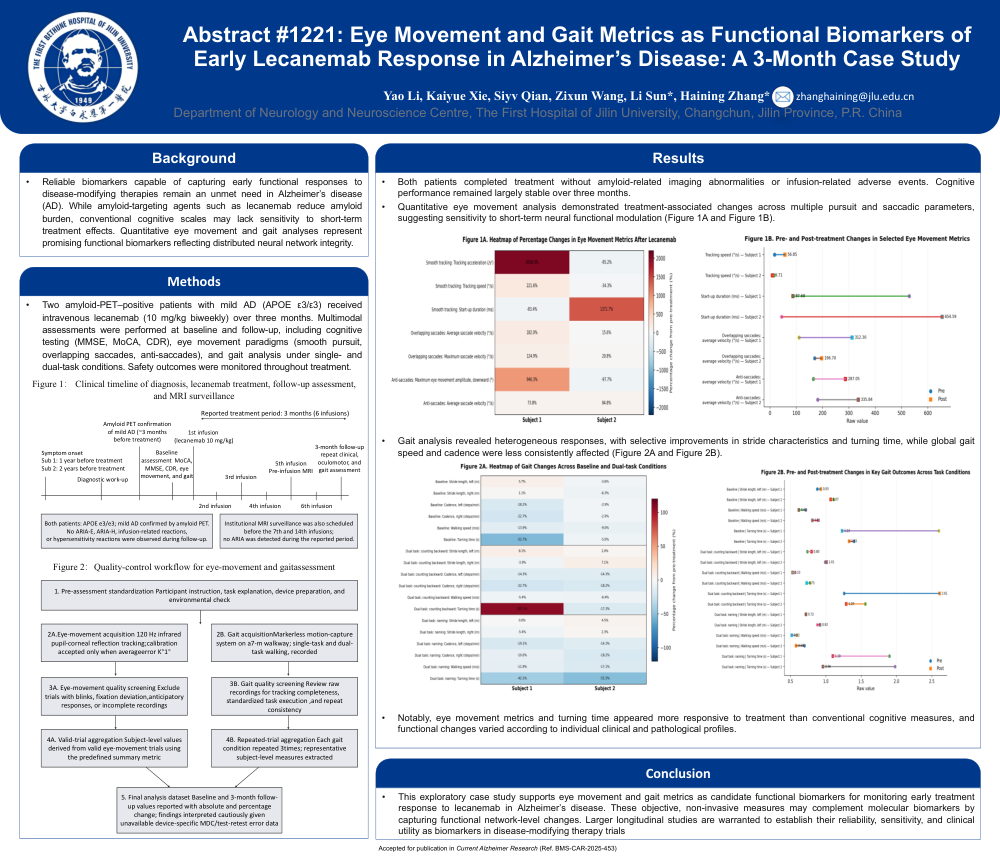
Background: Reliable biomarkers capable of capturing early functional responses to disease-modifying therapies remain an unmet need in Alzheimer’s disease (AD). While amyloid-targeting agents such as lecanemab reduce amyloid burden, conventional cognitive scales may lack sensitivity to short-term treatment effects. Quantitative eye movement and gait analyses represent promising functional biomarkers reflecting distributed neural network integrity.
Methods: Two amyloid-PET-positive patients with mild AD (APOE ε3/ε3) received intravenous lecanemab (10 mg/kg biweekly) over three months. Multimodal assessments were performed at baseline and follow-up, including cognitive testing (MMSE, MoCA, CDR), eye movement paradigms (smooth pursuit, overlapping saccades, anti-saccades), and gait analysis under single- and dual-task conditions. Safety outcomes were monitored throughout treatment.
Results: Both patients completed treatment without amyloid-related imaging abnormalities or infusion-related adverse events. Cognitive performance remained largely stable over three months. Quantitative eye movement analysis demonstrated treatment-associated changes across multiple pursuit and saccadic parameters, suggesting sensitivity to short-term neural functional modulation. Gait analysis revealed heterogeneous responses, with selective improvements in stride characteristics and turning time, while global gait speed and cadence were less consistently affected. Notably, eye movement metrics and turning time appeared more responsive to treatment than conventional cognitive measures, and functional changes varied according to individual clinical and pathological profiles.
Conclusion: This exploratory case study supports eye movement and gait metrics as candidate functional biomarkers for monitoring early treatment response to lecanemab in Alzheimer’s disease. These objective, non-invasive measures may complement molecular biomarkers by capturing functional network-level changes. Larger longitudinal studies are warranted to establish their reliability, sensitivity, and clinical utility as biomarkers in disease-modifying therapy trials.
Comments
Email is required but is not shown publicly.
Loading comments...