4,068 posters, 219 videos, 101 topics, 69 sessions, 14,365 authors, 6,128 institutions
ePostersLive by SciGen Technologies S.A. All rights reserved.
Alzheimer's Association International Conference 2026
July 12-15, 2026 | London, United Kingdom, and Online

6093
Prevalence And Longitudinal Dynamics Of Alpha-synuclein Co-pathology In ADNI: A Cross-sectional And Longitudinal SAA Study
Poster Presenter
Authors
Affiliations
Part of Topic
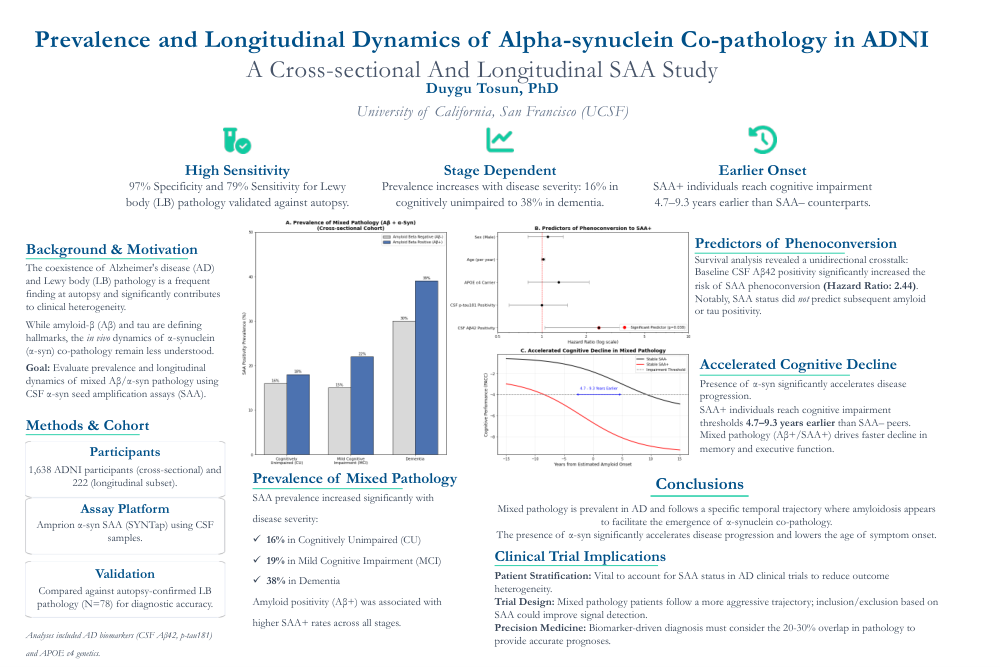
BACKGROUND: The coexistence of Alzheimer’s disease (AD) and Lewy body (LB) pathology is afrequent finding at autopsy and significantly contributes to heterogeneity in clinical presentationand trial outcomes. While amyloid-ß (Aß) and tau are the defining hallmarks of AD, the in vivodynamics of α-synuclein (α-syn) co-pathology remain less understood. This study evaluated theprevalence, longitudinal dynamics, and clinical impact of mixed Aß/α-syn pathology in theAlzheimer’s Disease Neuroimaging Initiative (ADNI) cohort using cerebrospinal fluid (CSF) α-synseed amplification assays (SAA).
METHODS: We analyzed CSF samples from 1,638 ADNI participants (cross-sectional) and alongitudinal subset of 222 participants (407 samples) using the Amprion α-syn SAA. SAAperformance was validated against autopsy-confirmed LB pathology (N=78). We examinedassociations between SAA status, AD biomarkers (CSF Aß42, p-tau181), and genetics (APOE ε4).Linear mixed-effects models and survival analyses were used to assess the impact of SAApositivity (SAA+) on cognitive trajectories and to characterize "phenoconverters" who progressedfrom SAA- to SAA+ over time.
RESULTS: SAA demonstrated 97% specificity and 79% sensitivity for LB pathology, with prevalenceincreasing with disease severity (16% in cognitively unimpaired, 19% in MCI, and 38% indementia). Cross-sectionally, SAA+ was associated with higher amyloid burden but, notably,lower CSF p-tau181 levels in dementia. Longitudinally, 34 participants (~5%) converted fromSAA- to SAA+7. Survival analysis revealed a unidirectional relationship: baseline CSF Aß42positivity significantly increased the risk of SAA phenoconversion (HR: 2.44), whereas SAA statusdid not predict subsequent amyloid or tau positivity. Clinically, SAA+ individuals reachedcognitive impairment thresholds 4.7-9.3 years earlier than SAA- counterparts, with mixedpathology (Aß+/SAA+) driving faster decline in memory and executive function than Aß alone.
CONCLUSIONS: Mixed pathology is prevalent in AD and follows a specific temporal trajectorywhere amyloidosis appears to facilitate the emergence of α-synuclein co-pathology. Thepresence of α-syn significantly accelerates disease progression and lowers the age of symptomonset. These findings underscore the necessity of stratifying patients by SAA status in AD clinical trials to account for the distinct aggressive trajectory of mixed pathology.
Comments
Email is required but is not shown publicly.
Loading comments...