4,068 posters, 219 videos, 101 topics, 69 sessions, 14,365 authors, 6,128 institutions
ePostersLive by SciGen Technologies S.A. All rights reserved.
Alzheimer's Association International Conference 2026
July 12-15, 2026 | London, United Kingdom, and Online

6029
Give The Patients Their Own Music: The Efficacy Of Autobiographical Music In Memory Retrieval.
Poster Presenter
Authors
Part of Topic
Video
Author: Jayendran Pillay. Wesleyan, CT, USA.
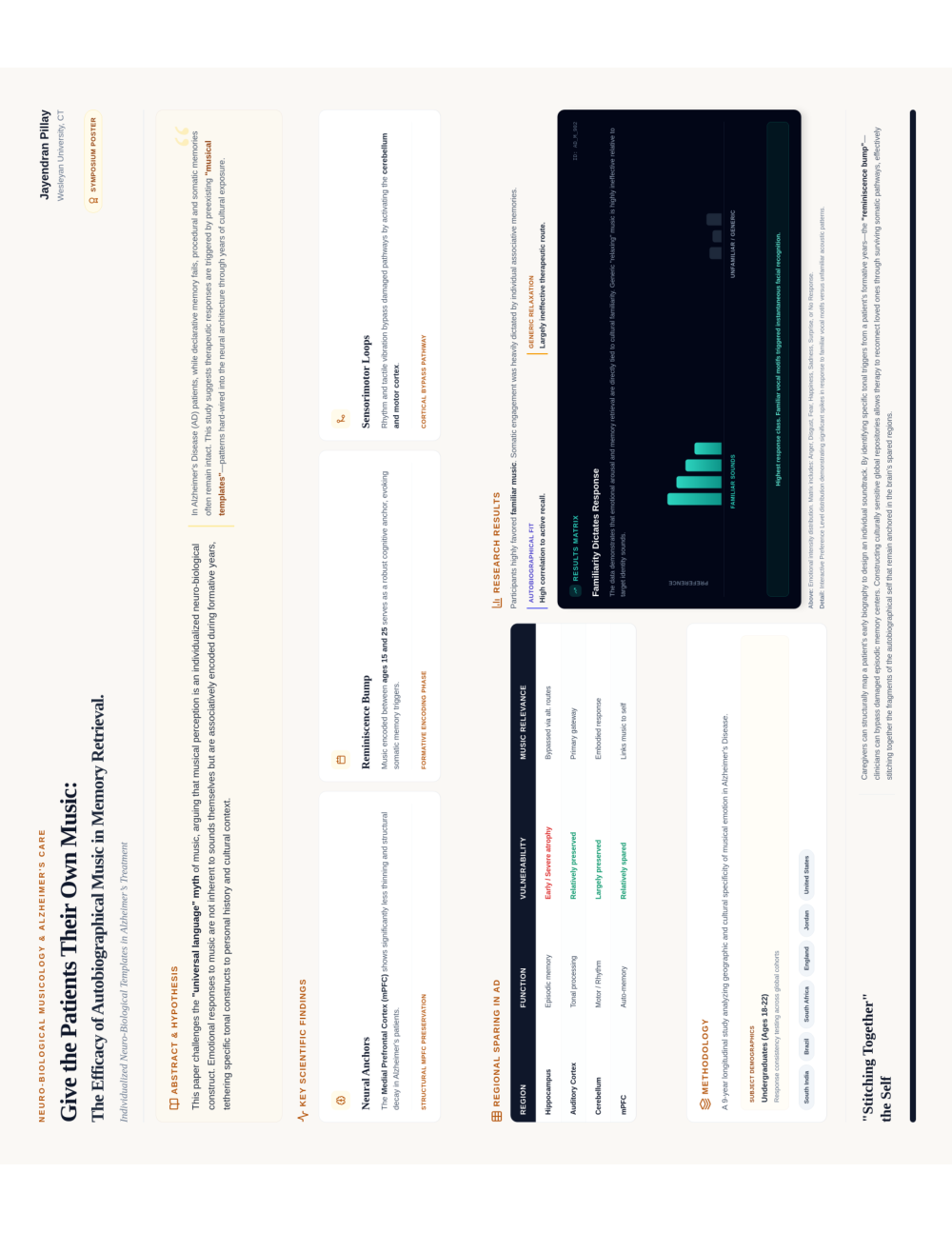
Abstract: Background: This paper challenges the "universal language" myth of music, arguing that musical perception is an individualized neuro-biological construct. Emotional responses to music are not inherent to the sounds themselves but are associatively encoded during a person’s formative years, tethering specific tonal constructs to personal history and cultural context. In Alzheimer’s Disease (AD) patients, while declarative memory fails, procedural and somatic memories often remain intact. The study suggests that therapeutic responses are triggered productively by preexisting "musical templates"—patterns hard-wired into the neural architecture through years of cultural exposure. This process reshapes the brain, blurring the line between nature and culture.
Key findings include:
• Neural Anchors: The Medial Prefrontal Cortex (mPFC), which links music and memory, shows less thinning in AD patients.
• The Reminiscence Bump: Music encoded between ages 15-25 serves as a powerful anchor for the "self."
• Sensorimotor Loops: Music bypasses damaged cortical pathways by activating the cerebellum and motor cortex through rhythm and vibration.
Methods: Over a 9-year period, I tested undergraduate students (18-22 years) for their emotional responses to the same pieces of music from different parts of the world, including South India, Brazil, South Africa, Indonesia, England, Jordan, and the United States. The students had to choose among Anger, Disgust, Fear, Happiness, Sadness, Surprise, No Emotional Response.
Results: Participants overwhelmingly favored familiar music. Their emotional responses were dictated by associative memories, aligning with ethnomusicological data that connects specific cultural sounds to specific sentiments.The findings suggest that generic "relaxing" music is less effective than autobiographically salient stimuli. By collaborating with ethnomusicologists, clinicians can identify memory "sonic triggers" unique to a patient’s identity and autobiography.
Conclusion: Caregivers can "stitch together" an autobiographical soundtrack to awaken memories and re-establish a sense of self. Constructing a global repository of music allows for idiosyncratic, culturally sensitive treatment that helps loved ones reconnect with patients through deeply embedded sensorimotor loops.
Comments
Email is required but is not shown publicly.
Loading comments...