4,068 posters, 219 videos, 101 topics, 69 sessions, 14,365 authors, 6,128 institutions
ePostersLive by SciGen Technologies S.A. All rights reserved.
Alzheimer's Association International Conference 2026
July 12-15, 2026 | London, United Kingdom, and Online

6104
Regional Disparities In Alzheimer’s Disease Hospitalizations In Brazil From 2015 To 2025
Poster Presenter
Authors
Affiliations
Part of Topic
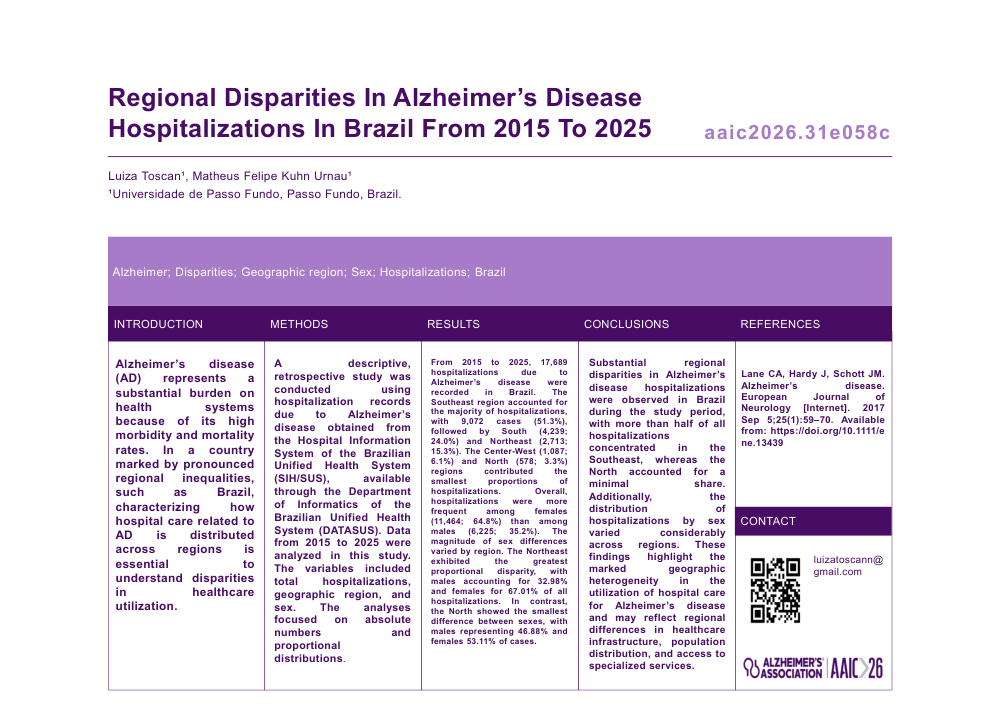
Regional Disparities In Alzheimer’s Disease Hospitalizations In Brazil From 2015 To 2025
Author Block: Luiza Toscan, Matheus Felipe Kuhn Urnau.
Universidade de Passo Fundo, Passo Fundo, Brazil.
Abstract:
Background: Alzheimer’s disease (AD) represents a substantial burden on health systems because of its high morbidity and mortality rates. In a country marked by pronounced regional inequalities, such as Brazil, characterizing how hospital care related to AD is distributed across regions is essential to understand disparities in healthcare utilization.
Methods: A descriptive, retrospective study was conducted using hospitalization records due to Alzheimer’s disease obtained from the Hospital Information System of the Brazilian Unified Health System (SIH/SUS), available through the Department of Informatics of the Brazilian Unified Health System (DATASUS). Data from 2015 to 2025 were analyzed in this study. The variables included total hospitalizations, geographic region, and sex. The analyses focused on absolute numbers and proportional distributions.
Results: From 2015 to 2025, 17,689 hospitalizations due to Alzheimer’s disease were recorded in Brazil. The Southeast region accounted for the majority of hospitalizations, with 9,072 cases (51.3%), followed by South (4,239; 24.0%) and Northeast (2,713; 15.3%). The Center-West (1,087; 6.1%) and North (578; 3.3%) regions contributed the smallest proportions of hospitalizations. Overall, hospitalizations were more frequent among females (11,464; 64.8%) than among males (6,225; 35.2%). The magnitude of sex differences varied by region. The Northeast exhibited the greatest proportional disparity, with males accounting for 32.98% and females for 67.01% of all hospitalizations. In contrast, the North showed the smallest difference between sexes, with males representing 46.88% and females 53.11% of cases.
Conclusion: Substantial regional disparities in Alzheimer’s disease hospitalizations were observed in Brazil during the study period, with more than half of all hospitalizations concentrated in the Southeast, whereas the North accounted for a minimal share. Additionally, the distribution of hospitalizations by sex varied considerably across regions. These findings highlight the marked geographic heterogeneity in the utilization of hospital care for Alzheimer’s disease and may reflect regional differences in healthcare infrastructure, population distribution, and access to specialized services.
Comments
Email is required but is not shown publicly.
Loading comments...