4,068 posters, 219 videos, 101 topics, 69 sessions, 14,365 authors, 6,128 institutions
ePostersLive by SciGen Technologies S.A. All rights reserved.
Alzheimer's Association International Conference 2026
July 12-15, 2026 | London, United Kingdom, and Online

3887
Cognitive Domains Influenced By Reproductive History In Older Men: Findings From The HELIAD Study
Poster Presenter
Authors
Sotiria Moza, Mary Yannakoulia, Efthimios Dardiotis, Paraskevi Sakka, Nikolaos Scarmeas, Georgios M. Hadjigeorgiou, Mary H. Kosmidis
Affiliations
Lab of Neuropsychology & Behavioral Neuroscience, School of Psychology, Aristotle University of Thessaloniki, Thessaloniki, Greece, sotimoza@psy.auth.gr, 1st Department of Neurology, Eginition Hospital, Medical School, National and Kapodistrian University of Athens, Athens, Greece. -- Taub Institute for Research in Alzheimer’s Disease and the Aging Brain, the Gertrude H. Sergievsky Center, Department of Neurology, Columbia University, New York, USA, ns257@columbia.edu, School of Medicine, University of Cyprus, Nicosia, Cyprus, hadjigeorgiou.georgios@ucy.ac.cy, Department of Neurology, Faculty of Medicine, University of Thessaly, Thessaly, Greece, edar@med.uth.gr, Department of Nutrition Science-Dietetics, Harokopio University, Athens, Greece, myiannak@hua.gr, Athens Alzheimer Association, Athens, Greece, info@psakka.gr, Lab of Neuropsychology & Behavioral Neuroscience, School of Psychology, Aristotle University of Thessaloniki, Thessaloniki, Greece, kosmidis@psy.auth.gr
Part of Topic
Title: Cognitive domains influenced by reproductive history in older men: Findings from the HELIAD study
Sotiria Moza1a, Mary Yannakoulia2, Efthimios Dardiotis3, Paraskevi Sakka4, Nikolaos Scarmeas5, 6, Georgios M. Hadjigeorgiou7, & Mary H. Kosmidis1b*
1 Lab of Neuropsychology & Behavioral Neuroscience, School of Psychology, Aristotle University of Thessaloniki, Thessaloniki, Greece, asotimoza@psy.auth.gr, bkosmidis@psy.auth.gr
2 Department of Nutrition Science-Dietetics, Harokopio University, Athens, Greece, myiannak@hua.gr
3 Department of Neurology, Faculty of Medicine, University of Thessaly, Thessaly, Greece, edar@med.uth.gr
4 Athens Alzheimer Association, Athens, Greece, info@psakka.gr
5 1st Department of Neurology, Eginition Hospital, Medical School, National and Kapodistrian University of Athens, Athens, Greece.
6 Taub Institute for Research in Alzheimer’s Disease and the Aging Brain, the Gertrude H. Sergievsky Center, Department of Neurology, Columbia University, New York, USA, ns257@columbia.edu
7 School of Medicine, University of Cyprus, Nicosia, Cyprus, hadjigeorgiou.georgios@ucy.ac.cy
Background:
Several studies have reported associations between reproductive factors and late-life cognitive outcomes in women; however, evidence regarding reproductive history and cognition in men remains very limited (Basit et al., 2023). In the present study, we examined associations between reproductive history in men and cognitive performance across multiple domains in later life.
Methods:
The sample included 811 men (MeanAGE=74.43±5.37 years, meanEDUCATION=8.92±5.28 years) from the Hellenic Longitudinal Investigation of Aging and Diet (HELIAD; Dardiotis et al., 2014). Participants provided detailed reproductive, medical, and social histories and had a comprehensive neuropsychological assessment. Scores on individual neuropsychological tests were grouped into Memory, Attention/Speed, Executive Functioning, Visuospatial and Language domains, and summed to produce a Cognitive Total domain score. Multiple linear regressions were conducted to examine whether reproductive variables predicted performance in the aforementioned domains. Analyses were adjusted for age, education, medical comorbidities, genetic factors (presence of ApoE ε4 alleles), lifestyle behaviors (smoking, drinking, adherence to Mediterranean diet), and socioeconomic variables.
Results:
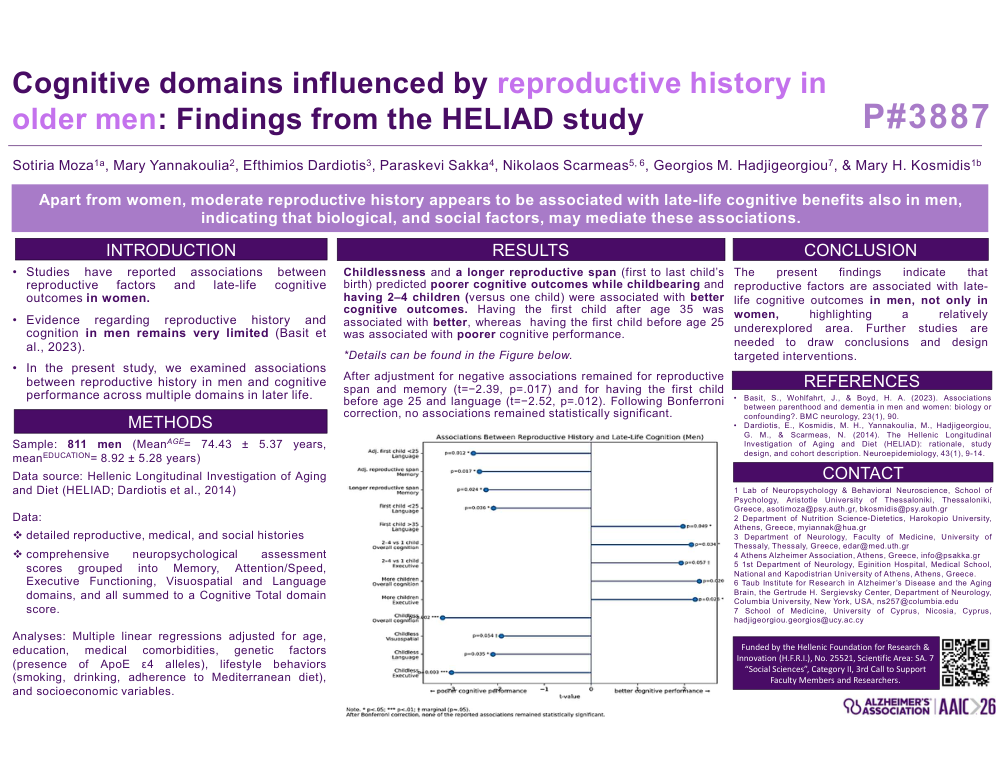
Childlessness predicted poorer executive functioning (t=−2.99, p=.003), language (t=−2.10, p=.035), visuospatial (marginally) (t=−1.92, p=.054), and overall cognitive scores (t=−3.18, p=.002). In contrast, having more children was associated with better executive functioning (t=2.23, p=.026) and overall cognitive performance (t=2.32, p=.020). Having 2–4 children, specifically, versus one child was associated with higher executive functioning (marginally) (t=1.93, p=.057) and overall cognitive scores (t=2.15, p=.034). Having the first child after age 35 was associated with better language scores (t=1.97, p=.049), whereas having the first child before age 25 was associated with poorer language performance (t=−2.09, p=.036). A longer reproductive span (first to last child’s birth) was associated with poorer memory scores (t=-2.25, p=.024). After adjustment for medical, sociodemographic, lifestyle, and medication covariates, significant negative associations remained for reproductive span and memory (t=−2.39, p=.017) and for having the first child before age 25 and language (t=−2.52, p=.012). Following Bonferroni correction, no associations remained statistically significant.
Conclusions:
The present findings indicate that reproductive factors are associated with late-life cognitive outcomes in men, not only in women, highlighting a relatively underexplored area. Further studies are needed to draw conclusions and design targeted interventions.
Basit, S., Wohlfahrt, J., & Boyd, H. A. (2023). Associations between parenthood and dementia in men and women: biology or confounding?. BMC neurology, 23(1), 90.
Dardiotis, E., Kosmidis, M. H., Yannakoulia, M., Hadjigeorgiou, G. M., & Scarmeas, N. (2014). The Hellenic Longitudinal Investigation of Aging and Diet (HELIAD): rationale, study design, and cohort description. Neuroepidemiology, 43(1), 9-14.
Comments
Email is required but is not shown publicly.
Loading comments...