4,068 posters, 219 videos, 101 topics, 69 sessions, 14,365 authors, 6,128 institutions
ePostersLive by SciGen Technologies S.A. All rights reserved.
Alzheimer's Association International Conference 2026
July 12-15, 2026 | London, United Kingdom, and Online

2981
Are Trauma-related Intrusions Worse Among War Survivors In Late-life? Associations With Cognitive Decline.
Poster Presenter
Authors
Sotiria Moza, Sotiria Moza, Romina Sampanai, Mary H. Kosmidis
Affiliations
Department of Psychology, University of Bielefeld, Universitätsstraße 25, 33615 Bielefeld, Germany, sarah.neofytou@uni-bielefeld.de, Lab of Neuropsychology & Behavioral Neuroscience, School of Psychology, Aristotle University of Thessaloniki, Thessaloniki, Greece, kosmidis@psy.auth.gr, Noesis Cognitive Center & Tech Solutions, Kifisias 9, Tseri, 2480, Nicosia, Cyprus, sotiria@noesis.cy, Materia Group, Athalassis 41, 2221, Nicosia, Cyprus romina@materia.com.cy
Part of Topic
Title: Are trauma-related intrusions worse among war survivors in late-life? Associations with cognitive decline.
Sarah Neofytou1, Sotiria Moza2, Romina Sampanai3 & Mary H. Kosmidis4
1 Department of Psychology, University of Bielefeld, Universitätsstraße 25, 33615 Bielefeld, Germany, sarah.neofytou@uni-bielefeld.de
2 Noesis Cognitive Center & Tech Solutions, Kifisias 9, Tseri, 2480, Nicosia, Cyprus, sotiria@noesis.cy
3 Materia Group, Athalassis 41, 2221, Nicosia, Cyprus romina@materia.com.cy
4 Lab of Neuropsychology & Behavioral Neuroscience, School of Psychology, Aristotle University of Thessaloniki, Thessaloniki, Greece, kosmidis@psy.auth.gr
Background:
Previous research has shown that exposure to traumatic events can lead to long-lasting intrusive memories across the lifespan (Brewin et al., 2010). Executive functions, including inhibitory control, are thought to support the regulation of intrusive memories; however, it remains unclear whether age-related cognitive decline following early-life war exposure influences the severity of intrusions in later life. This study examined associations between age, trauma-related intrusions, and cognitive function in older adults exposed to war.
Methods:
Thirty-four participants (MeanAGE=75.85 years, SD= 11.05; MeanEDUCATION=11.11, SD=4.21; 58.82% female) exposed to conflict periods in Cyprus, including the British Occupation (1878-1960), the subsequent civil conflict (1955-1959), and the Turkish Invasion (1974), provided sociodemographic information and were administered the Impact of Events Scale-IES (IES; Weiss & Marmar, 1997) and the Addenbrooke’s Cognitive Examination -Revised (ACE-R; Mioshi et al., 2006).
Results:
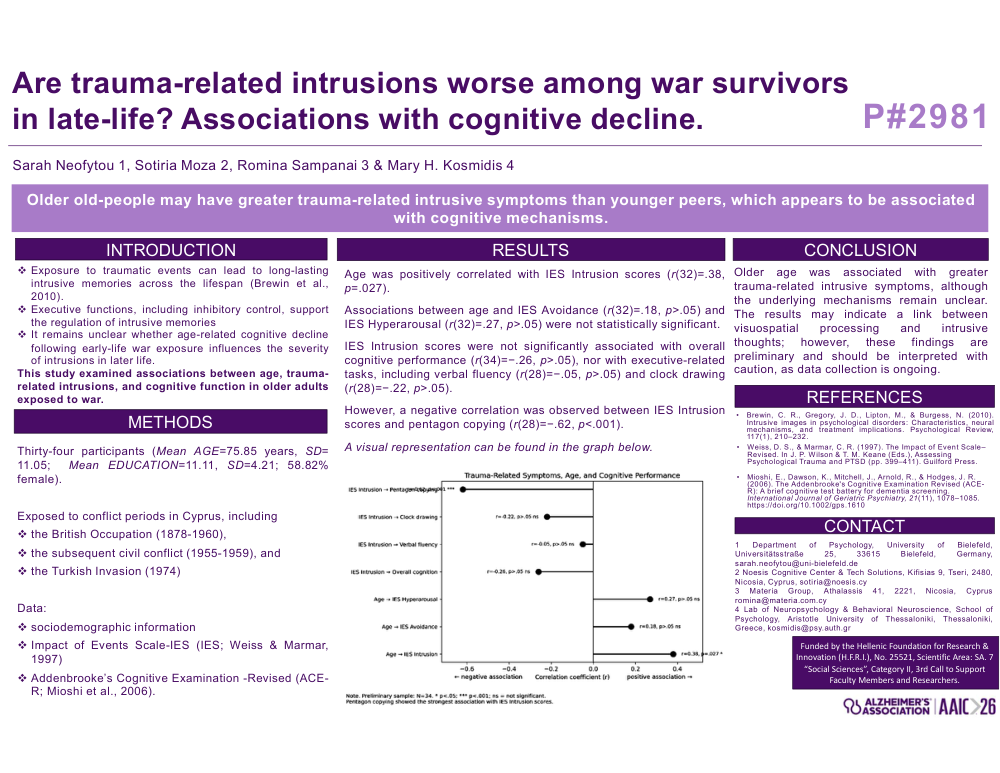
In the preliminary sample (N=34), age was positively correlated with IES Intrusion scores (r(32)=.38, p=.027), indicating that higher age was associated with greater trauma-related intrusive symptoms. Associations between age and IES Avoidance (r(32)=.18, p>.05) and IES Hyperarousal (r(32)=.27, p>.05) were not statistically significant. IES Intrusion scores were not significantly associated with overall cognitive performance (r(34)=−.26, p>.05), nor with executive-related tasks, including verbal fluency (r(28)=−.05, p>.05) and clock drawing (r(28)=−.22, p>.05). However, a negative correlation was observed between IES Intrusion scores and pentagon copying (r(28)=−.62, p<.001), indicating that poorer visuospatial construction was associated with higher levels of intrusive trauma-related symptoms.
Conclusions:
Older age was associated with greater trauma-related intrusive symptoms, although the underlying mechanisms remain unclear. The results may indicate a link between visuospatial processing and intrusive thoughts; however, these findings are preliminary and should be interpreted with caution, as data collection is ongoing.
Brewin, C. R., Gregory, J. D., Lipton, M., & Burgess, N. (2010). Intrusive images in psychological disorders: Characteristics, neural mechanisms, and treatment implications. Psychological Review, 117(1), 210–232.
Comments
Email is required but is not shown publicly.
Loading comments...