4,068 posters, 219 videos, 101 topics, 69 sessions, 14,365 authors, 6,128 institutions
ePostersLive by SciGen Technologies S.A. All rights reserved.
Alzheimer's Association International Conference 2026
July 12-15, 2026 | London, United Kingdom, and Online

3883
Moderate Reproductive History May Protect Against Certain Dementia Subtypes In Both Sexes
Poster Presenter
Authors
Sotiria Moza, Nikolaos Scarmeas, Georgios M. Hadjigeorgiou, Efthimios Dardiotis, Mary Yannakoulia, Paraskevi Sakka, Mary H. Kosmidis
Affiliations
Lab of Neuropsychology & Behavioral Neuroscience, School of Psychology, Aristotle University of Thessaloniki, Thessaloniki, Greece, sotimoza@psy.auth.gr, 1st Department of Neurology, Eginition Hospital, Medical School, National and Kapodistrian University of Athens, Athens, Greece. -- Taub Institute for Research in Alzheimer’s Disease and the Aging Brain, the Gertrude H. Sergievsky Center, Department of Neurology, Columbia University, New York, USA, ns257@columbia.edu, School of Medicine, University of Cyprus, Nicosia, Cyprus, hadjigeorgiou.georgios@ucy.ac.cy, Department of Neurology, Faculty of Medicine, University of Thessaly, Thessaly, Greece, edar@med.uth.gr, Department of Nutrition Science-Dietetics, Harokopio University, Athens, Greece, myiannak@hua.gr, Athens Alzheimer Association, Athens, Greece, info@psakka.gr, Lab of Neuropsychology & Behavioral Neuroscience, School of Psychology, Aristotle University of Thessaloniki, Thessaloniki, Greece, kosmidis@psy.auth.gr
Part of Topic
Title: Moderate reproductive history may protect against certain dementia subtypes in both sexes
Sotiria Moza1a, Nikolaos Scarmeas2, 3, Georgios M. Hadjigeorgiou4, Efthimios Dardiotis5, Mary Yannakoulia6, Paraskevi Sakka7, & Mary H. Kosmidis1b*
1 Lab of Neuropsychology & Behavioral Neuroscience, School of Psychology, Aristotle University of Thessaloniki, Thessaloniki, Greece, asotimoza@psy.auth.gr, bkosmidis@psy.auth.gr
2 1st Department of Neurology, Eginition Hospital, Medical School, National and Kapodistrian University of Athens, Athens, Greece.
3 Taub Institute for Research in Alzheimer’s Disease and the Aging Brain, the Gertrude H. Sergievsky Center, Department of Neurology, Columbia University, New York, USA, ns257@columbia.edu
4 School of Medicine, University of Cyprus, Nicosia, Cyprus, hadjigeorgiou.georgios@ucy.ac.cy
5 Department of Neurology, Faculty of Medicine, University of Thessaly, Thessaly, Greece, edar@med.uth.gr
6 Department of Nutrition Science-Dietetics, Harokopio University, Athens, Greece, myiannak@hua.gr
7 Athens Alzheimer Association, Athens, Greece, info@psakka.gr
Background:
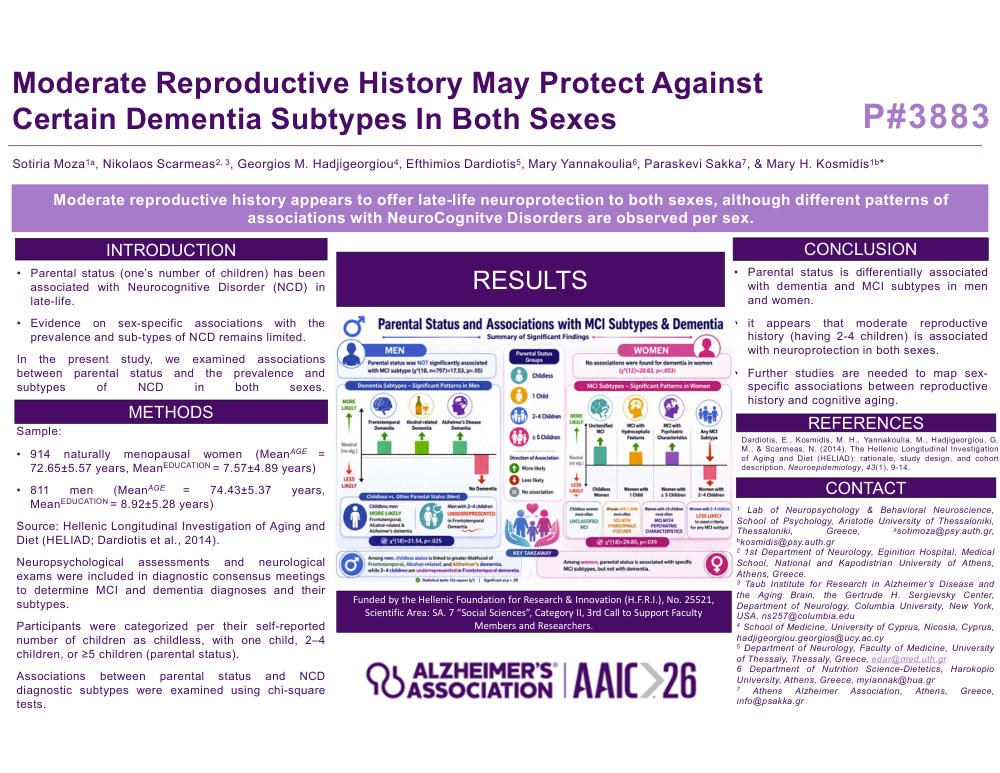
Parental status (one’s number of children) has been associated with Neurocognitive Disorder (NCD) in late-life, yet evidence on sex-specific associations with the prevalence and sub-types of NCD remains limited. In the present study, we examined associations between parental status and the prevalence and subtypes of NCD in both sexes.
Methods:
The sample included 914 naturally menopausal women (MeanAGE=72.65±5.57 years, meanEDUCATION=7.57±4.89 years) and 811 men (MeanAGE=74.43±5.37 years, meanEDUCATION=8.92±5.28 years) from the Hellenic Longitudinal Investigation of Aging and Diet (HELIAD; Dardiotis et al., 2014). Neuropsychological assessments and neurological exams were included in diagnostic consensus meetings to determine MCI and dementia diagnoses and their subtypes. Participants were categorized per their self-reported number of children as childless, with one child, 2–4 children, or ≥5 children (parental status). Associations between parental status and NCD diagnostic subtypes were examined using chi-square tests.
Results:
Among men, parental status was not significantly associated with MCI subtype (χ²(18, n=797)=17.53, p>.05). However, childless men were more likely to develop frontotemporal, alcohol-related, or Alzheimer’s disease dementia, and less likely to have no dementia. Also, men with 2–4 children were underrepresented in frontotemporal dementia (χ²(18)=31.54, p=.025). Likewise, childless women more often presented with unclassified MCI, women with one child more frequently showed MCI with hydrocephalic features, women with ≥5 children more often exhibited MCI with psychiatric characteristics, while women with 2–4 children appeared less likely to meet criteria for any MCI subtype (χ²(18)=29.80, p=.039). No associations were found in regard to dementia in women (χ²(12)=20.83, p=.053).
Conclusions:
Parental status is differentially associated with dementia and MCI subtypes in men and women. Yet, it appears that moderate reproductive history (having 2-4 children) is associated with neuroprotection in both sexes. Further studies are needed to map sex-specific associations between reproductive history and cognitive aging.
Dardiotis, E., Kosmidis, M. H., Yannakoulia, M., Hadjigeorgiou, G. M., & Scarmeas, N. (2014). The Hellenic Longitudinal Investigation of Aging and Diet (HELIAD): rationale, study design, and cohort description. Neuroepidemiology, 43(1), 9-14.
Comments
Email is required but is not shown publicly.
Loading comments...