4,068 posters, 219 videos, 101 topics, 69 sessions, 14,365 authors, 6,128 institutions
ePostersLive by SciGen Technologies S.A. All rights reserved.
Alzheimer's Association International Conference 2026
July 12-15, 2026 | London, United Kingdom, and Online

5276
Experience Of A Latin American Tertiary Center With Donanemab Infusion
Poster Presenter
Authors
Isabela Louise Weber, Caroline Colvara, Maria Eduarda Dissenha, Renata Cristine Alves, Karen Luiza Socher
Affiliations
Part of Topic
Introduction: Donanemab is an anti-amyloid monoclonal antibody approved by ANVISA in 2025 for early-stage Alzheimer’s disease. We report the initial implementation experience of Donanemab therapy in a Latin American tertiary center.
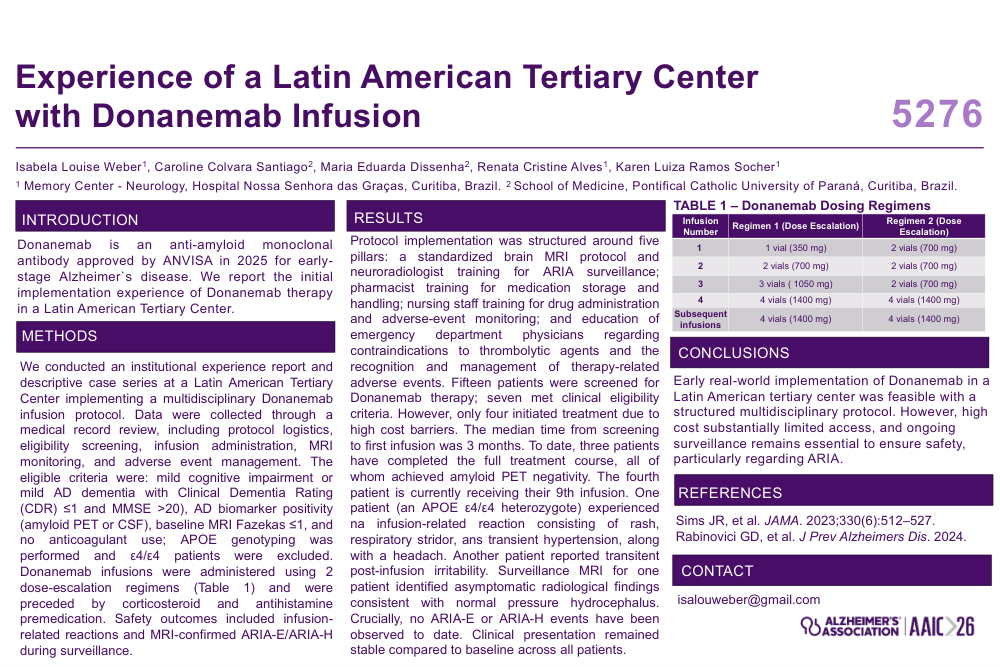
Methods: We conducted an institutional experience report and descriptive case series at a Latin American tertiary center implementing a multidisciplinary Donanemab infusion protocol. Data were collected through a medical record review, including protocol logistics, eligibility screening, infusion administration, MRI monitoring, and adverse event management. The eligible criteria were: mild cognitive impairment or mild AD dementia with Clinical Dementia Rating (CDR) ≤1 and MMSE >20), AD biomarker positivity (amyloid PET or CSF), baseline MRI Fazekas ≤1, and no anticoagulant use; APOE genotyping was performed and ε4/ε4 patients were excluded. Donanemab infusions were administered using 2 dose-escalation regimens (Table 1) and were preceded by corticosteroid and antihistamine premedication. Safety outcomes included infusion-related reactions and MRI-confirmed ARIA-E/ARIA-H during surveillance.
Results: Protocol implementation was structured around five pillars: a standardized brain MRI protocol and neuroradiologist training for ARIA surveillance; pharmacist training for medication storage and handling; nursing staff training for drug administration and adverse-event monitoring; and education of emergency department physicians regarding contraindications to thrombolytic agents and the recognition and management of therapy-related adverse events. Fifteen patients were screened for Donanemab therapy; seven met clinical eligibility criteria. However, only four initiated treatment due to high cost barriers. The median time from screening to first infusion was 3 months. To date, three patients have completed the full treatment course, all of whom achieved amyloid PET negativity. The fourth patient is currently receiving their 9th infusion. One patient (an APOE ε4/ε4 heterozygote) experienced na infusion-related reaction consisting of rash, respiratory stridor, ans transient hypertension, along with a headach. Another patient reported transitent post-infusion irritability. Surveillance MRI for one patient identified asymptomatic radiological findings consistent with normal pressure hydrocephalus. Crucially, no ARIA-E or ARIA-H events have been observed to date. Clinical presentation remained stable compared to baseline across all patients.
Conclusion: Early real-world implementation of Donanemab in a Latin American tertiary center was feasible with a structured multidisciplinary protocol.However, high cost substantially limited access, and ongoing surveillance remains essential to ensure safety, particularly regarding ARIA.
Comments
Email is required but is not shown publicly.
Loading comments...