4,068 posters, 219 videos, 101 topics, 69 sessions, 14,365 authors, 6,128 institutions
ePostersLive by SciGen Technologies S.A. All rights reserved.
Alzheimer's Association International Conference 2026
July 12-15, 2026 | London, United Kingdom, and Online

10813
Bridging The Gap: An Audit Of Ai-simplified Dementia Care Resources
Poster Presenter
Authors
Part of Topic
Bridging the Gap: An Audit of AI-Simplified Dementia Care Resources
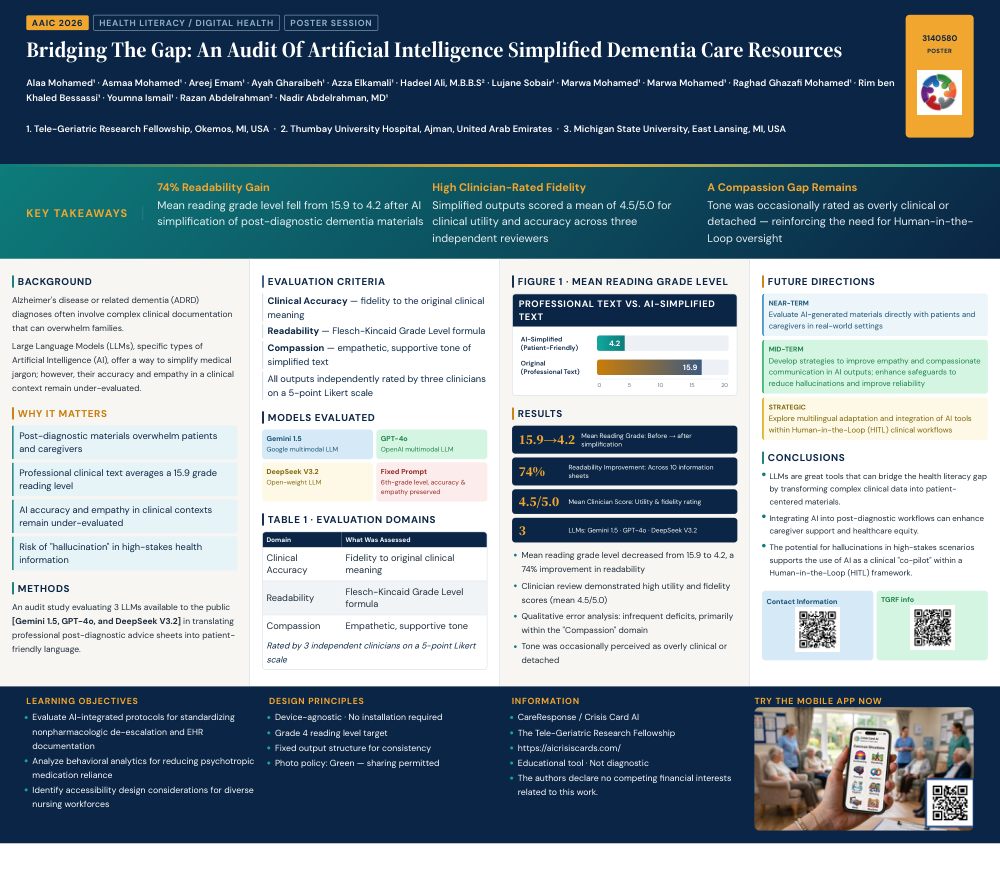
Background: Receiving a diagnosis of Alzheimer’s disease or related dementia (ADRD) is often accompanied by complex clinical documentation that can be overwhelming for families. While Large Language Models (LLMs) offer a way to simplify medical jargon, their accuracy and "empathy" in a clinical context remain under-evaluated. This study audits the performance of three different AI tools (Gemini 1.5, GPT-4o, and DeepSeek V3.2) in translating professional post-diagnostic advice into patient-friendly language.
Methods: Ten standardized post-diagnostic information sheets (covering topics like safety, medication adherence, and legal planning) were selected. Each was processed through an LLM with the prompt: "Simplify this for a 6th-grade reading level while maintaining clinical accuracy and an empathetic tone." Three independent clinicians used a 5-point Likert scale to score the outputs across three domains: Clinical Accuracy, Readability, and Compassion. Readability was also quantitatively measured using the Flesch-Kincaid Grade Level formula.
Results: Preliminary results indicate that LLMs reduced the mean reading grade level from 15.9 (post-graduate level) to 4.2 (primary school level). Expert clinician review yielded high utility and fidelity scores (mean: 4.5/5.0). Qualitative error analysis identified infrequent deficits primarily within the "Compassion" domain, where AI-generated tone was occasionally perceived as overly clinical or detached. Notably, standardized readability indices for AI-generated text outperformed original clinical documentation by 74%, representing a substantial transition toward patient-centered communication standards.
Conclusion: LLMs effectively bridge the health literacy gap in dementia care by transforming complex clinical data into patient-centered materials. While readability improved by 74%, the potential for "hallucinations" in high-stakes scenarios confirms that AI should function as a clinical "co-pilot" within a Human-in-the-Loop (HITL) framework. This study validates a scalable methodology for integrating AI into post-diagnostic workflows to enhance caregiver support and healthcare equity.
Comments
Email is required but is not shown publicly.
Loading comments...