4,068 posters, 219 videos, 101 topics, 69 sessions, 14,365 authors, 6,128 institutions
ePostersLive by SciGen Technologies S.A. All rights reserved.
Alzheimer's Association International Conference 2026
July 12-15, 2026 | London, United Kingdom, and Online

3011
A Self-determination Theory-informed, Human-centred Approach To Multidisciplinary Stroke Rehabilitation: A Case Study
Poster Presenter
Authors
Sotiria Moza, Pinelopi Pavlidi, Constantina Tsounta, Antonia Tziannarou, Athina Constantinou, Sara Neofytou
Affiliations
Noesis Cognitive Center & Tech Solutions, Kifisias 9, Tseri, Nicosia, Cyprus, sotiria@noesis.cy, Noesis Cognitive Center & Tech Solutions, Kifisias 9, Tseri, Nicosia, Cyprus, pinelopi@noesis.cy, Noesis Cognitive Center & Tech Solutions, Kifisias 9, Tseri, Nicosia, Cyprus, constantina@noesis.cy, Noesis Cognitive Center & Tech Solutions, Kifisias 9, Tseri, Nicosia, Cyprus, antonia@noesis.cy, Materia Group, Athalassis 41, 2221, Nicosia, Cyprus, athina@materia.com.cy, Department of Psychology, University of Bielefeld, Universitätsstraße 25, 33615 Bielefeld, Germany, sarah.neofytou@uni-bielefeld.de
Part of Topic
Title: A Self-Determination Theory–Informed, Human-Centred Approach to Multidisciplinary Stroke Rehabilitation: A Case Study
Sotiria Moza1a, Pinelopi Pavlidi1b, Constantina Tsounda1c, Athina Constantinou2, & Sara Neofytou3
1 Noesis Cognitive Center & Tech Solutions, Kifisias 9, Tseri, Nicosia, Cyprus, a sotiria@noesis.cy b pinelopi@noesis.cy c constantina@noesis.cy
2 Materia Group, Athalassis 41, 2221, Nicosia, Cyprus, athina@materia.com.cy
3 Department of Psychology, University of Bielefeld, Universitätsstraße 25, 33615 Bielefeld, Germany, sarah.neofytou@uni-bielefeld.de
Background:
Multidisciplinary stroke rehabilitation is considered optimal for functional recovery; however, many contemporary programmes rely on generic protocols while the role of person-centred frameworks remains underrecognised, despite its contribution to therapeutic alliance and outcomes. This case study examines the impact of a Human-Centred, Personalised, Multidisciplinary (HCPM) intervention in a post-stroke patient.
Methods:
A 74-year-old woman (12 years of education) sustained a stroke in March 2025 and presented to our centre after previous multidisciplinary rehabilitation, reporting low motivation for therapy. The patient completed a 2.5-month HCPM intervention protocol informed by Self-Determination Theory (SDT) (October 2025–December 2026), three hours/day, three times/week. The multidisciplinary intervention included neuropsychological, occupational, speech-language and physio therapy, and family psychoeducation. The programme emphasised autonomy, collaborative goal-setting, informed consent, graded task success, emotional support/humour, and therapeutic alliance. Rehabilitation activities were tailored to the patient’s personal interests. Cognitive/linguistic/occupational training targeted arithmetic, naming, reading, writing, visuoconstructive tasks, semantic associations, reasoning, memory, and compensatory strategies using paper-and-pencil tasks, and computerized exercises (MEMO, aphasia modules, Sudoku, visual memory games).
Results:
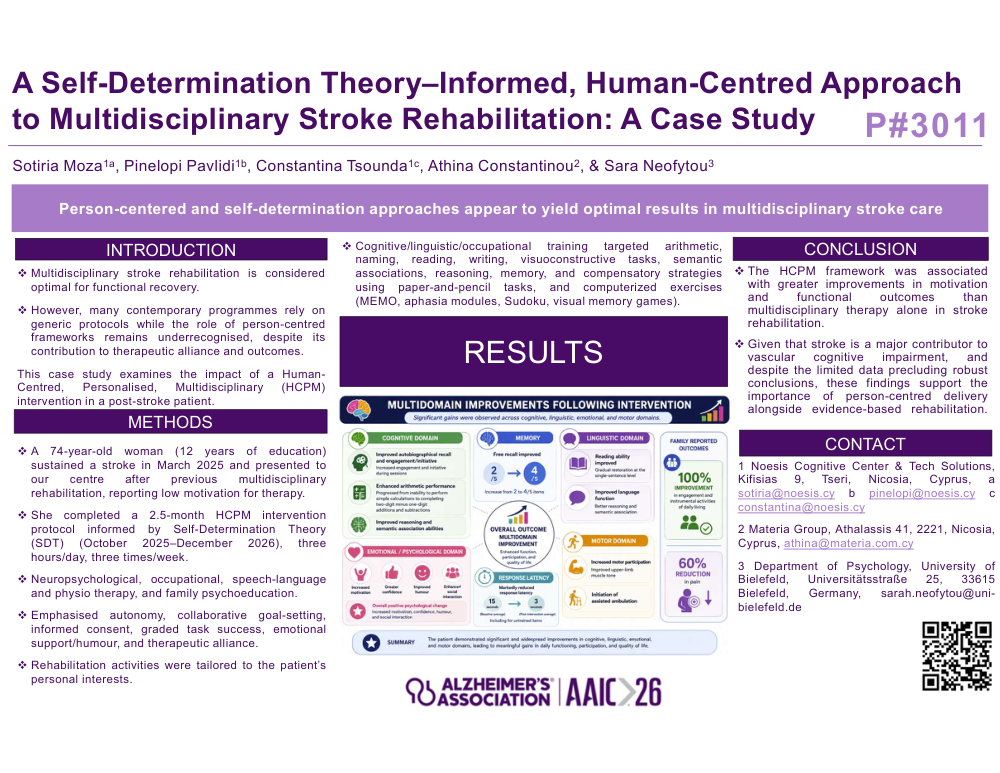
Improvements were observed across cognitive, linguistic, emotional, and motor domains. The patient showed increased engagement and initiative during sessions, improved autobiographical recall, and enhanced arithmetic performance, progressing from inability to perform simple calculations to completing two-digit minus one-digit additions and subtractions. Memory improved, with free recall increasing from 2 to 4/5 items. Response latency was markedly reduced from an average of 15 to 3 seconds, including for untrained items. Reading ability was gradually restored at the single-sentence level, and reasoning and semantic association abilities also improved. Motor participation increased, with improved upper-limb muscle tone and initiation of assisted ambulation. Psychologically, the patient demonstrated increased motivation, confidence, humour, and social interaction. Family reports indicated a 100% improvement in engagement and instrumental activities of daily living, as well as a 60% reduction in pain.
Conclusions:
In our study, the HCPM framework was associated with greater improvements in motivation and functional outcomes than multidisciplinary therapy alone in stroke rehabilitation. Given that stroke is a major contributor to vascular cognitive impairment, and despite the limited data precluding robust conclusions, these findings support the importance of person-centred delivery alongside evidence-based rehabilitation.
Comments
Email is required but is not shown publicly.
Loading comments...