4,068 posters, 219 videos, 101 topics, 69 sessions, 14,365 authors, 6,128 institutions
ePostersLive by SciGen Technologies S.A. All rights reserved.
Alzheimer's Association International Conference 2026
July 12-15, 2026 | London, United Kingdom, and Online

942
Proteomic Signatures Of Global Cognitive Trajectories And Incident Cognitive Impairment And Dementia
Poster Presenter
Authors
Minghao Kou, Alexis Wood, Jerome Rotter, Robert Gerszten, Mohamad Habes, Jose Luchsinger, Yongmei Liu, Timothy Hughes
Affiliations
Wake Forest University School of Medicine, Winston-Salem, NC, Baylor College of Medicine, Houston, TX, The Lundquist Institute for Biomedical Innovation at Harbor-UCLA Medical Center, Torrance, CA, Beth Israel Deaconess Medical Center, Harvard Medical School Teaching Hospital, Boston, MA, University of Texas Health Science Center, San Antonio, TX, Columbia University Irving Medical Center, New York, NY, Duke University School of Medicine, Durham, NC
Part of Topic
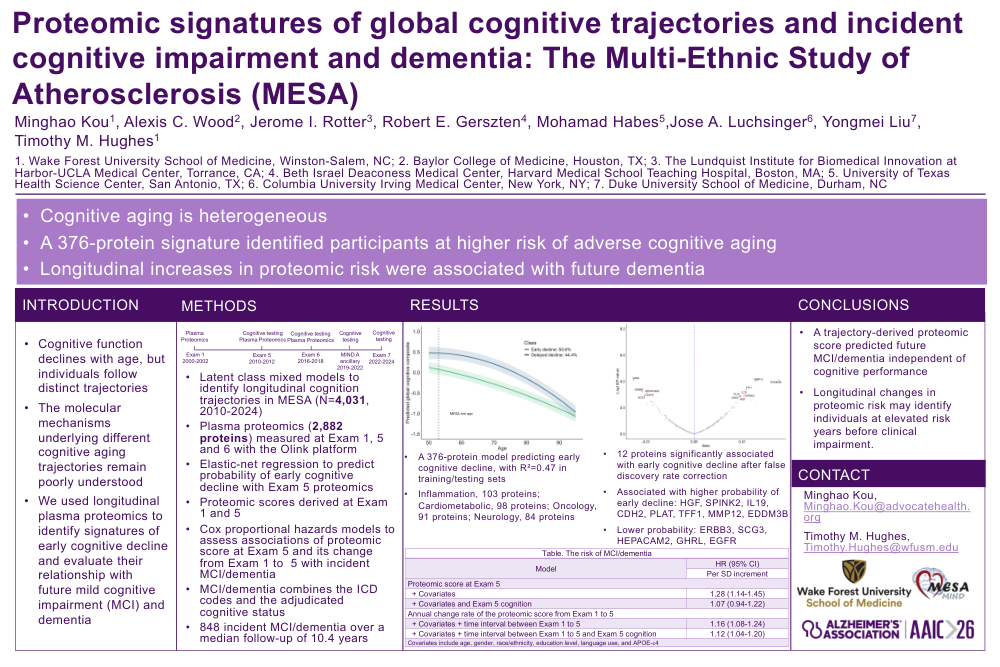
Background: Cognitive function declines with age at varying rates and patterns across individuals. Heterogeneous trajectories may reflect distinct molecular bases, which remain incompletely understood. We identified proteomic signatures of early cognitive decline and investigated their longitudinal associations with incident mild cognitive impairment (MCI) and dementia.
Method: Cognitive decline trajectories were identified using a 27-point cognitive scale from 1995 to 2022 in 37,761 participants (aged 50–95 years) from the Health and Retirement Study (HRS) and replicated using a longitudinal global cognitive composite (combining Cognitive Abilities Screening Instrument, Digit Symbol Coding, and Digit Span tests) from Exam 5 to 7 (2010–2024) in 4,031 participants (aged 53–105 years) from the Multi-Ethnic Study of Atherosclerosis (MESA), using latent class mixed models. An elastic net model using 2,882 plasma proteomic markers at MESA Exam 5 predicted the probability of early cognitive decline and generated a composite proteomic score. Associations of the Exam 5 proteomic score and its longitudinal change from Exam 1 to Exam 5 with incident MCI/dementia were assessed using multivariable adjusted Cox proportional hazards models.
Result: Four distinct cognitive decline trajectories were identified over aging in HRS, with two modest trajectories (delayed vs early decline) replicated in MESA. Using plasma proteomics at MESA Exam 5, an elastic-net model predicted the probability of early cognitive decline (R²=0.47 in both training and testing sets, 376 proteins). Seven proteins related to metabolic, neuroinflammatory, and stroke risk factors showed consistent associations with early decline probability across Exam 1 and Exam 5. A 376-protein composite score was associated with incident MCI/dementia after covariate adjustment, with attenuation after further adjustment for baseline cognitive performance. Importantly, the annual rate of increase in the proteomic score from Exam 1 to Exam 5 was significantly associated with higher risk of incident MCI/dementia independent of baseline cognition.
Conclusion: Plasma proteomic signatures distinguish heterogeneous cognitive aging trajectories and provide longitudinal indicators of future MCI/dementia risk. Changes in a trajectory-derived proteomic score predicted incident MCI/dementia independent of cognitive testing implicating changes in metabolic, neuroinflammatory, and stroke risk factors among individuals at high risk before clinical impairment.
Comments
Email is required but is not shown publicly.
Loading comments...