4,068 posters, 219 videos, 101 topics, 69 sessions, 14,365 authors, 6,128 institutions
ePostersLive by SciGen Technologies S.A. All rights reserved.
Alzheimer's Association International Conference 2026
July 12-15, 2026 | London, United Kingdom, and Online

2800
Occupational Therapy In Value-based Dementia Care
Poster Presenter
Authors
Part of Topic
Occupational Therapy In Value-based Dementia Care
#2800
Sydney Marshman, OTD, OTR/L, BCG
Happy at Home Consulting, Des Moines, Iowa, USA
Key Takeaway
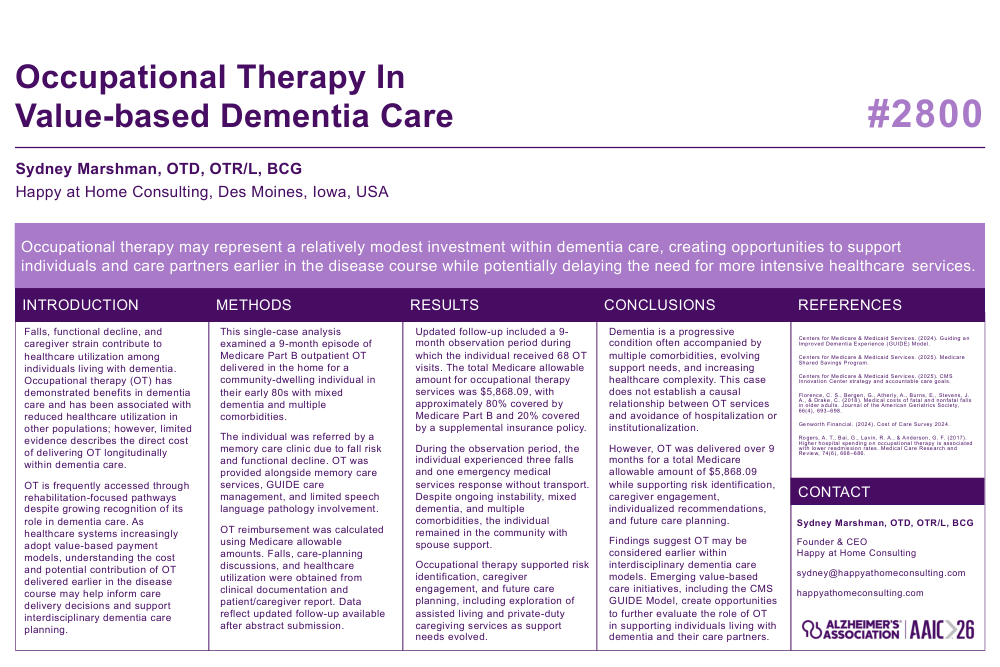
Occupational therapy may represent a relatively modest investment within dementia care, creating opportunities to support individuals and care partners earlier in the disease course while potentially delaying the need for more intensive healthcare services.
Introduction
Falls, functional decline, and caregiver strain contribute to healthcare utilization among individuals living with dementia. Occupational therapy (OT) has demonstrated benefits in dementia care and has been associated with reduced healthcare utilization in other populations; however, limited evidence describes the direct cost of delivering OT longitudinally within dementia care.
OT is frequently accessed through rehabilitation-focused pathways despite growing recognition of its role in dementia care. As healthcare systems increasingly adopt value-based payment models, understanding the cost and potential contribution of OT delivered earlier in the disease course may help inform care delivery decisions and support interdisciplinary dementia care planning.
Methods
This single-case analysis examined a 9-month episode of Medicare Part B outpatient OT delivered in the home for a community-dwelling individual in their early 80s with mixed dementia and multiple comorbidities.
The individual was referred by a memory care clinic due to fall risk and functional decline. OT was provided alongside memory care services, GUIDE care management, and limited speech language pathology involvement.
OT reimbursement was calculated using Medicare allowable amounts. Falls, care-planning discussions, and healthcare utilization were obtained from clinical documentation and patient/caregiver report. Data reflect updated follow-up available after abstract submission.
Results
Updated follow-up included a 9-month observation period during which the individual received 68 OT visits. The total Medicare allowable amount for occupational therapy services was $5,868.09, with approximately 80% covered by Medicare Part B and 20% covered by a supplemental insurance policy.
During the observation period, the individual experienced three falls and one emergency medical services response without transport. Despite ongoing instability, mixed dementia, and multiple comorbidities, the individual remained in the community with spouse support.
Occupational therapy supported risk identification, caregiver engagement, and future care planning, including exploration of assisted living and private-duty caregiving services as support needs evolved.
Conclusions
Dementia is a progressive condition often accompanied by multiple comorbidities, evolving support needs, and increasing healthcare complexity. This case does not establish a causal relationship between OT services and avoidance of hospitalization or institutionalization.
However, OT was delivered over 9 months for a total Medicare allowable amount of $5,868.09 while supporting risk identification, caregiver engagement, individualized recommendations, and future care planning.
Findings suggest OT may be considered earlier within interdisciplinary dementia care models. Emerging value-based care initiatives, including the CMS GUIDE Model, create opportunities to further evaluate the role of OT in supporting individuals living with dementia and their care partners.
References
Centers for Medicare & Medicaid Services. (2024). Guiding an Improved Dementia Experience (GUIDE) Model.
Centers for Medicare & Medicaid Services. (2026). Medicare Shared Savings Program.
Centers for Medicare & Medicaid Services. (2025). CMS Innovation Center strategy and accountable care goals.
Florence, C. S., Bergen, G., Atherly, A., Burns, E., Stevens, J., & Drake, C. (2018). Medical costs of fatal and nonfatal falls in older adults. Journal of the American Geriatrics Society, 66(4), 693–698.
Genworth Financial. (2024). Cost of Care Survey 2024.
Rogers, A. T., Bai, G., Lavin, R. A., & Anderson, G. F. (2017). Higher hospital spending on occupational therapy is associated with lower readmission rates. Medical Care Research and Review, 74(6), 668–686.
Contact
Sydney Marshman, OTD, OTR/L, BCG
Founder & CEO
Happy at Home Consulting
sydney@happyathomeconsulting.com
happyathomeconsulting.com
Comments
Email is required but is not shown publicly.
Loading comments...