4,068 posters, 219 videos, 101 topics, 69 sessions, 14,365 authors, 6,128 institutions
ePostersLive by SciGen Technologies S.A. All rights reserved.
Alzheimer's Association International Conference 2026
July 12-15, 2026 | London, United Kingdom, and Online

7431
Neuropsychiatric Symptoms In An Australian Mild Cognitive Impairment Cohort
Poster Presenter
Authors
Matthew Shrimpton, Kai Sin Chin, Kim Fendel, Laura Gilbertson, Jenny Jia Yu, Leonid Churilov, Dina LoGiudice, Nawaf Yassi, Rosie Watson
Affiliations
Departments of Medicine and Neurology, Melbourne Brain Centre @ The Royal Melbourne Hospital, Department of Medicine, University of Melbourne, Parkville, VIC, 3050, Australia, Department of Aged Care, Royal Melbourne Hospital, Parkville, VIC, 3050, Australia
Part of Topic
Video
Background
Mild cognitive impairment (MCI) encompasses a heterogeneous clinical presentation with variable risk of progression to dementia. Neuropsychiatric symptoms frequently accompany MCI and are recognised as early markers of neurodegenerative disease, however their distribution across MCI subgroups is poorly characterised. We aimed to describe the demographic, clinical and neuropsychiatric symptom profile in amnestic (aMCI) and non-amnestic (nMCI) MCI.
Methods
A descriptive single centre cohort study was conducted within the Royal Melbourne Hospital Cognitive Dementia and Memory Service clinic. Clinicodemographic and medical data were extracted from the electronic medical record on consecutive patients with MCI who attended the clinic between 2016 and 2019. As part of the clinic’s routine workflow, neuropsychiatric symptoms were assessed using the Neuropsychiatric Inventory. Clinical diagnosis was based on multidisciplinary clinical assessment, supported by standard-of-care ancillary investigations.
Results
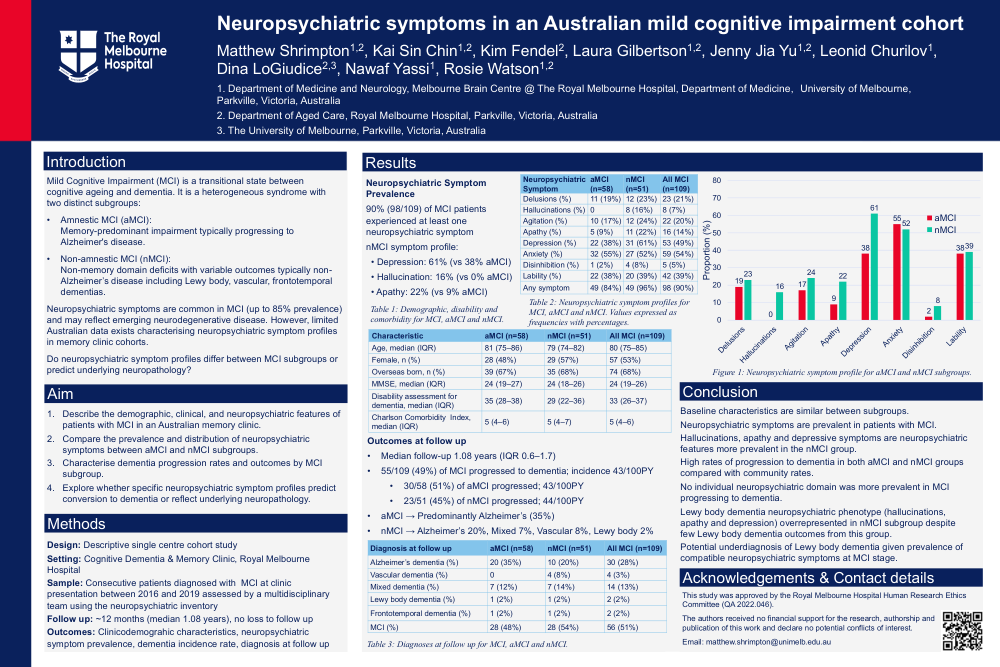
A total of 109 patients with MCI were included with a median [IQR] age 80 years [75-85], 53% female. Median (IQR) baseline MMSE was 24 (19-26). The majority (61%) were living at home with family and 68% were born outside of Australia, in keeping with the clinic’s typical catchment. Ninety-eight (90%) of all patients experienced at least one neuropsychiatric symptom, with the commonest domains being anxiety (54%), depression (49%) and emotional lability (39%).
Fifty eight (53%) of patients were classified as aMCI compared to 51 (47%) with nMCI. Patients with nMCI were more likely to experience depression (61% vs 38%), hallucinations (16% vs 0%) and apathy (22% vs 9%). Other neuropsychiatric symptoms were more equally distributed between groups.
Conclusions
Distinct neuropsychiatric profiles are evident across MCI subgroups with depression, hallucination and apathy more common in nMCI suggesting a potential association with non-Alzheimer’s pathology. Future work will evaluate the association between neuropsychiatric symptoms and progression to dementia. Incorporating such assessments into routine care may assist in discriminating MCI subgroups to better inform prognosis and disease modifying treatment eligibility.
Comments
Email is required but is not shown publicly.
Loading comments...