4,068 posters, 219 videos, 101 topics, 69 sessions, 14,365 authors, 6,128 institutions
ePostersLive by SciGen Technologies S.A. All rights reserved.
Alzheimer's Association International Conference 2026
July 12-15, 2026 | London, United Kingdom, and Online

1681
Compare Of Sleep Characteristics In Alzheimer's Dementia And Parkinson's Disease Dementia
Poster Presenter
Part of Topic
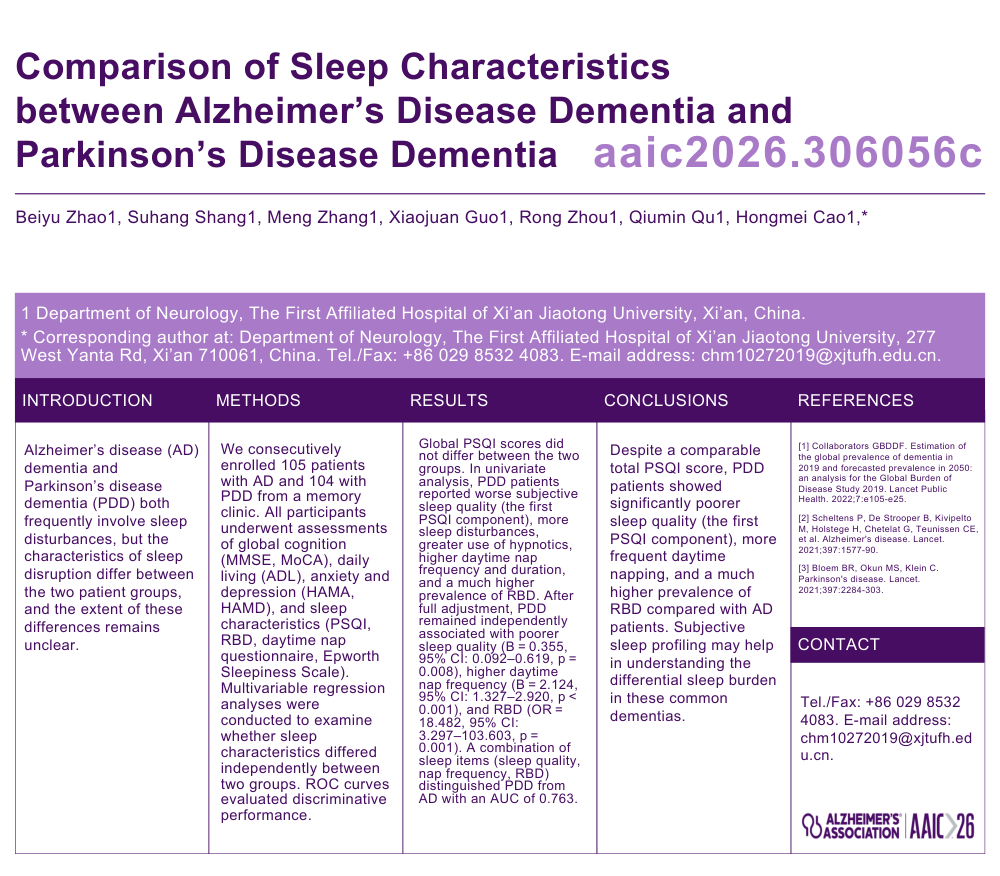
Comparison of Sleep Characteristics between Alzheimer’s Disease Dementia and Parkinson’s Disease Dementia
Introduction: Alzheimer’s disease (AD) dementia and Parkinson’s disease dementia (PDD) both frequently involve sleep disturbances, but the characteristics of sleep disruption differ between the two patient groups, and the extent of these differences remains unclear.
Methods: We consecutively enrolled 105 patients with AD and 104 with PDD from a memory clinic. All participants underwent assessments of global cognition (MMSE, MoCA), daily living (ADL), anxiety and depression (HAMA, HAMD), and sleep characteristics (PSQI, RBD, daytime nap questionnaire, Epworth Sleepiness Scale). Multivariable regression analyses were conducted to examine whether sleep characteristics differed independently between two groups. ROC curves evaluated discriminative performance.
Results: Global PSQI scores did not differ between the two groups. In univariate analysis, PDD patients reported worse subjective sleep quality (the first PSQI component), more sleep disturbances, greater use of hypnotics, higher daytime nap frequency and duration, and a much higher prevalence of RBD. After full adjustment, PDD remained independently associated with poorer sleep quality (B = 0.355, 95% CI: 0.092–0.619, p = 0.008), higher daytime nap frequency (B = 2.124, 95% CI: 1.327–2.920, p < 0.001), and RBD (OR = 18.482, 95% CI: 3.297–103.603, p = 0.001). A combination of sleep items (sleep quality, nap frequency, RBD) distinguished PDD from AD with an AUC of 0.763.
Conclusion: Despite a comparable total PSQI score, PDD patients showed significantly poorer sleep quality (the first PSQI component), more frequent daytime napping, and a much higher prevalence of RBD compared with AD patients. Subjective sleep profiling may help in understanding the differential sleep burden in these common dementias.
Comments
Email is required but is not shown publicly.
Loading comments...