4,068 posters, 219 videos, 101 topics, 69 sessions, 14,365 authors, 6,128 institutions
ePostersLive by SciGen Technologies S.A. All rights reserved.
Alzheimer's Association International Conference 2026
July 12-15, 2026 | London, United Kingdom, and Online

1589
Exploring Early Neuropsychological And Behavioral Alterations In Young Former Rugby Players: A Study Protocol
Poster Presenter
Authors
Camila Roldán Olivera, Waleska Berrios, María Cecilia Fernández
Affiliations
Part of Topic
Exploring Early Neuropsychological And Behavioral Alterations In Young Former Rugby Players: A Study Protocol
Author: Camila Roldan Olivera, Waleska Berrios, Maria Cecilia Fernandez.
Neurology, Hospital Italiano de Buenos Aires, Buenos Aires, Argentina.
Abstract:
Background: Chronic traumatic encephalopathy (CTE) is a neurodegenerative disease associated with repetitive traumatic brain injuries (TBI), with increasing evidence in contact-sport athletes. In rugby, prolonged early exposure has been linked to cognitive and behavioral alterations and increased CTE risk. However, most studies have focused on older or long-retired professional athletes, leaving it unclear whether early cognitive or behavioral signs can be detected in younger individuals. This study aims to compare the neuropsychological and behavioral profiles of young former rugby players with a non-contact sport control group to explore subtle differences that may reflect early indicators of decline.
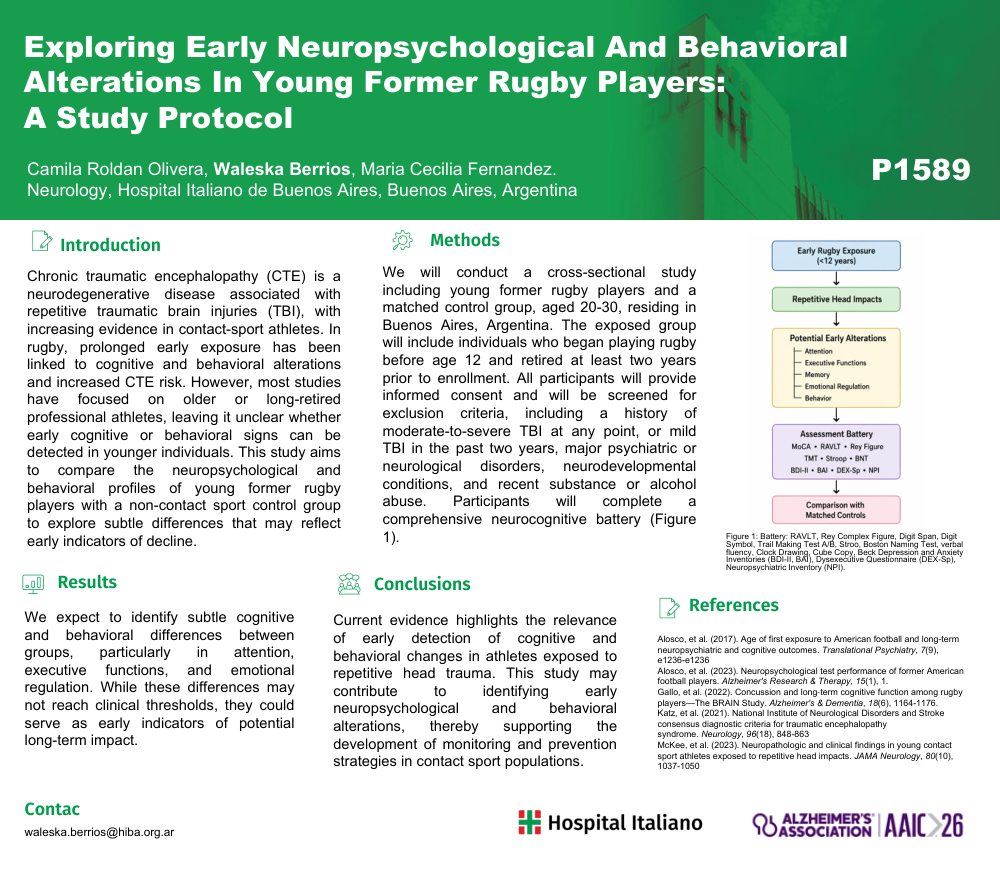
Methods: We will conduct a cross-sectional study including young former rugby players and a matched control group, aged 20-30, residing in Buenos Aires, Argentina. The exposed group will include individuals who began playing rugby before age 12 and retired at least two years prior to enrollment. All participants will provide informed consent and will be screened for exclusion criteria, including a history of moderate-to-severe TBI at any point, or mild TBI in the past two years, major psychiatric or neurological disorders, neurodevelopmental conditions, and recent substance or alcohol abuse. Participants will complete a comprehensive neurocognitive battery assessing global cognition (MoCA), verbal and visual memory (RAVLT, Rey Complex Figure), attention and executive functions (Digit Span, Digit Symbol, Trail Making Test A/B, Stroop), language (Boston Naming Test, verbal fluency), and visuospatial abilities (Clock Drawing, Cube Copy). Emotional and behavioral symptoms will be assessed using the Beck Depression and Anxiety Inventories (BDI-II, BAI), the Dysexecutive Questionnaire (DEX-Sp), and the Neuropsychiatric Inventory (NPI, via informant report).
Results: We expect to identify subtle cognitive and behavioral differences between groups, particularly in attention, executive functions, and emotional regulation. While these differences may not reach clinical thresholds, they could serve as early indicators of potential long-term impact.
Conclusion: Current evidence highlights the relevance of early detection of cognitive and behavioral changes in athletes exposed to repetitive head trauma. This study may contribute to identifying early neuropsychological and behavioral alterations, thereby supporting the development of monitoring and prevention strategies in contact sport populations.
Comments
Email is required but is not shown publicly.
Loading comments...