4,068 posters, 219 videos, 101 topics, 69 sessions, 14,365 authors, 6,128 institutions
ePostersLive by SciGen Technologies S.A. All rights reserved.
Alzheimer's Association International Conference 2026
July 12-15, 2026 | London, United Kingdom, and Online

8921
Exploring Semantic Network Breakdown In Bengali Speaking Persons With Mild Cognitive Impairment And Alzheimer's Clinical Syndrome
Poster Presenter
Authors
Arpita Roy Choudhury, Dr. Akash Kumar Mahato, Soham Korade, Soham Saha, Dr. S. Bapi Raju, Dr. Amitabha Ghosh
Affiliations
Amity University and Apollo Multispecialty Hospital, Kolkata, Amity University, Kolkata, International Institute of Information Technology (IIIT), Hyderabad, Apollo Multispecialty Hospital, Kolkata
Part of Topic
Exploring Semantic Network Breakdown in Bengali Speaking Persons with Mild Cognitive Impairment and Alzheimer's Clinical Syndrome
Arpita Roy Choudhury, Dr. Akash Kumar Mahato, Soham Korade, Soham Saha, Dr. S. Bapi Raju, Dr. Amitabha Ghosh
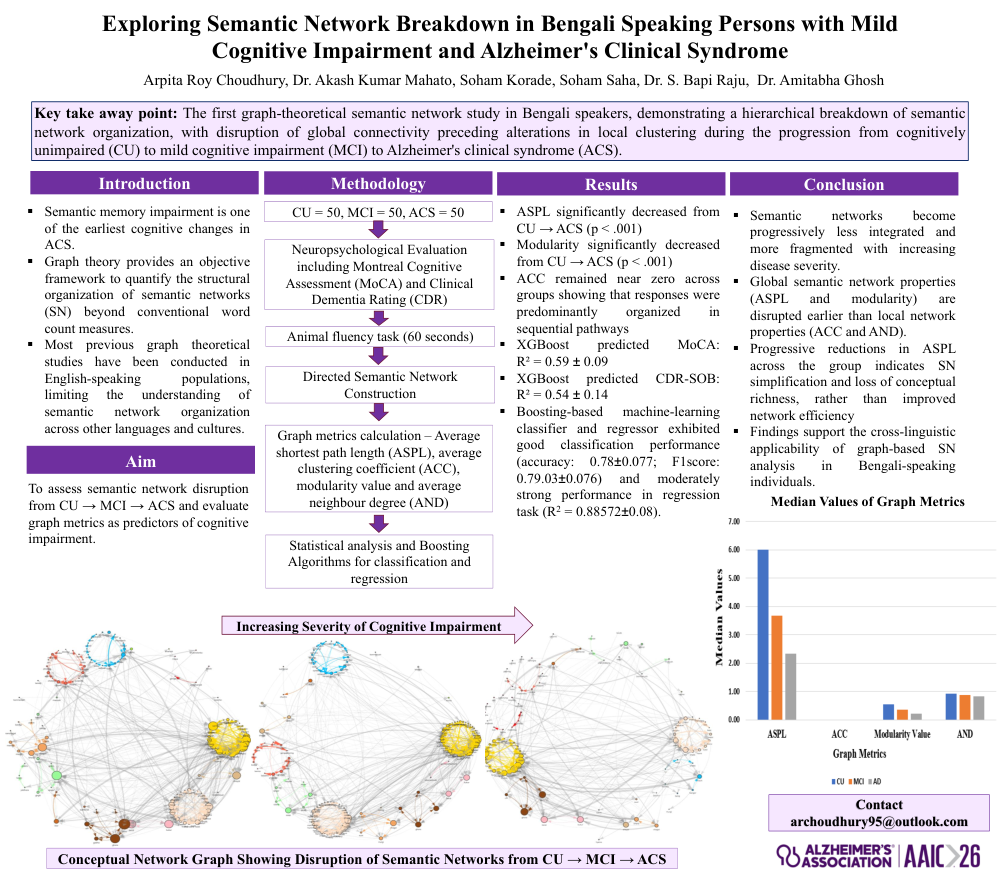
Key take away point: The first graph-theoretical semantic network study in Bengali speakers, demonstrating a hierarchical breakdown of semantic network organization, with disruption of global connectivity preceding alterations in local clustering during the progression from cognitively unimpaired (CU) to mild cognitive impairment (MCI) to Alzheimer's clinical syndrome (ACS).
Introduction: Semantic memory impairment is one of the earliest cognitive changes in ACS.Graph theory provides an objective framework to quantify the structural organization of semantic networks (SN) beyond conventional word count measures.Most previous graph theoretical studies have been conducted in English-speaking populations, limiting the understanding of semantic network organization across other languages and cultures.
Aim: To assess semantic network disruption from CU → MCI → ACS and evaluate graph metrics as predictors of cognitive impairment.
Methodology: CU = 50, MCI = 50, ACS = 50 -> Neuropsychological Evaluation including Montreal Cognitive Assessment (MoCA) and Clinical Dementia Rating (CDR) -> Animal fluency task (60 seconds) -> Directed Semantic Network Construction -> Graph metrics calculation – Average shortest path length (ASPL), average clustering coefficient (ACC), modularity value and average neighbour degree (AND) -> Statistical analysis and Boosting Algorithms for classification and regression.
Results: ASPL significantly decreased from CU → ACS (p < .001). Modularity significantly decreased from CU → ACS (p < .001). ACC remained near zero across groups showing that responses were predominantly organized in sequential pathways. XGBoost predicted MoCA: R² = 0.59 ± 0.09. XGBoost predicted CDR-SOB: R² = 0.54 ± 0.14. Boosting-based machine-learning classifier and regressor exhibited good classification performance (accuracy: 0.78±0.077; F1score: 0.79.03±0.076) and moderately strong performance in regression task (R2 = 0.88572±0.08).
Conclusion: Semantic networks become progressively less integrated and more fragmented with increasing disease severity. Global semantic network properties (ASPL and modularity) are disrupted earlier than local network properties (ACC and AND). Progressive reductions in ASPL across the group indicates SN simplification and loss of conceptual richness, rather than improved network efficiency. Findings support the cross-linguistic applicability of graph-based SN analysis in Bengali-speaking individuals.
Comments
Email is required but is not shown publicly.
Loading comments...