4,068 posters, 219 videos, 101 topics, 69 sessions, 14,365 authors, 6,128 institutions
ePostersLive by SciGen Technologies S.A. All rights reserved.
Alzheimer's Association International Conference 2026
July 12-15, 2026 | London, United Kingdom, and Online

1553
Interval Timing As A Potential Early Behavioral Marker Of Mild Cognitive Impairment: A Study Protocol
Poster Presenter
Part of Topic
Interval Timing As A Potential Early Behavioral Marker Of Mild Cognitive Impairment: A Study Protocol
Author: Waleska Berrios1, Maria Cecilia Fernandez1, Marcos Vallati1, Agustin Perez1, Facundo Escandon1, Alice Baez1, Emilia Gatto2, Nicolás Chocobar2, Beatriz Crotti2, Patricia Agostino3,4.
1Neurology, Hospital Italiano de Buenos Aires, Buenos Aires, Argentina, 2Neurology, Sanatorio Trinidad Mitre, Buenos Aires, Argentina, 3Universidad Nacional de Quilmes, Buenos Aires, Argentina, 4CONICET, Buenos Aires, Argentina.
Abstract:
Background: Time perception, particularly interval timing (IT) - the ability to estimate short durations in the seconds-to-minutes range, is closely linked to core cognitive functions including attention, memory, and executive control. Although alterations in IT accuracy and precision have been consistently reported in patients with Alzheimer's disease, findings in mild cognitive impairment (MCI) populations remains limited and inconclusive. This study aims to compare IT accuracy and precision in older adults with MCI and cognitively normal controls using a visual reproduction task.
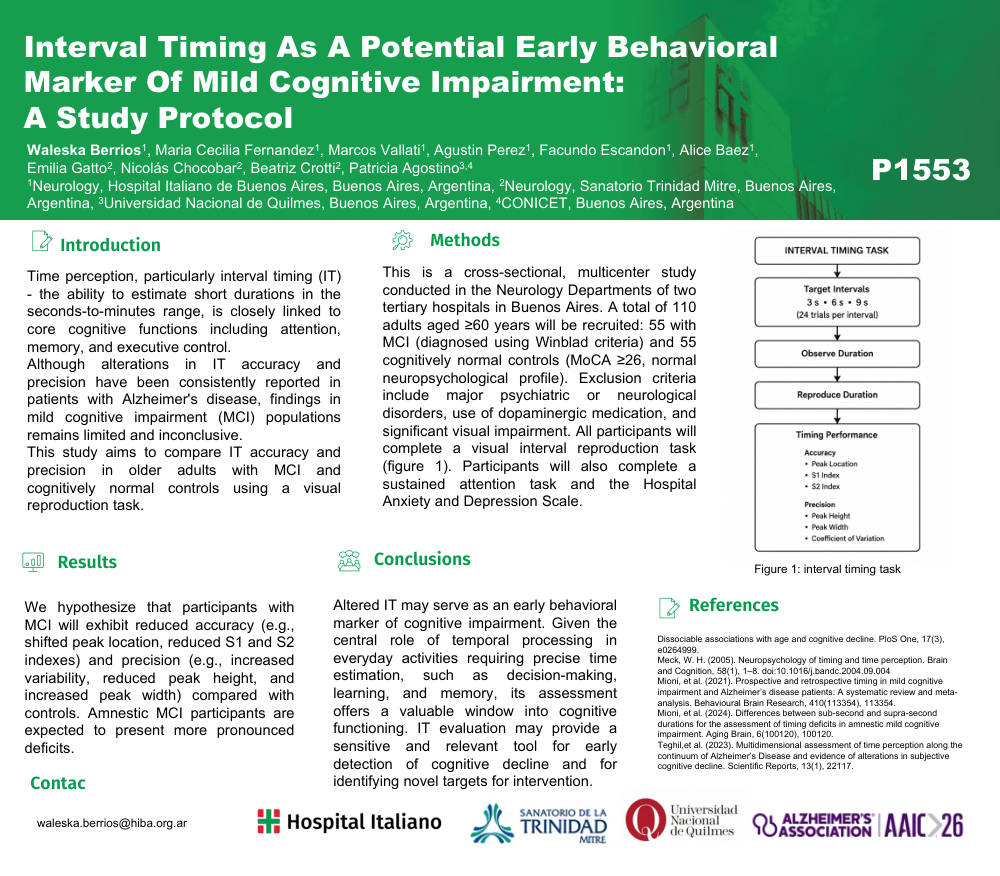
Methods: This is a cross-sectional, multicenter study conducted in the Neurology Departments of two tertiary hospitals in Buenos Aires. A total of 110 adults aged ≥60 years will be recruited: 55 with MCI (diagnosed using Winblad criteria) and 55 cognitively normal controls (MoCA ≥26, normal neuropsychological profile). Exclusion criteria include major psychiatric or neurological disorders, use of dopaminergic medication, and significant visual impairment. All participants will complete a visual interval reproduction task involving the reproduction of stimulus durations of 3, 6, and 9 seconds across 24 trials per interval. Key performance parameters such as peak location, peak height (amplitude), peak width, S1 and S2 rate indexes, and coefficient of variation will be derived from Gaussian model fits. Participants will also complete a sustained attention task and the Hospital Anxiety and Depression Scale (HADS). Between-group comparisons and correlational analyses will be conducted using mixed-model ANOVA and appropriate post-hoc tests.
Results: We hypothesize that participants with MCI will exhibit reduced accuracy (e.g., shifted peak location, reduced S1 and S2 indexes) and precision (e.g., increased variability, reduced peak height, and increased peak width) compared with controls. Amnestic MCI participants are expected to present more pronounced deficits.
Conclusion: Altered IT may serve as an early behavioral marker of cognitive impairment. Given the central role of temporal processing in everyday activities requiring precise time estimation, such as decision-making, learning, and memory, its assessment offers a valuable window into cognitive functioning. IT evaluation may provide a sensitive and relevant tool for early detection of cognitive decline and for identifying novel targets for intervention.
Comments
Email is required but is not shown publicly.
Loading comments...