4,068 posters, 219 videos, 101 topics, 69 sessions, 14,365 authors, 6,128 institutions
ePostersLive by SciGen Technologies S.A. All rights reserved.
Alzheimer's Association International Conference 2026
July 12-15, 2026 | London, United Kingdom, and Online

9451
Cerebral Small Vessel Disease Is Associated With Neuropsychiatric Vulnerability In Dementia With Lewy Bodies
Poster Presenter
Authors
Part of Topic
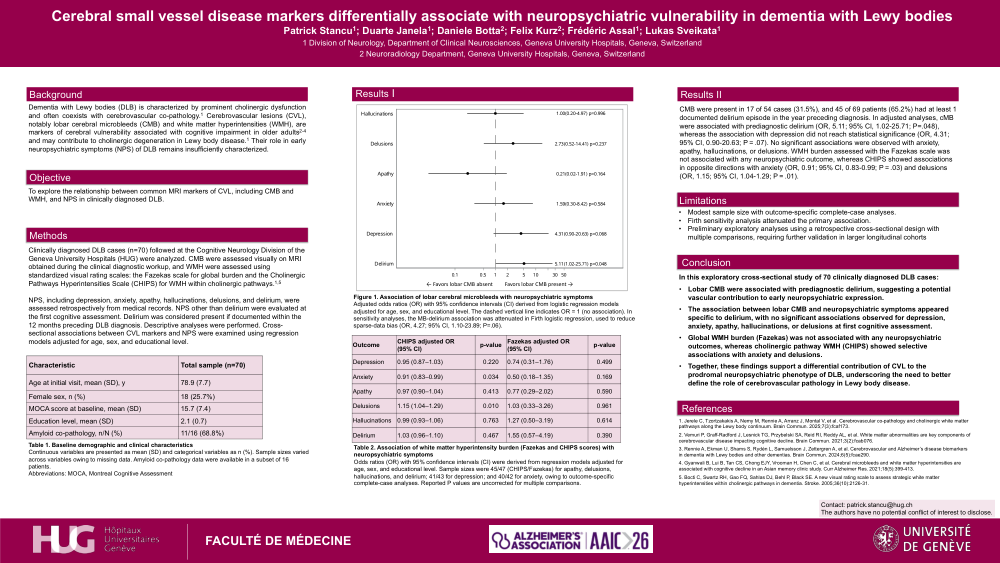
Cerebral small vessel disease markers differentially associate with neuropsychiatric vulnerability in dementia with Lewy bodies
Background
Dementia with Lewy bodies (DLB) is characterized by prominent cholinergic dysfunction and often coexists with cerebrovascular co-pathology.1 Cerebrovascular lesions (CVL), notably lobar cerebral microbleeds (CMB) and white matter hyperintensities (WMH), are markers of cerebral vulnerability associated with cognitive impairment in older adults2-4 and may contribute to cholinergic degeneration in Lewy body disease.1 Their role in early neuropsychiatric symptoms (NPS) of DLB remains insufficiently characterized.
Objective
To explore the relationship between common MRI markers of CVL, including CMB and WMH, and NPS in clinically diagnosed DLB.
Methods
Clinically diagnosed DLB cases (n=70) followed at the Cognitive Neurology Division of the Geneva University Hospitals (HUG) were analyzed. CMB were assessed visually on MRI obtained during the clinical diagnostic workup, and WMH were assessed using standardized visual rating scales: the Fazekas scale for global burden and the Cholinergic Pathways Hyperintensities Scale (CHIPS) for WMH within cholinergic pathways.1,5
NPS, including depression, anxiety, apathy, hallucinations, delusions, and delirium, were assessed retrospectively from medical records. NPS other than delirium were evaluated at the first cognitive assessment. Delirium was considered present if documented within the 12 months preceding DLB diagnosis. Descriptive analyses were performed. Cross-sectional associations between CVL markers and NPS were examined using regression models adjusted for age, sex, and educational level.
Results
CMB were present in 17 of 54 cases (31.5%), and 45 of 69 patients (65.2%) had at least 1 documented delirium episode in the year preceding diagnosis. In adjusted analyses, cMB were associated with prediagnostic delirium (OR, 5.11; 95% CI, 1.02-25.71; P=.048), whereas the association with depression did not reach statistical significance (OR, 4.31; 95% CI, 0.90-20.63; P = .07). No significant associations were observed with anxiety, apathy, hallucinations, or delusions. WMH burden assessed with the Fazekas scale was not associated with any neuropsychiatric outcome, whereas CHIPS showed associations in opposite directions with anxiety (OR, 0.91; 95% CI, 0.83-0.99; P = .03) and delusions (OR, 1.15; 95% CI, 1.04-1.29; P = .01).
Conclusions
In this exploratory cross-sectional study of 70 clinically diagnosed DLB cases:
Comments
Email is required but is not shown publicly.
Loading comments...