4,068 posters, 219 videos, 101 topics, 69 sessions, 14,365 authors, 6,128 institutions
ePostersLive by SciGen Technologies S.A. All rights reserved.
Alzheimer's Association International Conference 2026
July 12-15, 2026 | London, United Kingdom, and Online

6158
Plasma Neurofilament Light Chain Is Associated With Decreased Motivation In Mild Cognitive Impairment
Poster Presenter
Authors
Lucas Barnes, Brenda Gonçalves, Marjorie Silva, Italo Aventurato, Isadora Ribeiro, Liara Rizzi, Luis Santos, Ananssa Silva, Thais Pinheiro, Fernanda De Felice, Marcio Balthazar
Affiliations
Laboratory of Imaging and Biomarkers in Cognitive Disorders, UNICAMP, Brazil, Laboratory of Imaging and Biomarkers in Cognitive Disorders, UNICAMP, Brazil; Department of Neurology, UNICAMP, Brazil, Laboratory of Imaging and Biomarkers in Cognitive Disorders, UNICAMP, Brazil; Department of Neurology, UNICAMP, Brazil; Mayo Clinic Florida, USA, IDOR, Brazil, IDOR, Brazil; UFRJ, Brazil; Centre for Neuroscience Studies, Queen's University, Canada; Department of Psychiatry, Queen's University, Canada
Part of Topic
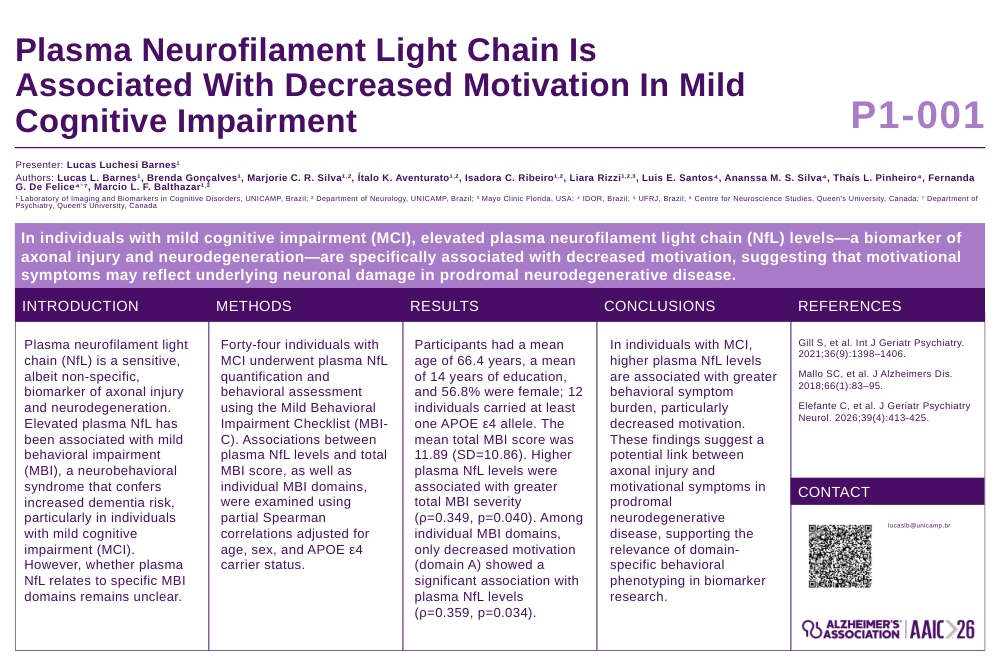
Background: Plasma neurofilament light chain (NfL) is a sensitive, albeit non-specific, biomarker of axonal injury and neurodegeneration. Elevated plasma NfL has been associated with mild behavioral impairment (MBI), a neurobehavioral syndrome that confers increased dementia risk, particularly in individuals with mild cognitive impairment (MCI). However, whether plasma NfL relates to specific MBI domains remains unclear.
Methods: Forty-four individuals with MCI underwent plasma NfL quantification and behavioral assessment using the Mild Behavioral Impairment Checklist (MBI-C). Associations between plasma NfL levels and total MBI score, as well as individual MBI domains, were examined using partial Spearman correlations adjusted for age, sex, and APOE ε4 carrier status.
Results: Participants had a mean age of 66.4 years, a mean of 14 years of education, and 56.8% were female; 12 individuals carried at least one APOE ε4 allele. The mean total MBI score was 11.89 (SD=10.86). Higher plasma NfL levels were associated with greater total MBI severity (ρ=0.349, p=0.040). Among individual MBI domains, only decreased motivation (domain A) showed a significant association with plasma NfL levels (ρ=0.359, p=0.034).
Conclusion: In individuals with MCI, higher plasma NfL levels are associated with greater behavioral symptom burden, particularly decreased motivation. These findings suggest a potential link between axonal injury and motivational symptoms in prodromal neurodegenerative disease, supporting the relevance of domain-specific behavioral phenotyping in biomarker research.
Comments
Email is required but is not shown publicly.
Loading comments...