4,068 posters, 219 videos, 101 topics, 69 sessions, 14,365 authors, 6,128 institutions
ePostersLive by SciGen Technologies S.A. All rights reserved.
Alzheimer's Association International Conference 2026
July 12-15, 2026 | London, United Kingdom, and Online

2417
Clinical Validation Of Plasma P-217tau In Neurological Diseases
Poster Presenter
Authors
Part of Topic
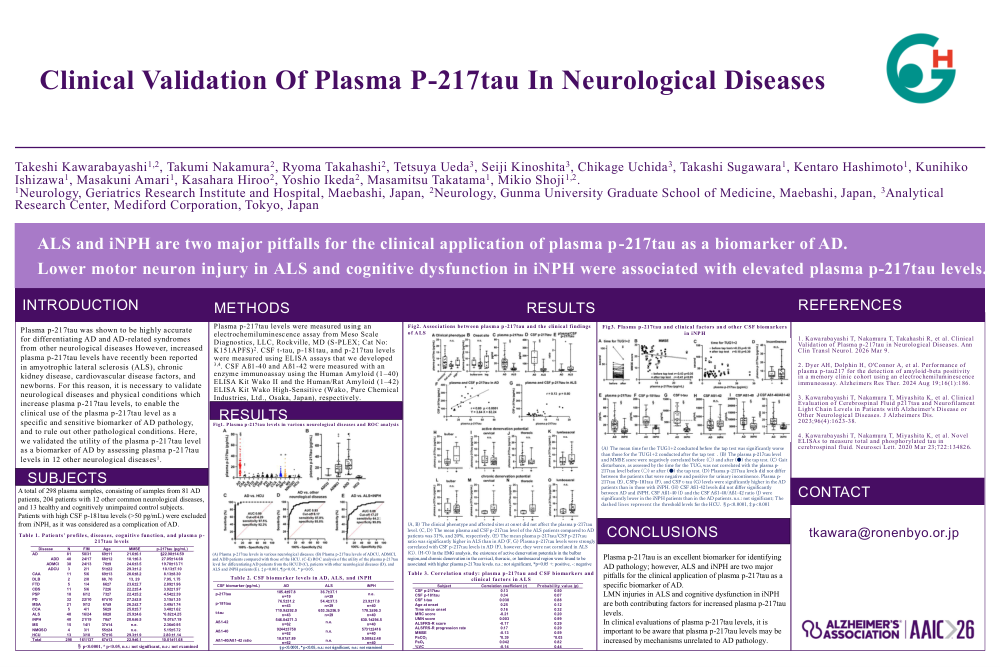
Introduction: Plasma p-217tau was shown to be highly accurate for differentiating AD and AD-related syndromes from other neurological diseases. However, increased plasma p-217tau levels have recently been reported in amyotrophic lateral sclerosis (ALS), chronic kidney disease, cardiovascular disease factors, and newborns. For this reason, it is necessary to validate neurological diseases and physical conditions which increase plasma p-217tau levels, to enable the clinical use of the plasma p-217tau level as a specific and sensitive biomarker of AD pathology, and to rule out other pathological conditions.
Purpose: We validated the utility of the plasma p-217tau level as a biomarker of AD by assessing plasma p-217tau levels in 12 other neurological diseases.
Sbjects: A total of 298 plasma samples, consisting of samples from 81 AD patients, 204 patients with 12 other common neurological diseases, and 13 healthy and cognitively unimpaired control subjects (HCU), were examined. Patients with high CSF p-181tau levels (>50 pg/mL) were excluded from iNPH, as it was considered as a complication of AD.
Mthods: Plasma p-217tau levels were measured using an electrochemiluminescence assay from Meso Scale Diagnostics, LLC, Rockville, MD (S-PLEX; Cat No: K151APFS). Cerebrospinal fluid (CSF) tau and Aß levels were simultaneously evaluated in AD, amyotrophic lateral sclerosis (ALS), and idiopathic normal pressure hydrocephalus (iNPH).CSF t-tau, p-181tau, and p-217tau levels were measured using ELISA assays that we developed 24. CSF Aß1-40 and Aß1-42 were measured with an enzyme immunoassay using the Human Amyloid (1–40) ELISA Kit Wako II and the Human/Rat Amyloid (1–42) ELISA Kit Wako High-Sensitive (Wako, Pure Chemical Industries, Ltd., Osaka, Japan), respectively.
Results: Plasma p-217tau levels increased in AD with the clinical stage, but also in ALS and iNPH, leading to them having decreased sensitivity and specificity for diagnosing AD. No increases in plasma p-217tau levels were seen in possible tauopathies or synucleinopathies. CSF and plasma p-217tau levels were strongly correlated in AD, but not in ALS. The plasma p-217tau/CSF p-217tau ratio was inversely higher in ALS than in AD. Active and chronic denervation potentials were associated with plasma p-217tau levels. In iNPH, plasma p-217tau was associated with cognitive dysfunction, but not with gait disturbance or urinary incontinence. CSF p-181tau, total tau, and Aß1-40 levels, and the Aß1-40/1-42 ratio were reduced in iNPH.
Conclusion: ALS and idiopathic normal pressure hydrocephalus (iNPH) are two major pitfalls for the clinical application of plasma p-217tau as a biomarker of AD. Lower motor neuron injury in ALS and cognitive dysfunction in iNPH were both found to be associated with elevated plasma p-217tau levels.
Comments
Email is required but is not shown publicly.
Loading comments...