4,068 posters, 219 videos, 101 topics, 69 sessions, 14,365 authors, 6,128 institutions
ePostersLive by SciGen Technologies S.A. All rights reserved.
Alzheimer's Association International Conference 2026
July 12-15, 2026 | London, United Kingdom, and Online

7401
Longitudinal Alzheimer’s Blood Biomarkers And Trajectories In A Cognitively Healthy APOE E4 Cohort
Poster Presenter
Authors
Billy Evans, Meredith Wicklund, Blake Langlais, Bryan Woodruff, Richard Caselli
Affiliations
null,
Part of Topic
Longitudinal Alzheimer’s Blood Biomarkers and Trajectories in a Cognitively Healthy APOE ε4 Cohort
Billy Evans, M.D.1; Meredith Wicklund, M.D.1; Blake Langlais, MS2; Bryan Woodruff, M.D.1; Richard Caselli, M.D.1
1Department of Neurology, Mayo Clinic Arizona, 2Division of Clinical Trials and Biostatistics, Mayo Clinic Arizona
Background: Alzheimer’s Disease (AD) is a neurodegenerative process characterized by deposition of Amyloid-Beta (Aβ) plaques and neurofibrillary tangles of hyperphosphorylated tau proteins. People who are carriers of the APOE ε4 allele have been shown to be at an increased risk of memory decline and development of Alzheimer’s Disease (AD).1 Diagnosis of AD has primarily been based on clinical presentation and neuropsychiatric testing, with the latter having been shown to be quite effective in monitoring for cognitive impairment.2,3 Confirmatory testing historically has been confined to either Cerebrospinal Fluid (CSF) biomarker studies or imaging modalities such as Positron Emission Tomography [PET] scans assessing amyloid plaque burden. Recentefforts are focused on evaluating blood based biomarkers as an alternative diagnostic measure.
Objectives: To compare the variance of different blood based biomarkers longitudinally amongst an APOE ε4 genetically enriched population who are neuropsychologically healthy at enrollment who convert to a diagnosis of AD versus those who do not convert.
Methods: We performed a prospective longitudinal study of an APOE ε4 genetically enriched population without cognitive impairment at time of enrollment. Neuropsychological testing and functional status were followed every 2 years with blood based Alzheimer’s biomarkers obtained within 2 weeks of study visits, including Amyloid Beta 40 (Aβ40), Amyloid Beta 42 (Aβ42), Amyloid Beta 42/40 ratio (Aβ42/40), phosphorylated tau 217 (p-Tau217), Glial Fibrillary Acidic Protein (GFAP), and the logarithmic transformation of Neurofilament Light (NFL). Determination of transition from normal cognition to Mild Cognitive Impairment (MCI) or AD was based on clinical evaluation, neuropsychological assessments and functional status.
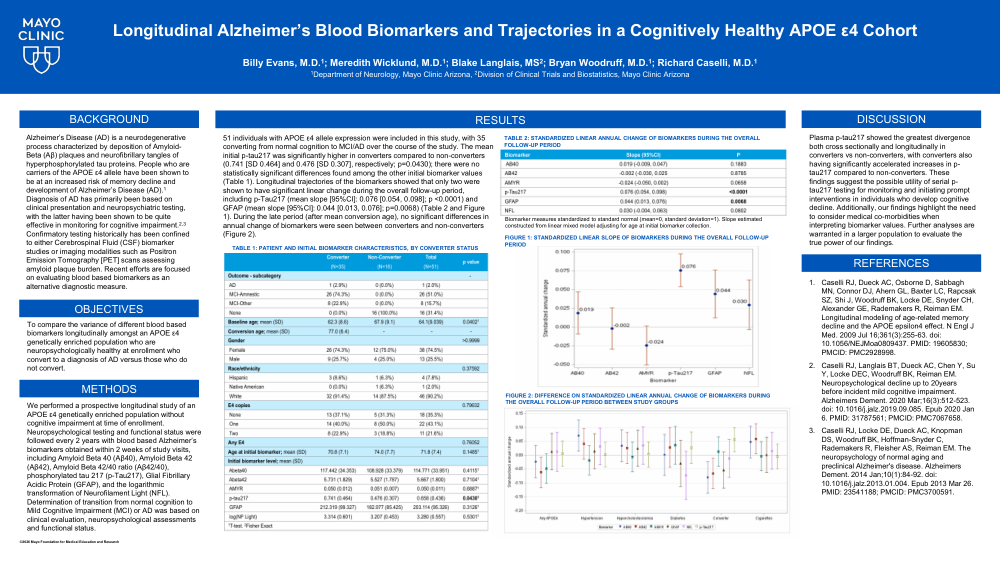
Results: 51 individuals with APOE ε4 allele expression were included in this study, with 35 converting from normal cognition to MCI/AD over the course of the study. The mean initial p-tau217 was significantly higher in converters compared to non-converters (0.741 [SD 0.464] and 0.476 [SD 0.307], respectively; p=0.0430); there were no statistically significant differences found among the other initial biomarker values (Table 1). Longitudinal trajectories of the biomarkers showed that only two were shown to have significant linear change during the overall follow-up period, including p-Tau217 (mean slope [95%CI]: 0.076 [0.054, 0.098]; p <0.0001) and GFAP (mean slope [95%CI]: 0.044 [0.013, 0.076]; p=0.0068) (Table 2 and Figure 1). During the late period (after mean conversion age), no significant differences in annual change of biomarkers were seen between converters and non-converters (Figure 2).
Discussion: Plasma p-tau217 showed the greatest divergence both cross sectionally and longitudinally in converters vs non-converters, with converters also having significantly accelerated increases in p-tau217 compared to non-converters. These findings suggest the possible utility of serial p-tau217 testingfor monitoring and initiating prompt interventions in individuals who develop cognitive decline. Additionally,our findings highlight the needto consider medical co-morbiditieswhen interpreting biomarker values.Further analyses are warranted in a larger population to evaluate the true power of our findings.
References: 1. Caselli RJ, Dueck AC, Osborne D, Sabbagh MN, Connor DJ, Ahern GL, Baxter LC, Rapcsak SZ, Shi J, Woodruff BK, Locke DE, Snyder CH, Alexander GE, Rademakers R, Reiman EM. Longitudinal modeling of age-related memory decline and the APOE epsilon4 effect. N Engl J Med. 2009 Jul 16;361(3):255-63. doi: 10.1056/NEJMoa0809437. PMID: 19605830; PMCID: PMC2928998. 2. Caselli RJ, Langlais BT, Dueck AC, Chen Y, Su Y, Locke DEC, Woodruff BK, Reiman EM. Neuropsychological decline up to 20years before incident mild cognitive impairment. Alzheimers Dement. 2020 Mar;16(3):512-523. doi: 10.1016/j.jalz.2019.09.085. Epub 2020 Jan 6. PMID: 31787561; PMCID: PMC7067658. 3. Caselli RJ, Locke DE, Dueck AC, Knopman DS, Woodruff BK, Hoffman-Snyder C, Rademakers R, Fleisher AS, Reiman EM. The neuropsychology of normal aging and preclinical Alzheimer's disease. Alzheimers Dement. 2014 Jan;10(1):84-92. doi: 10.1016/j.jalz.2013.01.004. Epub 2013 Mar 26. PMID: 23541188; PMCID: PMC3700591.
Comments
Email is required but is not shown publicly.
Loading comments...