4,068 posters, 219 videos, 101 topics, 69 sessions, 14,365 authors, 6,128 institutions
ePostersLive by SciGen Technologies S.A. All rights reserved.
Alzheimer's Association International Conference 2026
July 12-15, 2026 | London, United Kingdom, and Online

6910
Integrative GRN-inspired Analysis Uncovers Multi-domain Links In Behavioral And Psychological Symptoms Of Dementia
Part of Topic
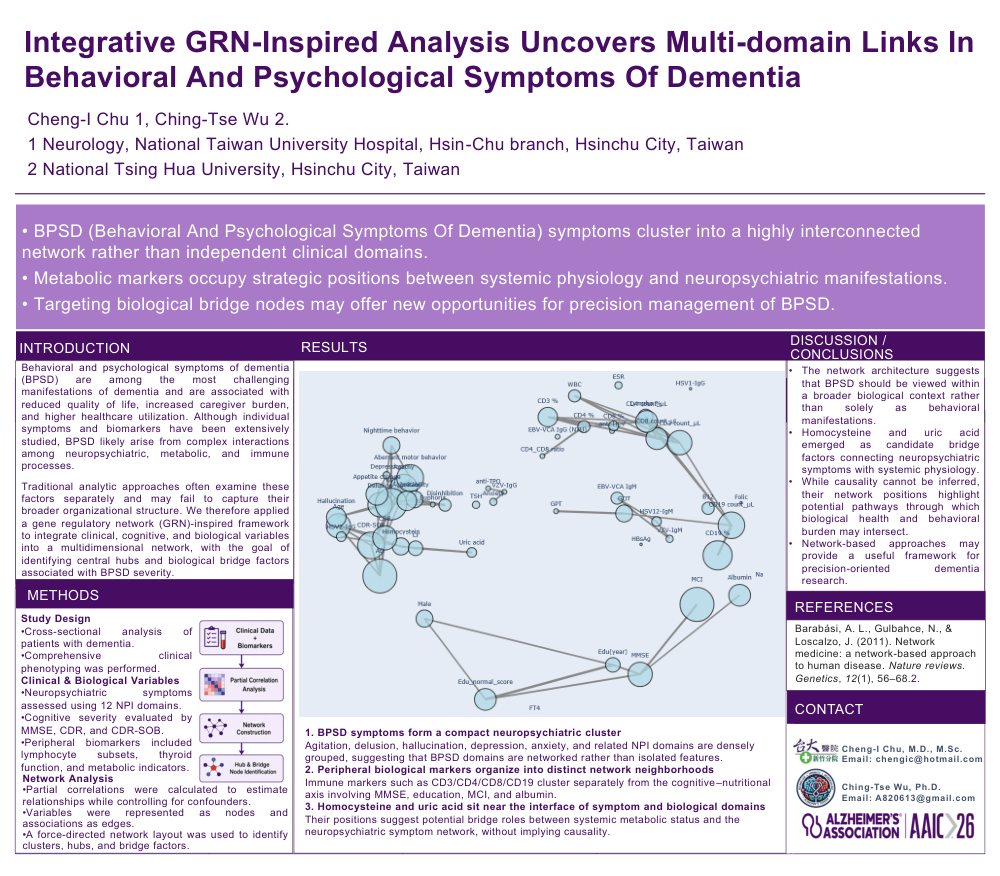
Background: Behavioral and psychological symptoms of dementia (BPSD) represent a significant clinical challenge characterized by complex, non-linear interactions between neuropsychiatric, metabolic, and immunological factors. Traditional univariate analyses often overlook the systemic "regulatory" architecture of these symptoms. This study applies a gene-regulatory-network (GRN)-inspired approach to model the multidimensional interactome of dementia, aiming to identify central hubs and bridging biomarkers that drive BPSD severity.
Methods: We conducted a cross-sectional analysis of patients with dementia who underwent comprehensive clinical phenotyping. Data included 12 BPSD domains via the Neuropsychiatric Inventory (NPI), cognitive severity scales (MMSE, CDR, CDR-SOB), and an extensive panel of peripheral biomarkers, including lymphocyte subpopulations (CD3, CD4, CD8), thyroid function, and metabolic indicators. Pairwise associations were computed using partial correlations to control for confounding variables. These associations were transformed into a network where variables served as nodes. Topology-based visualization using force-directed layouts in Python was employed to identify functional clusters and bridging factors.
Results: The resulting network revealed a highly organized, multi-layered interactome. A prominent Neuropsychiatric & Behavioral Cluster formed a dense hub on the left hemisphere, where symptoms such as Agitation, Delusion, Hallucination, and Depression exhibited strong mutual reinforcement. Notably, this cluster showed high topological proximity to Homocysteine and Age, suggesting that age-related metabolic dysfunction may serve as a regulatory driver for behavioral severity. Simultaneously, a Nutritional-Cognitive Axis emerged, linking MMSE scores and educational attainment with Albumin. Crucially, Homocysteine and Uric Acid functioned as "bridge nodes," providing the structural linkage between peripheral metabolic health and the neuropsychiatric symptom hub.
Conclusion: Integrative network analysis demonstrates that BPSD symptoms are embedded within a broader biological framework. The identification of Homocysteine and Uric Acid as bridging factors suggests that these metabolic markers are not merely correlates but are central to the pathway through which systemic physiological distress translates into behavioral symptoms. These findings advocate for a precision medicine approach in dementia, targeting metabolic "bridge" nodes to mitigate BPSD.
Comments
Email is required but is not shown publicly.
Loading comments...