4,068 posters, 219 videos, 101 topics, 69 sessions, 14,365 authors, 6,128 institutions
ePostersLive by SciGen Technologies S.A. All rights reserved.
Alzheimer's Association International Conference 2026
July 12-15, 2026 | London, United Kingdom, and Online

2811
Mild Behavioral Impairment Is Associated With Postmortem Alzheimer's Disease (AD) Neuropathology
Poster Presenter
Authors
Part of Topic
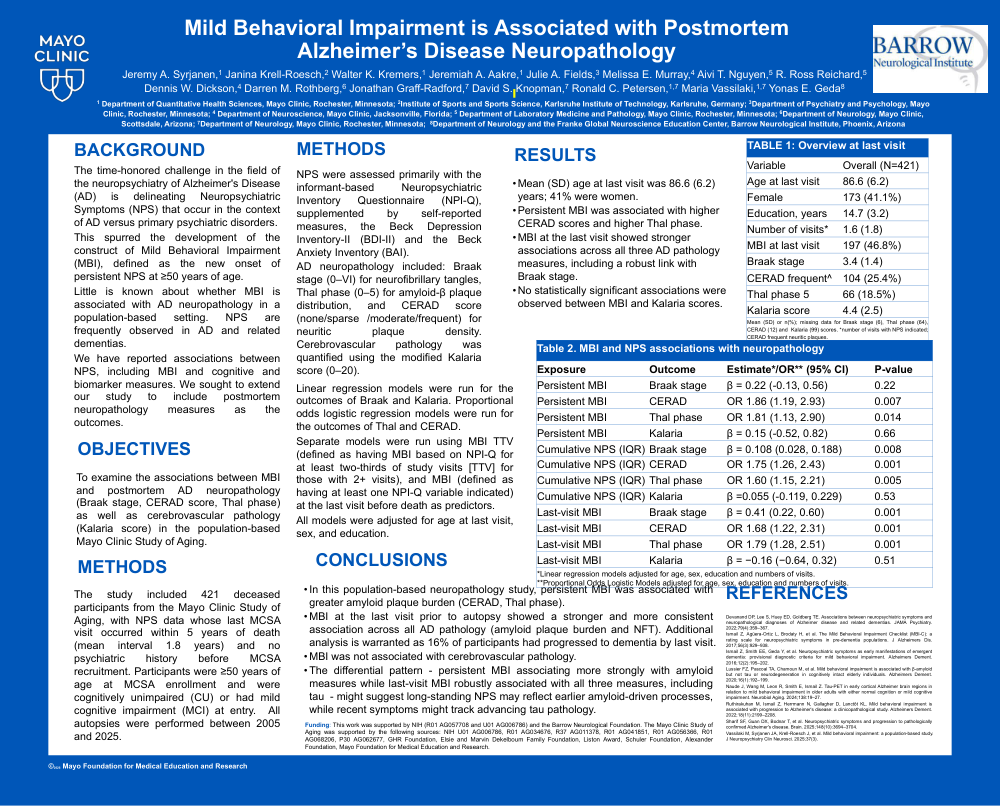
BACKGROUND The time-honored challenge in the field of the neuropsychiatry of Alzheimer's Disease (AD) is delineating Neuropsychiatric Symptoms (NPS) that occur in the context of AD versus primary psychiatric disorders. This spurred the development of the construct of Mild Behavioral Impairment (MBI), defined as the new onset of persistent NPS at ≥50 years of age. Little is known about whether MBI is associated with AD neuropathology in a population-based setting. NPS are frequently observed in AD and related dementias. We have reported associations between NPS, including MBI and cognitive and biomarker measures. We sought to extend our study to include postmortem neuropathology measures as the outcome.
Objective: To examine the associations between MBI and postmortem AD neuropathology (Braak stage, CERAD score, Thal phase) as well as cerebrovascular pathology (Kalaria score) in the population-based Mayo Clinic Study of Aging
Methods
The study included 421 deceased participants from the Mayo Clinic Study of Aging, with NPS data whose last MCSA visit occurred within 5 years of death (mean interval 1.8 years) and no psychiatric history before MCSA recruitment. Participants were ≥50 years of age at MCSA enrollment and were cognitively unimpaired (CU) or had mild cognitive impairment (MCI) at entry. All autopsies were performed between 2005 and 2025.
NPS were assessed primarily with the informant-based Neuropsychiatric Inventory Questionnaire (NPI-Q), supplemented by self-reported measures, the Beck Depression Inventory-II (BDI-II) and the Beck Anxiety Inventory (BAI).
AD neuropathology included: Braak stage (0–VI) for neurofibrillary tangles, Thal phase (0–5) for amyloid-β plaque distribution, and CERAD score (none/sparse /moderate/frequent) for neuritic plaque density. Cerebrovascular pathology was quantified using the modified Kalaria score (0–20).
Linear regression models were run for the outcomes of Braak and Kalaria. Proportional odds logistic regression models were run for the outcomes of Thal and CERAD.
Separate models were run using MBI TTV (defined as having MBI based on NPI-Q for at least two-thirds of study visits [TTV] for those with 2+ visits), and MBI (defined as having at least one NPI-Q variable indicated) at the last visit before death as predictors.
All models were adjusted for age at last visit, sex, and education.
Results
No statistically significant associations were observed between MBI and Kalaria scores
Conclusion
Comments
Email is required but is not shown publicly.
Loading comments...