4,068 posters, 219 videos, 101 topics, 69 sessions, 14,365 authors, 6,128 institutions
ePostersLive by SciGen Technologies S.A. All rights reserved.
Alzheimer's Association International Conference 2026
July 12-15, 2026 | London, United Kingdom, and Online

10191
CAIDE Dementia Risk Estimation Under Data Gaps: Evidence From Latin America
Poster Presenter
Authors
Juan Pablo Sanchez, Stella Maris Valencia, David Aguillón, Rajiv Chowdhury, Natalia Trujillo
Affiliations
Grupo de Neurociencias de Antioquia, Facultad de Medicina, Universidad de Antioquia, Medellín, Colombia., Robert Stempel College of Public Health and Social Work, Academic Health Center 5, Florida International University, Miami, United States, Grupo de investigación en Salud Mental, Universidad de Antioquia, Medellín, Colombia. ICONO Research Group, Faculty of Engineering, Institución Universitaria Pascual Bravo, Medellín 050034, Colombia., Robert Stempel College of Public Health and Social Work, Academic Health Center 5, Florida International University, Miami, United States. Grupo de investigación en Salud Mental, Universidad de Antioquia, Medellín, Colombia. Atlantic Fellowship in Equity in Brain Health, Global Brain Health Institute, University of California, San Francisco, CA, USA.
Part of Topic
CAIDE Dementia Risk Estimation Under Data Gaps: Evidence From Latin America
Authors:
Juan Pablo Sánchez¹, Stella Maris Valencia2,3 David Aguillón¹, Rajiv Chowdhury⁴, Natalia Trujillo2,4,5
¹ Grupo de Neurociencias de Antioquia, Facultad de Medicina, Universidad de Antioquia, Medellín, Colombia.
² Grupo de investigación en Salud Mental, Universidad de Antioquia, Medellín, Colombia.
³ ICONO Research Group, Faculty of Engineering, Institución Universitaria Pascual Bravo, Medellín 050034, Colombia.
⁴ Robert Stempel College of Public Health and Social Work, Academic Health Center 5, Florida International University, Miami, United States.
⁵ Atlantic Fellowship in Equity in Brain Health, Global Brain Health Institute, University of California, San Francisco, CA, USA.
Background:
FINGERS LATAM, a multidomain prevention trial, aims to identify populations at risk of dementia and advance prevention strategies. The CAIDE score, Cardiovascular Risk Factors, Aging, and Incidence of Dementia, is a validated tool that estimates dementia risk up to 20 years before symptom onset. In low- and middle-income countries, scalability is constrained by missing key variables, including lipid profiles, resulting in incomplete CAIDE assessments. The reliability of imputing missing CAIDE data in Latin America remains unclear, including in Antioquia, Colombia, where the world’s largest known PSEN1 E280A kindred is located.
Objective:
To compare three CAIDE estimation strategies under incomplete-data conditions in the FINGERS LATAM Colombian cohort and determine whether imputed scores preserve the distribution of complete-case estimates.
Methods:
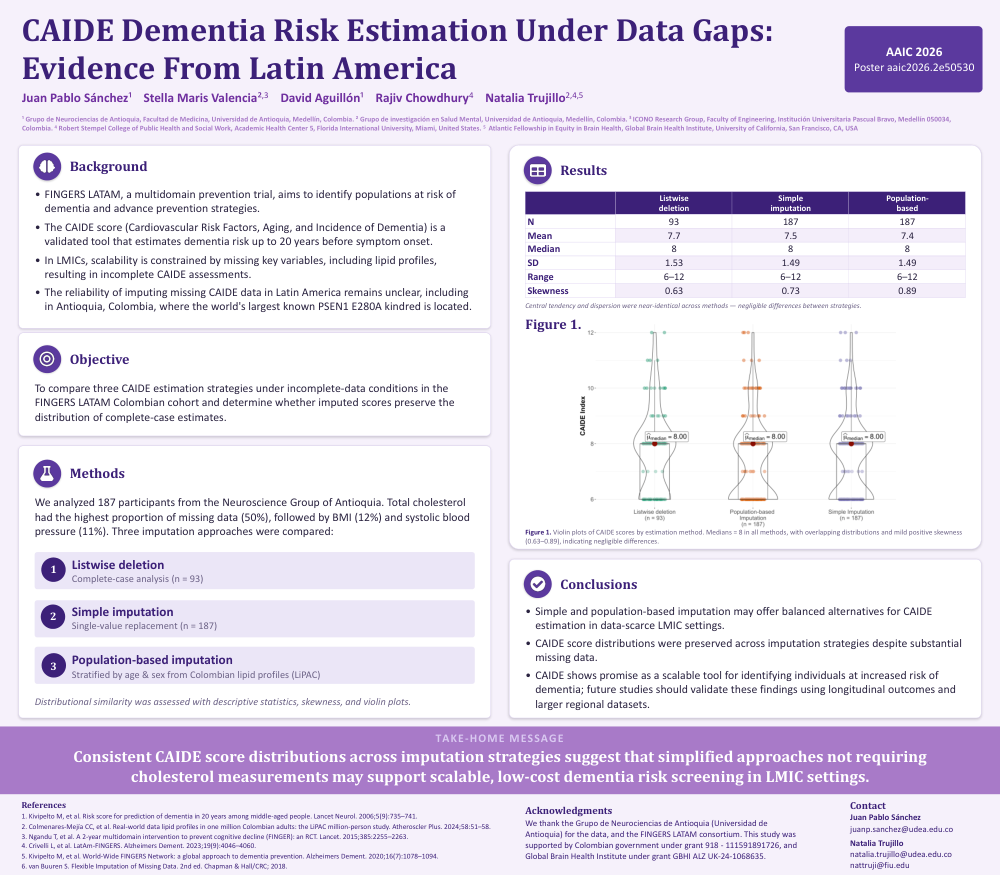
We analyzed 187 participants from the Neuroscience Group of Antioquia. Total cholesterol had the highest proportion of missing data, 50%, followed by body mass index, 12%, and systolic blood pressure, 11%. Three imputation approaches were compared: listwise deletion, complete-case analysis, n = 93; simple imputation, single-value replacement, n = 187; and population-based imputation, stratified by age and sex using Colombian lipid profiles from the LiPAC study. Distributional similarity was assessed with descriptive statistics, skewness, and violin plots.
Results:
CAIDE score distributions were highly similar across estimation strategies. For listwise deletion, n = 93, the mean was 7.7, median 8, standard deviation 1.53, range 6–12, and skewness 0.63. For simple imputation, n = 187, the mean was 7.5, median 8, standard deviation 1.49, range 6–12, and skewness 0.73. For population-based imputation, n = 187, the mean was 7.4, median 8, standard deviation 1.49, range 6–12, and skewness 0.89. Central tendency and dispersion were near-identical across methods, indicating negligible differences between strategies. Violin plots showed overlapping distributions, with medians of 8 in all methods and mild positive skewness.
Conclusions:
Simple and population-based imputation may offer balanced alternatives for CAIDE estimation in data-scarce low- and middle-income country settings. CAIDE score distributions were preserved across imputation strategies despite substantial missing data. CAIDE shows promise as a scalable tool for identifying individuals at increased risk of dementia. Future studies should validate these findings using longitudinal outcomes and larger regional datasets.
Take-home message:
Consistent CAIDE score distributions across imputation strategies suggest that simplified approaches not requiring cholesterol measurements may support scalable, low-cost dementia risk screening in low- and middle-income country settings.
References:
Kivipelto M, et al. Risk score for prediction of dementia in 20 years among middle-aged people. Lancet Neurol. 2006;5(9):735–741.
Colmenares-Mejía CC, et al. Real-world data lipid profiles in one million Colombian adults: the LiPAC million-person study. Atherosclerosis Plus. 2024;58:51–58.
Ngandu T, et al. A 2-year multidomain intervention to prevent cognitive decline: the FINGER randomized controlled trial. Lancet. 2015;385:2255–2263.
Crivelli L, et al. LatAm-FINGERS. Alzheimer’s & Dementia. 2023;19(9):4046–4060.
Kivipelto M, et al. World-Wide FINGERS Network: a global approach to dementia prevention. Alzheimer’s & Dementia. 2020;16(7):1078–1094.
van Buuren S. Flexible Imputation of Missing Data. 2nd ed. Chapman & Hall/CRC; 2018.
Acknowledgments:
We thank the Grupo de Neurociencias de Antioquia, Universidad de Antioquia, for the data, and the FINGERS LATAM consortium. This study was supported by the Colombian government under grant 918 - 111591891726, and the Global Brain Health Institute under grant GBHI ALZ UK-24-1068635.
Contact:
Juan Pablo Sánchez, juanp.sanchez@udea.edu.co
Natalia Trujillo, natalia.trujillo@udea.edu.co, nattruji@fiu.edu
Comments
Email is required but is not shown publicly.
Loading comments...