4,068 posters, 219 videos, 101 topics, 69 sessions, 14,365 authors, 6,128 institutions
ePostersLive by SciGen Technologies S.A. All rights reserved.
Alzheimer's Association International Conference 2026
July 12-15, 2026 | London, United Kingdom, and Online

9662
Establishing A Dementia Prevention Framework In Rural India: The Smruthi Cohort's Baseline View
Poster Presenter
Authors
Anu Gupta, Hina Narzari, Nilima Nilima, Shubham Gupta, Kritika Sharma, Bishakha Sen, Shaily Bhushan, Priyanka Kumari Meena, Ambika YV, Priya Darshanraj N, Phaniraj Vastrad, Sandip Bhattacharjee, Arnav Verma, Gajraj Singh Shekhawat, Sneha Sneha, Kamini Kamini, Sakshi Sharma, Maroof Ahmad Khan, Ashima Nehra, Kanika Vasudeva, Nimin Hafeez, Chanchal Goyal, Meenakshi Sharma, R S Dhaliwal, Subarna Roy, Manish Barvaliya, Subrata Baidya, Shampa Das, P K Anand, Sunil K Raina, Abhik Sinha, Venugopalan Y Vishnu, MV Padma Srivastava
Affiliations
All India Institute of Medical Sciences (AIIMS), New Delhi, MRHRU, Belgavi and Sirwar Karnataka, MRHRU, Khumulwng, Tripura, MRHRU, Jaipur, Rajasthan, Dr. Rajendra Prasad Government Medical College, Himachal Pradesh, ICMR Center for Ageing and Mental Health, Kolkata, Model Rural Health Research Unit, Khumulwng, Tripura, India, Department of Community Medicine, Dr. RP Government Medical College, Tanda, Himachal Pradesh, India, Model Rural Health Research Unit, Jaipur, Rajasthan, India, Model Rural Health Research Unit, Sirwar, Raichur, Karnataka, India, Model Rural Health Research Unit, Sirwar, Raichur, Karnataka, India,, Indian Council of Medical Research, New Delhi, India, ICMR-NITM, Belagavi, MRHRU, Sirwar, Raichur, Karnataka, India
Part of Topic
Establishing A Dementia Prevention Framework In Rural India: The Smruthi Cohort's Baseline View:
Author Block: Anu Gupta1, Hina Narzari1, Nilima Nilima, M.Sc. Statistics2, Shubham Gupta1, Kritika Sharma1, Bishakha Sen3, Shaily Bhushan4, Priyanka Kumari Meena5, Ambika YV6, Priya Darshanraj N6, Phaniraj Vastrad6, Sandip Bhattacharjee3, Arnav Verma4, Gajraj Singh Shekhawat5, Sneha Sneha, Masters of Physiotherapy7, Kamini Kamini1, Sakshi Sharma1, Maroof Ahmad Khan1, Ashima Nehra1, Kanika Vasudeva8, Nimin Hafeez8, Chanchal Goyal8, Meenakshi Sharma8, R S Dhaliwal8, Subarna Roy9, Manish Barvaliya9, Subrata Baidya3, Shampa Das3, P K Anand5, Sunil K. Raina4, Abhik Sinha10, Venugopalan Y. Vishnu1, MV Padma Srivastava1, SMRUTHI India Collaborators11.
1All India Institute of Medical Sciences, New Delhi, India, 2Biostatistics, All India Institute of Medical Sciences Delhi, Gn, India, 3Model Rural Health Research Unit, Khumulwng, Tripura, India, 4Department of Community Medicine, Dr. RP Government Medical College, Tanda, Himachal Pradesh, India, 5Model Rural Health Research Unit, Jaipur, Rajasthan, India, 6Model Rural Health Research Unit, Sirwar, Raichur, Karnataka, India, 7NEUROLOGY, AIIMS, NEW DELHI, India, 8Indian Council of Medical Research, New Delhi, India, 9ICMR-NITM, Belagavi, MRHRU, Sirwar, Raichur, Karnataka, India, 10ICMR Center for Ageing and Mental Health, Kolkata, India, 11All India Institute of Medical Sciences, ICMR-MRHRUs, New Delhi, India.
Abstract:
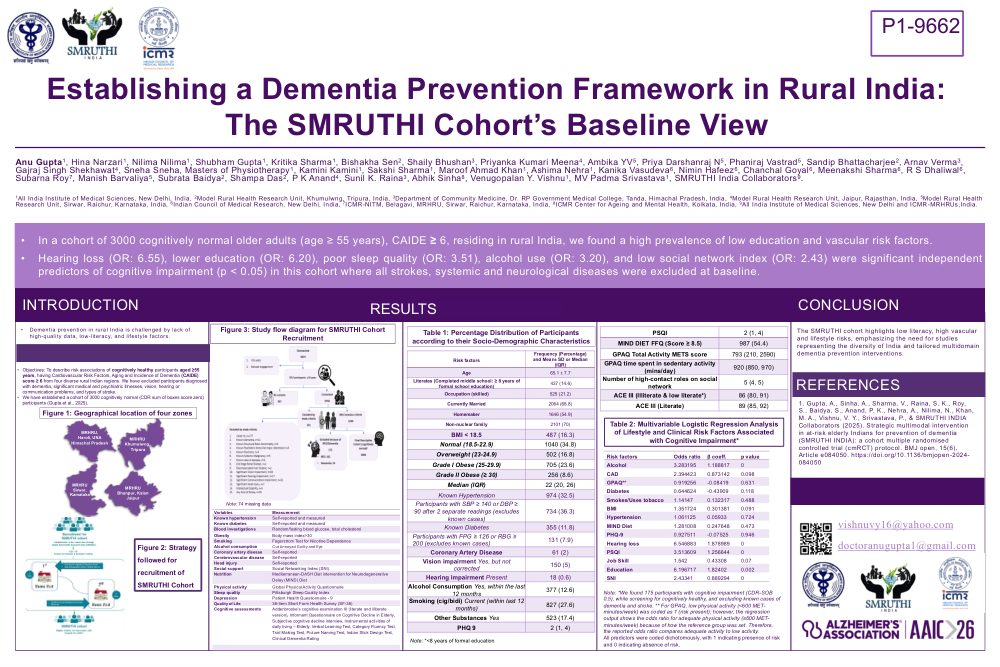
Background: Prevention of dementia in rural India is challenged by lack of high quality data, low-literacy, and lifestyle factors. India’s cultural and linguistic diversity needs to be addressed while conducting community based studies in rural India.
Methods: This ongoing multicentric cohort study has recruited 3,249 adults aged ≥55 years (CAIDE score ≥ 6) from four rural regions representing four zones of India (Himachal, Tripura, Karnataka and Rajasthan). After excluding 175 with confirmed cognitive impairment (Clinical dementia rating sum of boxes score ≥ 0.5), and 74 with incomplete data, 3,000 participants remain (figure 1). Trained investigators have conducted home-based assessments using Redcap case record forms.
Results: Among 3,000 participants (mean age 66.1 years; 62.9% women), 71.3% are illiterate; most are homemakers (54.9%), married (68.8%), and have a non-nuclear family (70.0%). Self-reported hypertension [974/3000 (32.5%)] and diabetes [355/3000 (11.8%)] are frequent, with an additional 734/2023 (36.3%) having at-least two high blood pressure recordings, and 131/1656 (7.9%) having fasting/random (single) blood glucose reading in the range defining diabetes. Other risk factors include - active smoking/alcohol/other substance abuse in 27.6%, 12.6% and 17.4% respectively, coronary artery disease in 2.0%, uncorrected vision loss in 5.0%, and hearing impairment in 0.6%. Using the WHO classification for BMI for Asians, overweight/obesity is seen in 49%, while 16.8% are underweight. Low to medium Mediterranean-DASH Intervention for Neurodegenerative Delay (MIND) diet scores are present in 43.7%. Over half (57.8%) meet activity thresholds (GPAQ total activity metabolic equivalents ≥ 600), though sedentary time is high (median 920 min/day). People have a median of 5 (4,5) high contact roles in their social network. Sleep problems (PSQI ≥5) affect 14.2%, while 3.7% have mild to moderate depression (PHQ-9≥5). In neuropsychological tests, the median Addenbrooke’s Cognitive Examination-III score is 86 in illiterate/low-literate and 89 in literate subjects. Regional variations are seen in the risk profile and domain wise neuropsychological test scores.
Conclusion: The SMRUTHI cohort highlights low literacy, high vascular and lifestyle risks, and variable performance on cognitive tests, emphasizing the need for studies representing the diversity of India and tailored multidomain dementia prevention interventions.
Comments
Email is required but is not shown publicly.
Loading comments...