4,068 posters, 219 videos, 101 topics, 69 sessions, 14,365 authors, 6,128 institutions
ePostersLive by SciGen Technologies S.A. All rights reserved.
Alzheimer's Association International Conference 2026
July 12-15, 2026 | London, United Kingdom, and Online

9507
Relationships Between Pain In Persons With Dementia And Family Caregiver Involvement
Poster Presenter
Authors
Nai-Ching Chi, Sujay Marisetty, Maya Kinser, Findley Dvorak, Lexi Henke, Zachary Erickson, Maria Hein, Yelena Perkhounkova
Affiliations
Part of Topic
Background:
•Nearly 60 million individuals have dementia worldwide, and their pain is frequently underrecognized and undertreated.
•As cognitive and communication abilities decline, individuals with dementia increasingly rely on family caregivers to identify pain, manage symptoms, and communicate with clinicians.
•Caregiver involvement, including communication and shared decision-making, may directly shape how patient pain is perceived, reported, and managed.
•Understanding these associations can inform the development of targeted interventions that empower caregivers and improve dementia-related pain management.
Purpose:
To investigate the associations between family caregiver involvement and pain-related outcomes among individuals with dementia.
Methods:
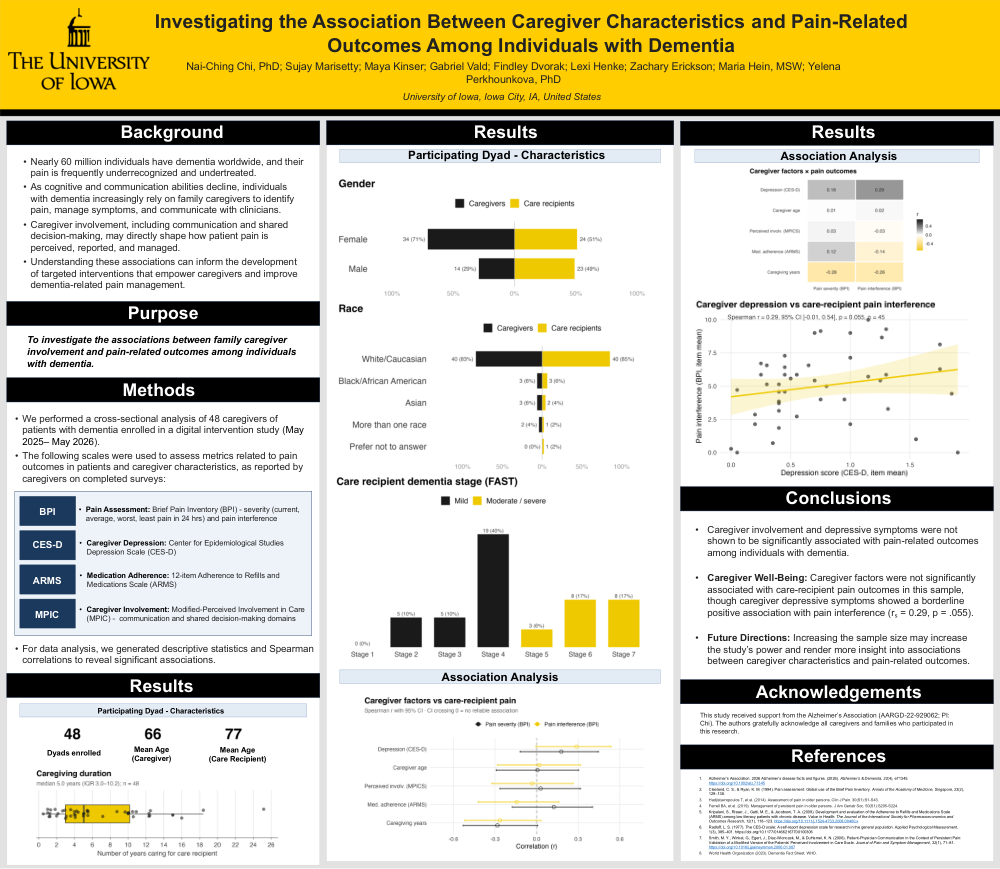
•We performed a cross-sectional analysis of 48 caregivers of patients with dementia enrolled in a digital intervention study (May 2025– May 2026).
•The following scales were used to assess metrics related to pain outcomes in patients and caregiver characteristics, as reported by caregivers on completed surveys:
•Pain Assessment: Brief Pain Inventory (BPI) - severity (current, average, worst, least pain in 24 hrs) and pain interference
•Caregiver Depression: Center for Epidemiological Studies Depression Scale (CES-D)
Medication Adherence: 12-item Adherence to Refills and Medications Scale (ARMS)
•Caregiver Involvement: Modified-Perceived Involvement in Care (MPIC) - communication and shared decision-making domains
For data analysis, we generated descriptive statistics and Spearman correlations to reveal significant associations.
Conclusions:
•Caregiver involvement and depressive symptoms were not shown to be significantly associated with pain-related outcomes among individuals with dementia.
•Caregiver Well-Being: Caregiver factors were not significantly associated with care-recipient pain outcomes in this sample, though caregiver depressive symptoms showed a borderline positive association with pain interference (rₛ = 0.29, p = .055).
•Future Directions: Increasing the sample size may increase the study’s power and render more insight into associations between caregiver characteristics and pain-related outcomes.
Comments
Email is required but is not shown publicly.
Loading comments...