4,068 posters, 219 videos, 101 topics, 69 sessions, 14,365 authors, 6,128 institutions
ePostersLive by SciGen Technologies S.A. All rights reserved.
Alzheimer's Association International Conference 2026
July 12-15, 2026 | London, United Kingdom, and Online

9091
Daily Extradyadic Social Interactions Among Couples Living With Dementia: Links To Cortisol And Alpha-amylase Synchrony
Poster Presenter
Authors
Courtney Polenick, Angela Turkelson, Charity Garner, Yin Liu
Affiliations
Part of Topic
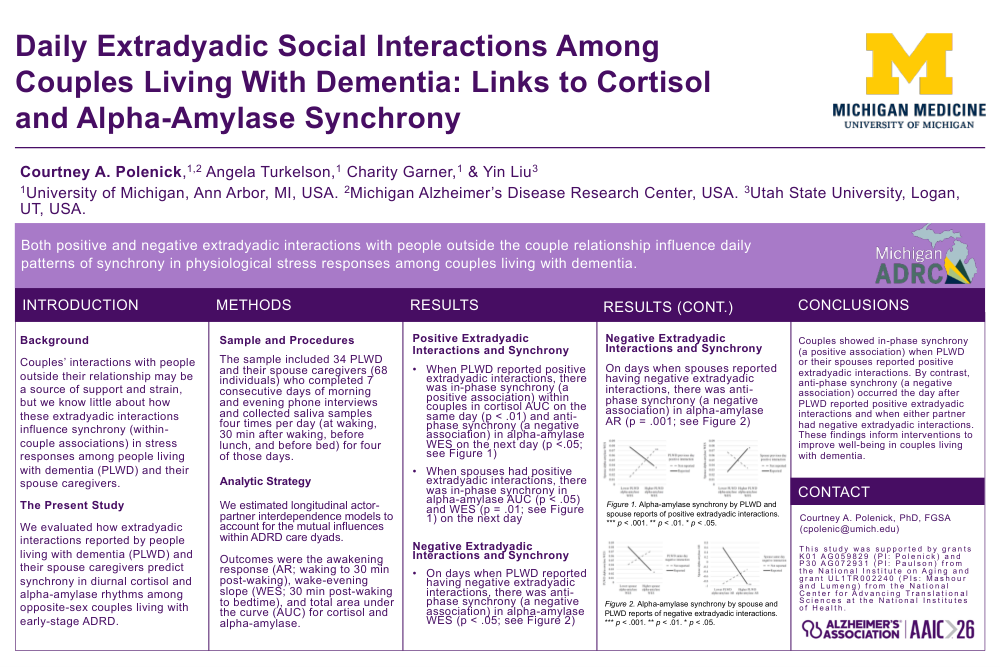
Background: Couples’ extradyadic social interactions with people outside their relationship may be a source of support and strain, but we know little about how extradyadic social interactions influence physiological synchrony in stress responses (i.e., within-couple associations) among people living with dementia (PLWD) and their spouses. We evaluated how positive and negative extradyadic social interactions predicted cortisol and alpha-amylase synchrony in couples living with dementia.
Methods: Participants included 34 PLWD (M = 71.2 years, SD = 7.5, range = 52-85 years) and their spouses (M = 69.5 years, SD = 8.7, range = 49-88 years) who completed 7 days of brief morning and evening phone interviews and collected saliva samples (four times per day) during four of those days. We estimated longitudinal actor-partner interdependence models to determine how daily extradyadic social interactions reported by both partners predicted synchrony in cortisol and alpha-amylase awakening response (AR; awakening to 30 min post-awakening), wake-evening slope (WES; 30-min post-awakening to bedtime), and total area under the curve (AUC).
Results: When PLWD reported positive extradyadic social interactions, in-phase synchrony (a positive association) in cortisol AUC occurred on the same day and anti-phase synchrony (a negative association) in alpha-amylase occurred on the next day. When spouses reported positive extradyadic social interactions, in-phase synchrony in alpha-amylase AUC and WES was observed on the next day. When PLWD reported negative extradyadic social interactions, anti-phase synchrony in alpha-amylase WES was found on the same day. When spouses reported negative extradyadic social interactions, anti-phase synchrony in alpha-amylase AR was found on the same day.
Conclusions: Couples showed in-phase physiological synchrony when PLWD or their spouses reported positive extradyadic social interactions, whereas anti-phase physiological synchrony was found the day after PLWD reported positive extradyadic social interactions and when either partner reported negative extradyadic social interactions. These findings inform targets for future interventions to improve health and well-being among couples living with dementia.
Comments
Email is required but is not shown publicly.
Loading comments...