4,068 posters, 219 videos, 101 topics, 69 sessions, 14,365 authors, 6,128 institutions
ePostersLive by SciGen Technologies S.A. All rights reserved.
Alzheimer's Association International Conference 2026
July 12-15, 2026 | London, United Kingdom, and Online

7209
Implementing Home-based Dementia Rehabilitation: A Content Analysis Of Staff Attitudes Towards An Allied Health Assistant Delivery Model
Poster Presenter
Authors
Clare Stephenson, Kasia Bail, Diane Gibson, Stephen Isbel, Nathan D'Cunha
Affiliations
Part of Topic
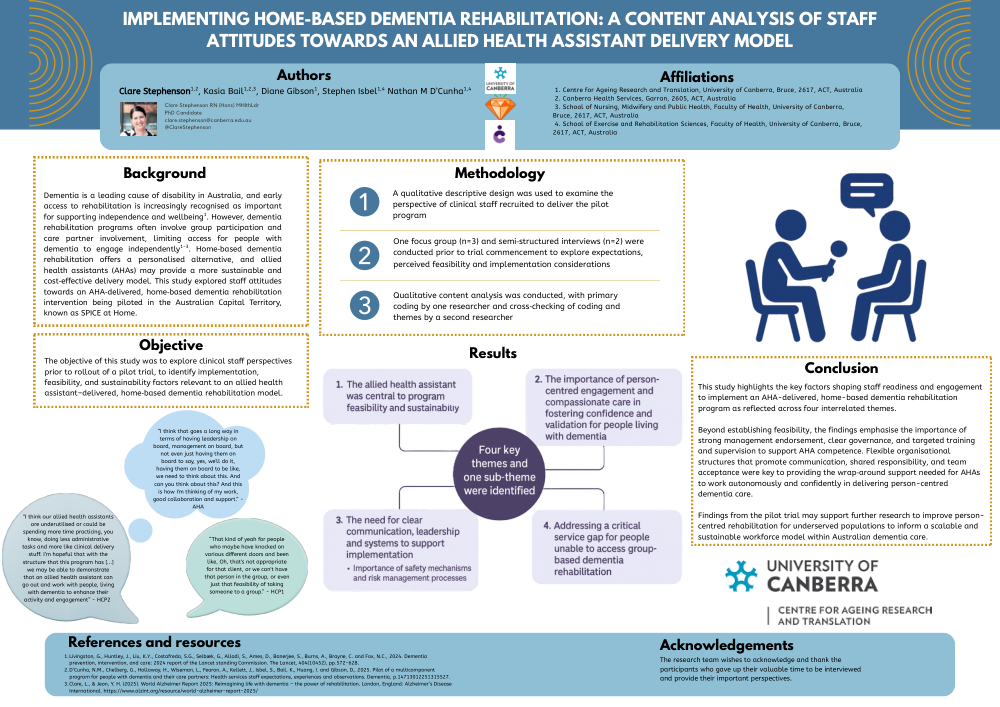
The poster presents a qualitative study exploring clinical staff perspectives on the SPICE at Home pilot, a home-based dementia rehabilitation program delivered by allied health assistants (AHAs) in the ACT. Using a qualitative descriptive design, the team conducted one focus group and two semi-structured interviews with clinical staff prior to trial commencement. The aim was to identify implementation, feasibility, and sustainability factors relevant to the AHA-delivered model. Four key themes and one sub-theme emerged from content analysis: the central role of AHAs in program feasibility and sustainability; the importance of person-centred and compassionate engagement in building confidence and validation for people with dementia; the need for clear communication, leadership, and systems to support implementation (including safety mechanisms and risk management processes); and the program's capacity to address a critical service gap for people unable to access group-based dementia rehabilitation.
The findings highlight that successful implementation of an AHA-delivered home-based model depends on more than clinical feasibility. Strong management endorsement, targeted training and supervision, and flexible organisational structures that promote shared responsibility and team acceptance were identified as essential to enabling AHAs to work autonomously and confidently. The study concludes that findings from the pilot may inform a scalable and sustainable workforce model for dementia rehabilitation in Australia, with particular relevance for underserved populations who are currently excluded from existing group-based programs.
Comments
Email is required but is not shown publicly.
Loading comments...