4,068 posters, 219 videos, 101 topics, 69 sessions, 14,365 authors, 6,128 institutions
ePostersLive by SciGen Technologies S.A. All rights reserved.
Alzheimer's Association International Conference 2026
July 12-15, 2026 | London, United Kingdom, and Online

9259
Determining The Neuroinflammatory And Vascular Events Leading To ARIA In Apoeε4 Mice After Chronic Anti-aβ Immunotherapy
Poster Presenter
Authors
Affiliations
Part of Topic
Background:
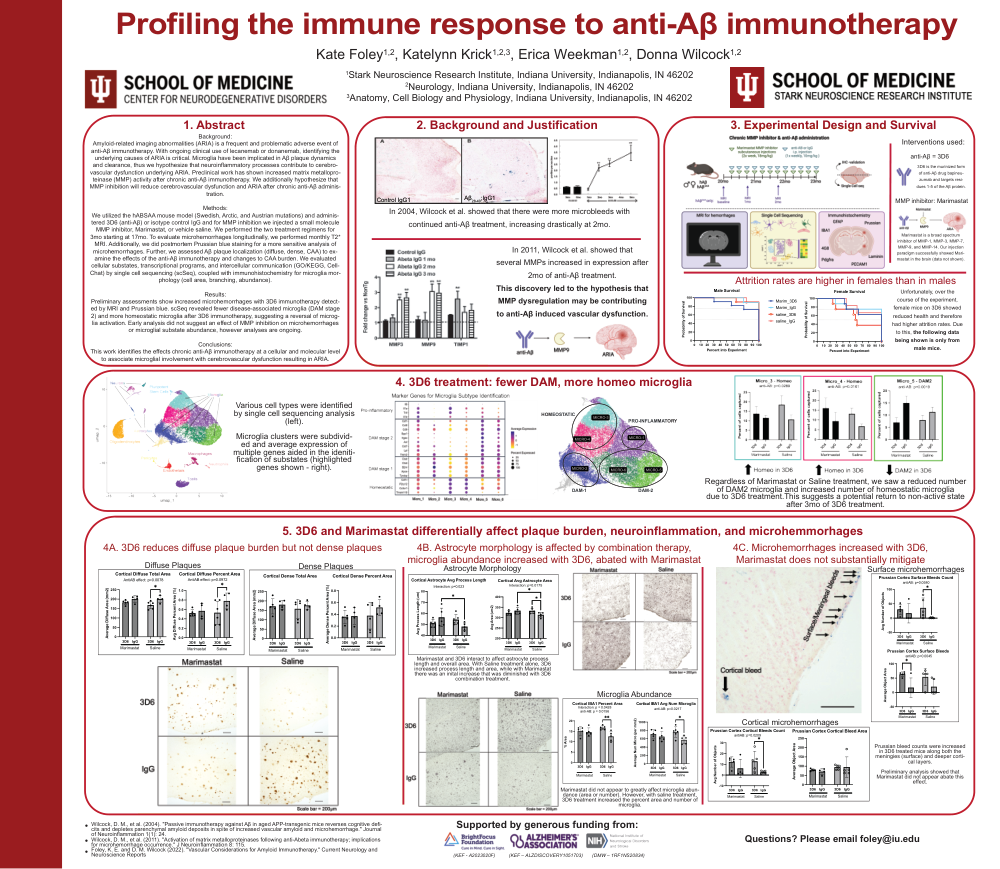
Amyloid-related imaging abnormalities (ARIA) is a frequent and problematic adverse event of anti-Aβ immunotherapy. With ongoing clinical use of lecanemab or donanemab, identifying the underlying causes of ARIA is critical. Microglia have been implicated in Aβ plaque dynamics and clearance, thus we hypothesize that neuroinflammatory processes contribute to cerebrovascular dysfunction underlying ARIA. Preclinical work has shown increased matrix metalloproteinase (MMP) activity after chronic anti-Aβ immunotherapy. We additionally hypothesize that MMP inhibition will reduce cerebrovascular dysfunction and ARIA after chronic anti-Aβ administration.
Methods:
We utilized the hABSAA mouse model (Swedish, Arctic, and Austrian mutations) and administered 3D6 (anti-Aβ) or isotype control IgG and for MMP inhibition we injected a small molecule MMP inhibitor, Marimastat, or vehicle saline. We performed the two treatment regimens for 3mo starting at 17mo. To evaluate microhemorrhages longitudinally, we performed monthly T2* MRI. Additionally, we did postmortem Prussian blue staining for a more sensitive analysis of microhemorrhages. Further, we assessed Aβ plaque localization (diffuse, dense, CAA) to examine the effects of the anti-Aβ immunotherapy and changes to CAA burden. We evaluated cellular substates, transcriptional programs, and intercellular communication (GO/KEGG, CellChat) by single cell sequencing (scSeq), coupled with immunohistochemistry for microglia morphology (cell area, branching, abundance).
Results:
Preliminary assessments show increased microhemorrhages with 3D6 immunotherapy detected by MRI and Prussian blue. scSeq revealed fewer disease-associated microglia (DAM stage 2) and more homeostatic microglia after 3D6 immunotherapy, suggesting a reversal of microglia activation. Early analysis did not suggest an effect of MMP inhibition on microhemorrhages or microglial substate abundance, however analyses are ongoing.
Conclusions:
This work identifies the effects chronic anti-Aβ immunotherapy at a cellular and molecular level to associate microglial involvement with cerebrovascular dysfunction resulting in ARIA.
Comments
Email is required but is not shown publicly.
Loading comments...