4,068 posters, 219 videos, 101 topics, 69 sessions, 14,365 authors, 6,128 institutions
ePostersLive by SciGen Technologies S.A. All rights reserved.
Alzheimer's Association International Conference 2026
July 12-15, 2026 | London, United Kingdom, and Online

9619
Clinical Spectrum And Outcomes In The AIIMS-Delhi Study Cohort Of Early/late Onset Dementia (ASCEND)
Poster Presenter
Authors
Anu Gupta, Aditi Dubey, Hina Narzari, Anjali Anjali, Madhavi Tripathi, Varuna Sharma, Abhilasha Dwivedi, Nilima N, Savyasachi Jain, Vaibhav Patil, Lakshmy Ramakrishnan, Ashima Nehra, Shailesh Gaikwad, Roopa Rajan, Venugopalan Y Vishnu, Mamta Bhushan Singh, Rohit Bhatia, Achal Srivastava, Manjari Tripathi, Padma Srivastava
Affiliations
Part of Topic
Title: Clinical spectrum and outcomes in Early and Late onset dementia: insights from the AIIMS-Delhi Study Cohort of Early/late oNset Dementia (ASCEND)
Keywords : Early onset dementia, late onset dementia, neuropsychological profile, cognition, outcome
Theme: Clinical manifestations
Authors: Anu Gupta, Aditi Dubey, Hina Narzari, Anjali Anjali, Madhavi Tripathi , Varuna Sharma, Abhilasha Dwivedi, Nilima N, Savyasachi Jain, Vaibhav Patil, , Lakshmy Ramakrishnan, Ashima Nehra, Shailesh Gaikwad, Roopa Rajan, Venugopalan Y Vishnu, Mamta Bhushan Singh, Rohit Bhatia, Achal Srivastava, Manjari Tripathi, Padma Srivastava.
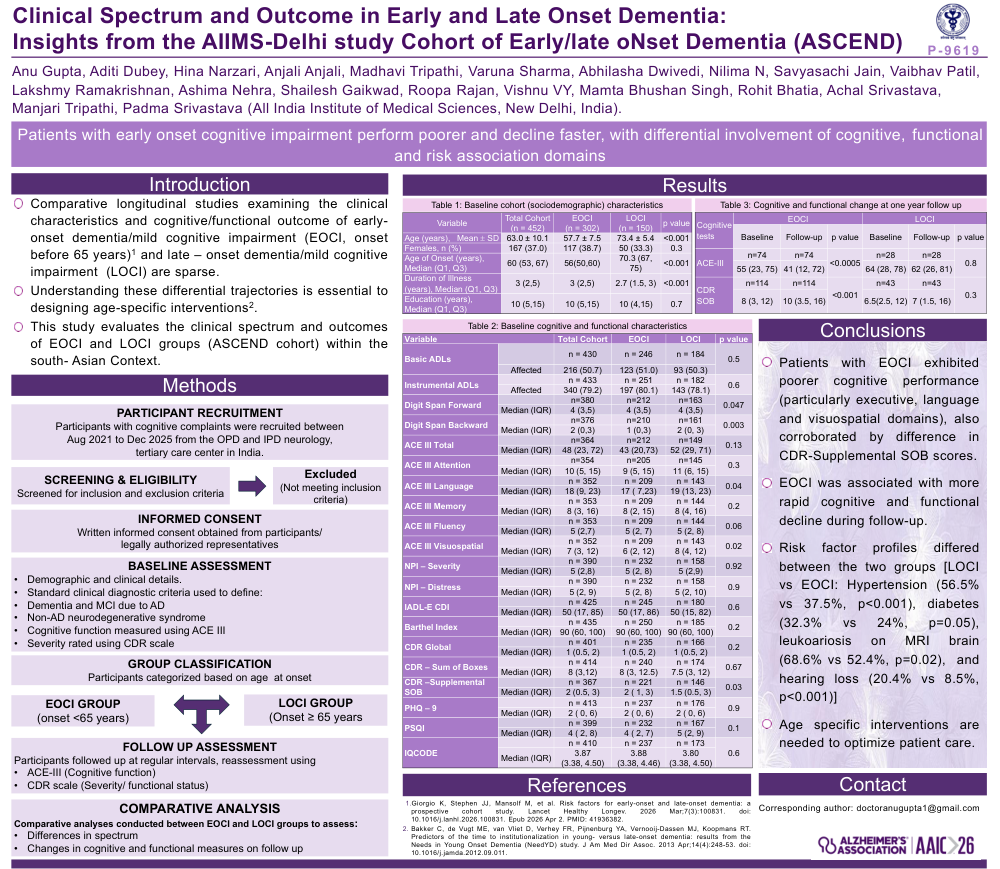
Background: Comparative longitudinal studies examining the clinical characteristics and cognitive/functional outcomes of early-onset dementia (EOD, onset before 65 years) and late-onset dementia (LOD) are sparse. Understanding these differential trajectories is essential to designing age-specific interventions. This study evaluates the clinical spectrum and outcomes of EOD and LOD groups (ASCEND cohort) within the South-Asian context.
Methods: Consecutive participants with cognitive complaints were recruited between August 2021 to December 2025 from the outpatient and inpatient neurology services at a tertiary care centre in India. A structured proforma was used to capture the demographic and clinical details. Standard clinical diagnostic criteria were used to define dementia and mild cognitive impairment (MCI) due to AD and non-AD neurodegenerative syndromes. Cognitive function was measured using the Addenbrooke’s Cognitive Examination (ACE-III) and severity was rated using the Clinical Dementia Rating (CDR) scale. Comparative analyses were conducted between EOD and LOD groups to assess differences in spectrum and changes in cognitive and functional measures on follow up.
Results: We have enrolled 452 patients with cognitive impairment [Early onset: 302 (66.8%), Late onset: 150 (33.2%), Dementia: 75.8%, MCI: 20.6%, Subjective cognitive decline: 3.6%], with a mean (SD) age of 63.0 (10.1) years (table 1). The most common aetiology is Alzheimer’s disease (40.5%), followed by fronto-temporal dementia (FTD) (28.8%), vascular dementia (12.4%), Lewy body dementia (5.9%) and other causes (12.4%). EOD and LOD differ in specific cognitive (EOD are worse on executive, language, visuospatial tasks) and functional domains (table 2). Frequency of hypertension (56.5% vs 37.5%, p<0.001), diabetes (32.3% vs 24%, p=0.05), leukoariosis on magnetic resonance imaging of brain (68.6% vs 52.4%, p=0.02), and hearing loss (20.4% vs 8.5%, p<0.001) is higher in the LOD group. The EOD group shows faster decline (table 3) compared to LOD group [157 participants (EOD:114, LOD:43) have completed one annual follow up].
Conclusion: This study demonstrates that EOD patients have poorer cognitive performance at presentation, experience more rapid cognitive and functional decline and differ in their risk associations from LOD, emphasizing the need for age-specific interventions.
Comments
Email is required but is not shown publicly.
Loading comments...