4,068 posters, 219 videos, 101 topics, 69 sessions, 14,365 authors, 6,128 institutions
ePostersLive by SciGen Technologies S.A. All rights reserved.
Alzheimer's Association International Conference 2026
July 12-15, 2026 | London, United Kingdom, and Online

10638
Deregulation Of Serum Micro RNA Associated With Late-onset Alzheimer’S Disease In Large-scale Japanese Cohort
Poster Presenter
Authors
Part of Topic
Background:
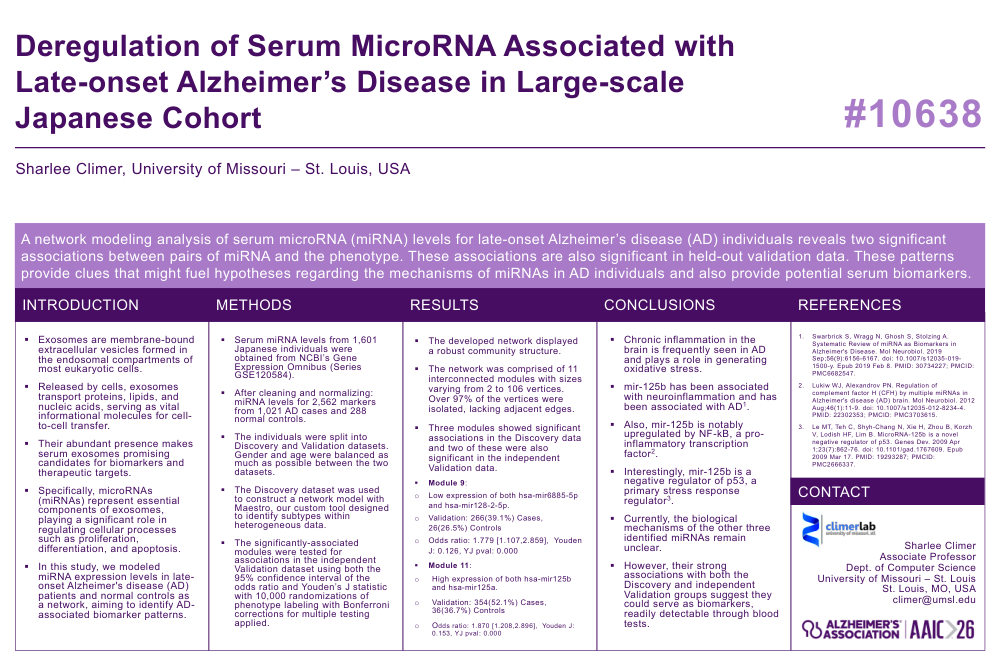
Exosomes are membrane-bound extracellular vesicles formed in the endosomal compartments of most eukaryotic cells. These exosomes can be found in various biological fluids, including blood. Released by cells, exosomes transport proteins, lipids, and nucleic acids, serving as vital informational molecules for cell-to-cell transfer. Their abundant presence makes serum exosomes promising candidates for biomarkers and therapeutic targets. Specifically, microRNAs (miRNAs) represent essential components of exosomes, playing a significant role in regulating cellular processes such as proliferation, differentiation, and apoptosis. In this study, we modeled miRNA expression levels in late-onset Alzheimer's disease (AD) patients and normal controls as a network, aiming to identify AD-associated biomarker patterns.
Methods:
Serum miRNA levels from 1,601 Japanese individuals were obtained from NCBI’s Gene Expression Omnibus database (Series GSE120584). After cleaning and normalizing the data, miRNA levels for 2,562 markers from 1,021 AD cases and 288 normal controls were divided into Discovery and Validation datasets. The Discovery dataset was used to construct a network model with Maestro, a tool designed to identify subtypes within heterogeneous data. The significantly-associated modules were tested for associations in the independent Validation dataset using both the 95% confidence interval of the odds ratio and Youden’s J statistic with 10,000 randomizations of phenotype labeling with Bonferroni corrections for multiple testing applied.
Results:
The developed network displayed a robust community structure, encompassing 11 interconnected modules with sizes varying from 2 to 106 vertices. Over 97% of the vertices were isolated, lacking adjacent edges. Two modules showed significant associations when validated with the independent data. Each of these validated modules represented biomarker patterns composed of two miRNAs. Module 9 consists of hsa-mir6885-5p and hsa-mir128-2-5p, while Module 11 includes hsa-mir125b and hsa-mir125a.
Conclusions:
Chronic inflammation in the brain is frequently seen in AD and plays a role in generating oxidative stress. mir-125b has been associated with neuroinflammation and is notably upregulated by NF-kB, a pro-inflammatory transcription factor. While the biological mechanisms of the other three identified miRNAs remain unclear, their strong associations with both the Discovery and independent Validation groups suggest they could serve as early biomarkers, readily detectable through blood tests.
Comments
Email is required but is not shown publicly.
Loading comments...