4,068 posters, 219 videos, 101 topics, 69 sessions, 14,365 authors, 6,128 institutions
ePostersLive by SciGen Technologies S.A. All rights reserved.
Alzheimer's Association International Conference 2026
July 12-15, 2026 | London, United Kingdom, and Online

4089
Influence Of Decreased Renal Function On A Broad Spectrum Of Blood Biomarkers Of Neurodegenerative Disorders In Routine-care Settings
Poster Presenter
Authors
Part of Topic
Etienne Mondesert1,2, Jean-Paul Cristol2, Anne-Sophie Bargnoux2, Marie Duchiron1, Germain Ulysse Busto3, Christophe Hirtz1, Geneviève Barnier-Figue4, Florence Perrein5, Cedric Turpinat3, Snejana Jurici6, Audrey A Gabelle3, Karim Bennys3, Sylvain Lehmann1, Constance Delaby1,7
1 LBPC-PPC, Université de Montpellier, INM INSERM, IRMB CHU de Montpellier, Montpellier, France
2 PhyMedExp, University of Montpellier, INSERM, CNRS, Department of Biochemistry and Hormonology, University Hospital Center of Montpellier, Montpellier, France
3 CMRR, CHU de Montpellier, Montpellier, France
4 Centre de Mémoire Territorial Gériatrie, CH de Perpignan, Perpignan, France
5 Département de Neurologie, CHU de Nîmes, Nîmes, France
6 Centre de Mémoire Territorial Gériatrie, CH de Perpignan, Perpignan, France
7 Sant Pau Memory Unit, Hospital de la Santa Creu i Sant Pau - Biomedical Research Institute Sant Pau - Universitat Autònoma de Barcelona, Barcelona, Spain
Background:
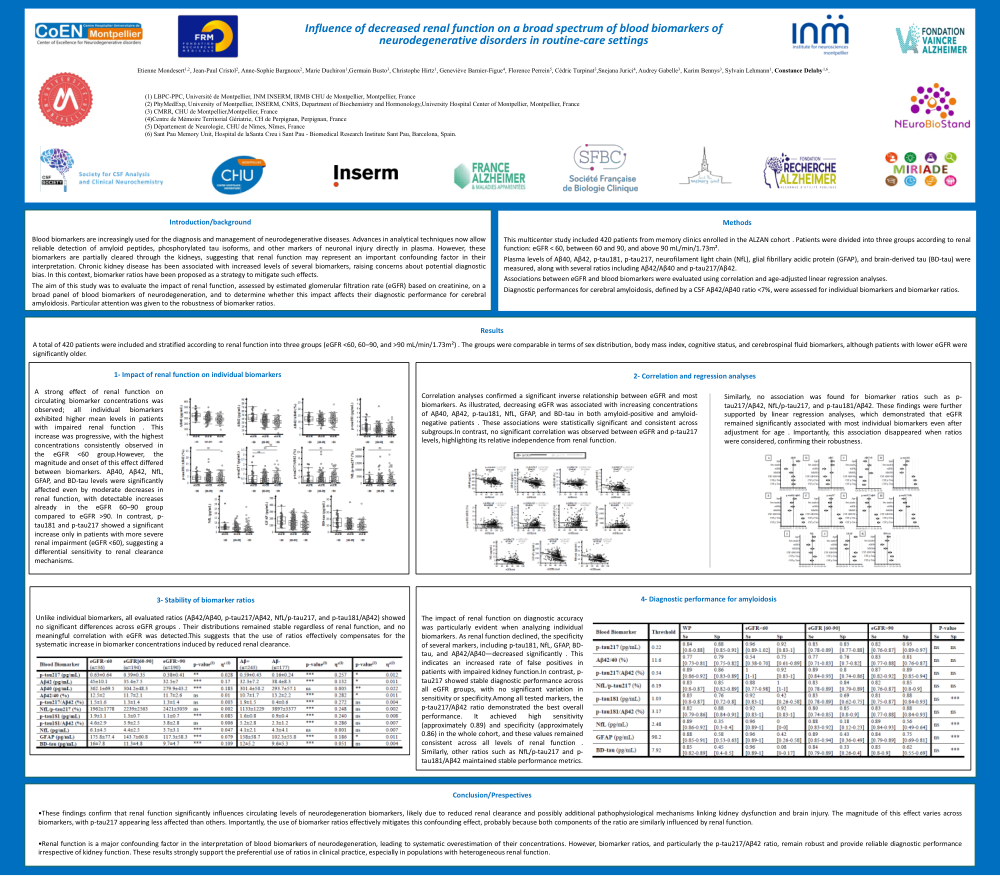
Blood biomarkers are increasingly used for the diagnosis and management of neurodegenerative disorders, including Alzheimer’s disease (AD). However, because many of these biomarkers are subject to renal clearance, impaired kidney function may represent a major confounding factor for their interpretation. This study aimed to evaluate the impact of renal function on a broad panel of blood biomarkers of neurodegeneration and to assess how kidney dysfunction affects their diagnostic performance for cerebral amyloidosis.
Methods:
We analyzed data from 420 patients recruited in the multicenter ALZAN cohort from routine memory-clinic settings. Simultaneous measurements of plasma creatinine, seven blood biomarkers (Aβ42, Aβ40, p-tau181, p-tau217, neurofilament light chain [NfL], glial fibrillary acidic protein [GFAP], and brain-derived tau [BD-tau]), and cerebrospinal fluid (CSF) biomarkers were available. Patients were stratified into three groups according to estimated glomerular filtration rate (eGFR): <60, 60–90, and >90 mL/min/1.73 m². Associations between eGFR and blood biomarkers were evaluated using correlation and age-adjusted linear regression analyses. Diagnostic performances for cerebral amyloidosis, defined by a CSF Aβ42/Aβ40 ratio <7%, were assessed for individual biomarkers and biomarker ratios.
Results:
Mean plasma levels of all individual biomarkers were significantly higher in patients with reduced renal function, particularly in those with eGFR <60 mL/min/1.73 m². With the exception of p-tau217, individual biomarkers showed a significant inverse association with eGFR, even after adjustment for age. Renal dysfunction reduced the specificity of several biomarkers for detecting cerebral amyloidosis, including p-tau181, GFAP, NfL, and BD-tau. In contrast, p-tau217 retained stable diagnostic performance across eGFR categories. Notably, biomarker ratios (Aβ42/Aβ40, p-tau217/Aβ42, NfL/p-tau217, p-tau181/Aβ42) were not affected by kidney function.
Conclusion:
Reduced renal function is associated with systematic overestimation of individual blood biomarkers of neurodegeneration. Biomarker ratios, particularly p-tau217/Aβ42, provide robust and reliable detection of cerebral amyloidosis regardless of renal function and should be favored in clinical practice.
Comments
Email is required but is not shown publicly.
Loading comments...